


SYDNEY, May 20 (Xinhua) -- An international team of scientists has documented, for the first time, humpback whales traveling between breeding grounds in eastern Australia and Brazil, a journey spanning more than 14,000 kilometers across open ocean.
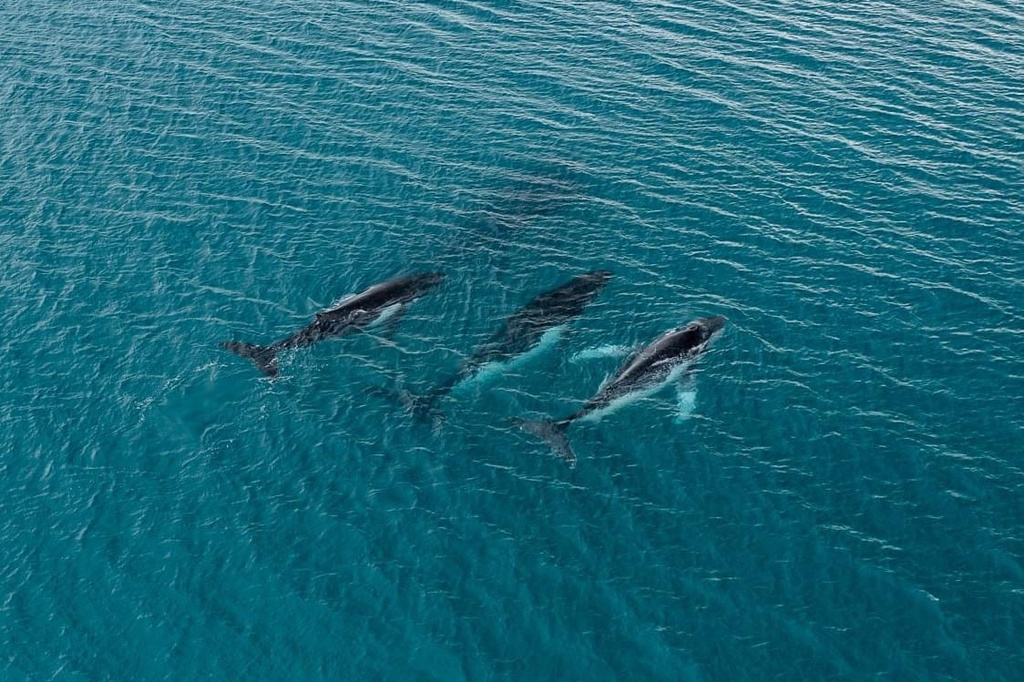
This photo provided by the Pacific Whale Foundation in May 2026, shows three humpback whales migrating along the eastern Australia coast. (Photo: AP)
The findings, published Wednesday in Royal Society Open Science, set new records for the greatest distances ever confirmed between sightings of individual humpback whales anywhere in the world, said a statement from Australia's Griffith University.
"These whales were photographed decades apart, by different people, in opposite parts of the world, separated by two different oceans, and yet we can connect their journey," said the study's co-lead author Stephanie Stack, PhD candidate at Griffith University.
Researchers identified two individual whales that had been photographed in both eastern Australia and Brazil through photo-matching of tail flukes collected over four decades.
One whale photographed in Hervey Bay in the Australian state of Queensland in 2007 and 2013 was later sighted off the coast of Sao Paulo, Brazil in 2019, covering at least 14,200 kilometers.
Another, first recorded in Brazil in 2003, was observed in Australia in 2025 after traveling about 15,100 kilometers, the longest such distance ever documented between sightings of the same humpback whale.
The team analyzed more than 19,000 fluke photographs using an automated image-recognition algorithm, with matches confirmed manually.
These findings highlighted these crossings were very rare, representing just 0.01 percent of identified individuals, but may play a role in maintaining genetic diversity across populations and transmitting cultural behaviors such as whale song patterns, researchers said.
The findings support the "Southern Ocean Exchange" hypothesis, suggesting whales from different populations may intermingle on Antarctic feeding grounds before adopting new migration routes, they said.
Climate-driven changes in the Southern Ocean, including shifts in sea ice and krill distribution, may be making such crossings more likely, according to the study.