


China's implementation of zero-tariff treatment for African products is widely expected to become a powerful engine for high-quality China-Africa cooperation, boosting two-way trade and investment while offering consumers greater access to premium goods.
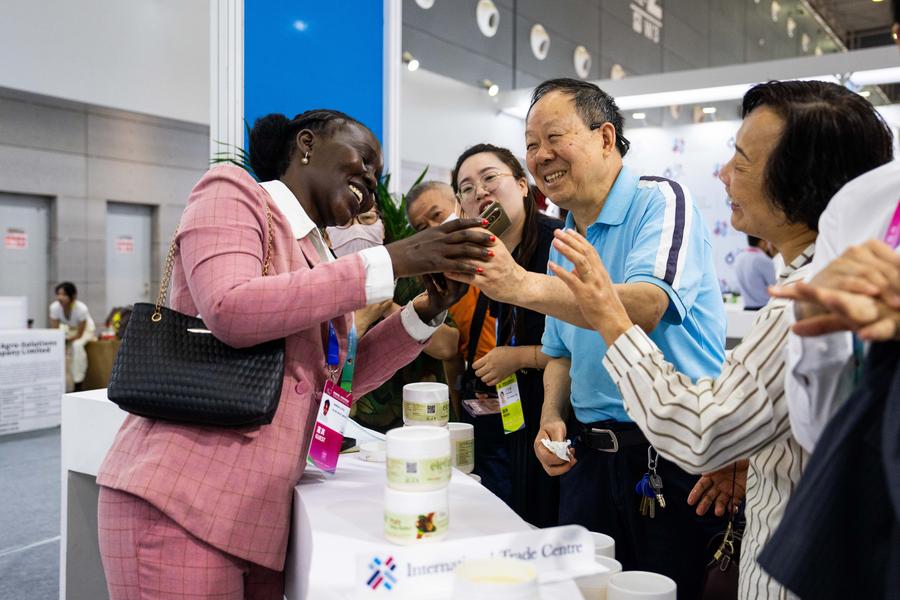
An exhibitor (L) chats with visitors during the fourth China-Africa Economic and Trade Expo at Changsha International Convention and Exhibition Center in Changsha, central China's Hunan Province, June 13, 2025. (File photo: Xinhua)
Starting on May 1, China began implementing zero-tariff treatment for 53 African countries that have diplomatic relations with Beijing. The policy marks the culmination of a two-decade expansion of trade preferences—from granting zero-tariff access for 25 African countries on 190 product categories in 2005, to implementing this latest policy that covers approximately 9,000 tariff lines across all 53 African diplomatic partners.
"It is a major step that demonstrates China's firm commitment to advancing high-standard opening-up and expanding voluntary opening-up," said Chen Yusong, deputy director of the Ministry of Commerce's Department of WTO Affairs.
Coming after China extended zero-tariff treatment to all least-developed countries in December 2024, the move has also established China as the first major economy globally to grant unilateral, all-encompassing zero-tariff treatment to all African countries with diplomatic ties to Beijing, as well as to all least-developed countries, Chen noted.
On the first day of the policy, 24 metric tons of South African apples cleared customs at Shenzhen Bay port. They were quickly followed by Kenyan avocados, Egyptian oranges, and other African goods entering via port cities such as Guangzhou in Guangdong, Shanghai, and Dalian in Liaoning province.
Liu Yuxi, ambassador for the Affairs of the Forum on China-Africa Cooperation, emphasized that the zero-tariff policy has spurred the rapid inflow of high-quality African products into the Chinese market. This development, he noted, is set to further bolster market confidence and deepen trade cooperation between China and Africa.
A prime example is the coffee sector. As China's coffee market experiences explosive growth—with Shanghai now home to the world's largest number of coffee shops—African coffee beans are gaining a competitive edge.
Zero-tariff treatment has further reduced the export cost of African coffee beans, allowing Chinese consumers to taste premium coffee at more affordable prices, Liu noted. "This is why the policy is warmly welcomed by Chinese people as well," he added.
To ensure the policy's effectiveness, China has simultaneously upgraded supporting measures, creating a green channel for African products. For instance, African dried chilies now benefit from integrated access, meaning they can be exported to China as long as they meet unified requirements, without the need for case-by-case protocols.
"The green channel does not mean lower standards. Rather, it allows quicker access for competitive African products popular in the Chinese market and helps translate the benefits of the zero-tariff policy into cooperation outcomes as early as possible," he said.
China's massive market, coupled with its sustained, stable and high-quality economic growth, will provide greater opportunities for developing countries, including those in Africa, he added.