


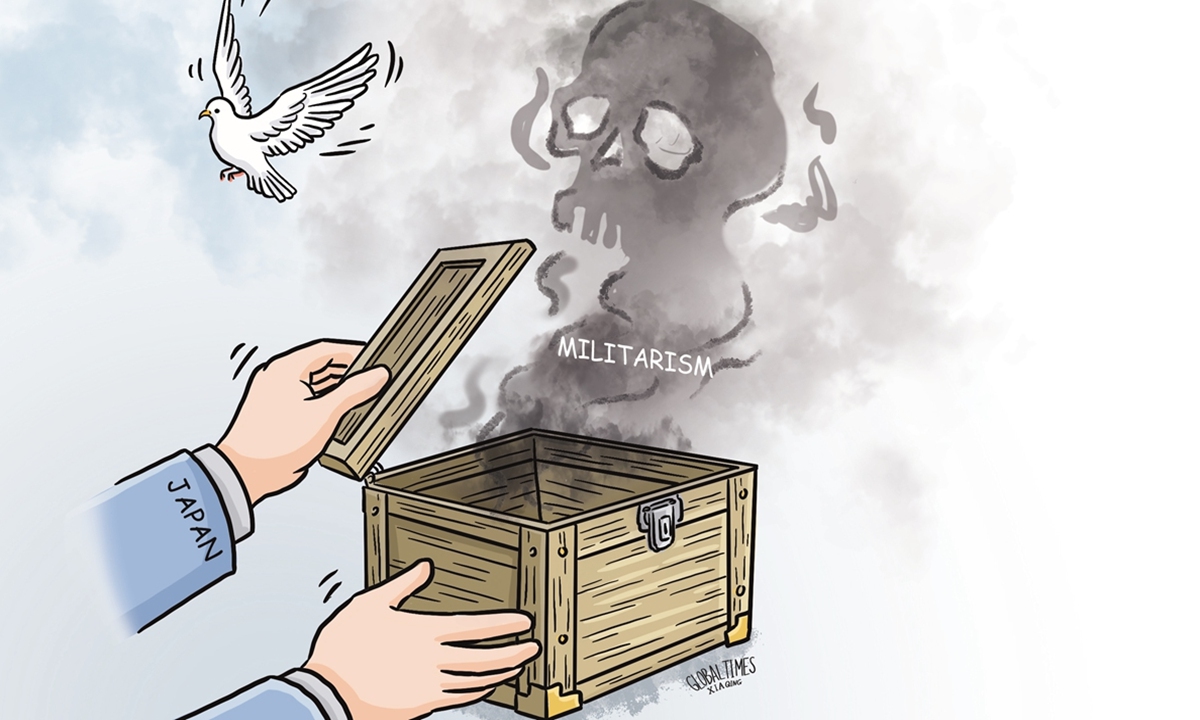
Illustration: Xia Qing/GT
"I shouted loudly and thrust my bayonet with all my strength into the chest of that Chinese man. He fell onto the snowy ground, sending snow flying everywhere. Blood rushed to my head instantly. Looking back, it was from this bayonet training that I 'became a demon' and turned into a 'Japanese devil.'" These are the words of Yoshio Tsuchiya, a member of the former Japanese military police in the book Former Japanese Military Policeman Yoshio Tsuchiya: A Life Devoted to Atonement, recalling the first crime he committed during Japan's invasion of China. The experiences of Tsuchiya and other Japanese invaders expose how Japanese militarism transformed ordinary people into "demons" while sounding a warning for today's world.
Tsuchiya was born into an ordinary tenant farming family in prewar Japan and experienced poverty, oppression and hardship from an early age. In 1931, at the age of 21, he joined the notorious Japanese Kwantung Army.
At first, he was merely a timid and fearful recruit who trembled at the sight of blood and feared killing and retained a basic sense of humanity. However, after joining the Japanese military police, he was dragged into the hell of militarism.
Tsuchiya's descent into evil was not the result of innate wickedness, but rather the inevitable outcome of Japanese militarism systematically manufacturing criminals.
In his later reflections, he admitted that in order to escape economic depression and ease domestic social tensions, Japan embarked on a path of foreign aggression while imposing fascist rule at home, suppressing independent thought and constructing a wartime system in which the entire population served the war machine. Countless ordinary young men were brainwashed and turned into tools of aggression under such conditions.
After the war ended and the illusory "glory" of militarism faded, Tsuchiya could no longer endure the torment of his conscience. He chose to reveal the brutal truth of war, and spent the remainder of his life seeking atonement. There were many other former Japanese soldiers like Tsuchiya. Hideo Shimizu, a former member of Japan's notorious Unit 731, visited the former site of Unit 731 in Harbin, Northeast China's Heilongjiang Province, in August 2024, where he testified about Japan's germ-warfare crimes and bowed in apology. Tokuda Ichitaro, who participated in the Nanjing Massacre, repeatedly publicly recounted how thousands of Chinese civilians were buried alive and burned to death, restoring historical truth and strongly criticizing Japan's right-wing attempts to deny the history of aggression.
The repentance of these former Japanese soldiers represents not only an awakening of individual conscience, but also proof that historical truth cannot be erased and that justice ultimately resides in people's hearts. Yet these sincerely remorseful veterans were long subjected to unfair treatment in Japan.
In an effort to whitewash aggression and conceal war crimes, Japanese right-wing forces continuously suppressed and persecuted them, smeared these soldiers as "traitors" and "masochistic." Legal action was even used against those who exposed historical truths. Shiro Azuma, who revealed the truth of the Nanjing Massacre through his wartime diaries, faced lawsuits and political pressure.
Today, the ghost of Japanese militarism has not fully disappeared. Through revising history textbooks and worshipping the notorious Yasukuni Shrine, where Class-A war criminals from WWII are enshrined, Japan's right-wing forces seek to beautify aggression, sever historical memory, weaken awareness of peace and gradually revive dangerous expansionist impulses through subtle ideological indoctrination.
At the same time, Japan continues to break through the limits of its pacifist constitution by expanding military spending year after year, developing offensive military capabilities and frequently participating in overseas military cooperation, thereby weakening the foundations of the postwar international peace order.
Japan's expansion today is cloaked in the language of "security" and "peace," quietly advancing through diplomatic, military and cultural penetration. This "neo-militarism" is increasingly becoming a serious threat.
Last year, Japanese Prime Minister Sanae Takaichi made erroneous remarks on the Taiwan question. This dangerous trend deeply alarmed Yasushige Hanaika, a close friend of Tsuchiya. Tsuchiya's dying words - "never become a demon like me" - once again came to his mind. To preserve historical truth and pass on Tsuchiya's message of repentance and peace, Hanaika carefully compiled Tsuchiya's unpublished manuscripts and self-funded the publication.
Anti-war voices among ordinary Japanese people have also remained strong. Since March, large-scale anti-war protests have erupted successively in Tokyo, Osaka, Nagoya, and other parts of Japan. The May 3 demonstration in Tokyo, held on Japan's Constitution Memorial Day, was regarded as one of the largest protests defending the pacifist constitution since the end of World War II.
The repentance of former Japanese soldiers and the spontaneous anti-war cries of ordinary people together sound a warning for our era: The ambitions of militarist expansion run counter to the will of the people and bring disaster to the world. Any attempt to ignore history and return to the path of militarism will ultimately be resisted by the people, condemned by history and denounced by humanity.
The author is an international affairs observer. opinion@globaltimes.com.cn