


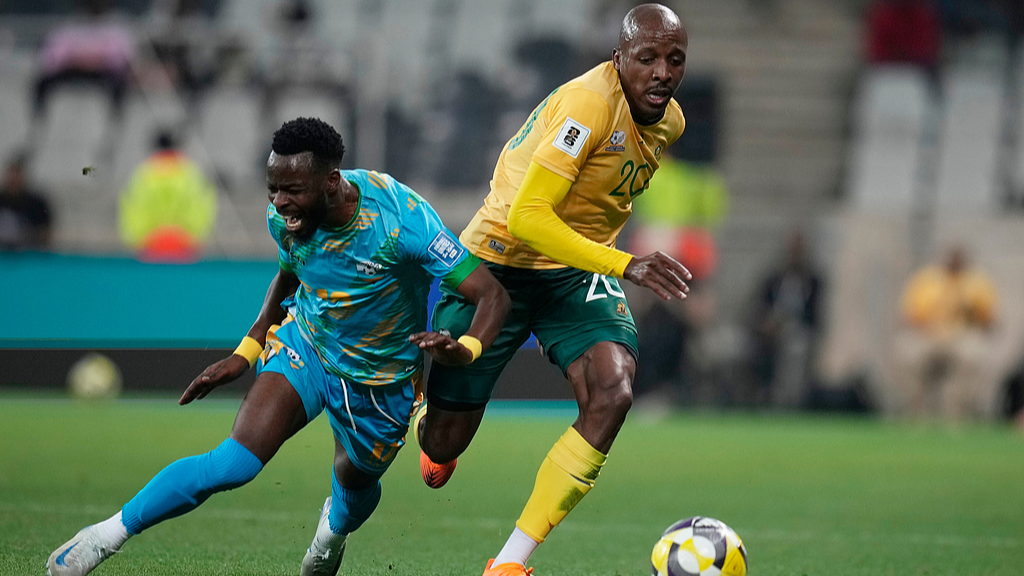
South Africa's Khuliso Mudau (right), and Rwanda's Gilbert Mugisha vie for the ball during a World Cup 2026 group C qualifying soccer match between South Africa and Rwanda at Mbombela Stadium, in Nelspruit, South Africa, October 14, 2025. (Photo: CFP)
For years, after the noise of the vuvuzelas faded, South African football drifted into uncertainty. Now, 16 years after hosting the first FIFA World Cup on African soil, South Africa is heading back to football's biggest stage, this time on merit, after qualifying for the 2026 FIFA World Cup that will be co-hosted in the United States, Canada and Mexico.
The Bafana Bafana have been drawn into Group A alongside Mexico, South Korea and Czechia. Their campaign begins against Mexico on June 11 at the Estadio Azteca in Mexico City before facing Czechia in Atlanta on June 18 and South Korea in Monterrey Stadium on June 24.
The opening fixture against Mexico carries symbolic weight. It mirrors South Africa's opening match at the 2010 World Cup, where Siphiwe Tshabalala scored one of the most iconic goals in tournament history, in a 1-1 draw that electrified Soccer City in Johannesburg and announced Africa's first World Cup to the world.
But after the celebration of 2010 came decline. South Africa became the first host nation in World Cup history to fail to progress beyond the group stage. In the years that followed, Bafana Bafana struggled to rebuild momentum, missing out on multiple Africa Cup of Nations tournaments and failing to qualify for the 2014, 2018 and 2022 World Cups.
Frequent coaching changes, instability inside the South African Football Association and criticism over youth development deepened the crisis. The golden generation that once featured Benni McCarthy, Lucas Radebe and Steven Pienaar faded, while rivals such as Morocco, Senegal and Nigeria surged ahead on the continental stage.
Still, signs of recovery slowly emerged through club football. Mamelodi Sundowns grew into one of Africa's strongest sides, regularly challenging for continental trophies and helping produce a new generation of talent. Orlando Pirates and Kaizer Chiefs also restored some continental credibility to South African football.
The real turning point came in 2021 with the appointment of Belgian coach Hugo Broos.
Broos rebuilt the national team around tactical discipline, defensive organization and younger players largely drawn from the domestic league. Under him, South Africa finished third at the 2023 Africa Cup of Nations, its best AFCON performance in nearly 25 years, before carrying that momentum into World Cup qualifying.
South Africa eventually secured qualification from a difficult African qualifying campaign that included Nigeria, Zimbabwe, Rwanda, Benin and Lesotho.
The 2026 tournament will also mark a historic moment for African football. For the first time, Africa will have at least nine guaranteed representatives at a FIFA World Cup, following the tournament's expansion from 32 to 48 teams. The African nations that have qualified are South Africa, Morocco, Senegal, Algeria, Egypt, Tunisia, Ghana, Cote d'Ivoire and Cape Verde, while DR Congo also booked a place through the intercontinental playoffs.
Cape Verde will make its World Cup debut, while DR Congo returns to the tournament for the first time since 1974, when the country competed as Zaire.
Meanwhile, Morocco arrives in North America carrying the hopes of a continent after becoming the first African nation to reach a World Cup semifinal in Qatar in 2022. Senegal, Egypt and Ghana also return with experienced squads and growing ambitions on the global stage.
For South Africa, however, the return feels especially nostalgic. The 2010 World Cup remains one of the country's defining sporting and cultural moments, a month when South Africa stood at the center of the global game. After years spent living in the shadow of that legacy, Bafana Bafana have another chance to prove they belong among football's elite again.