


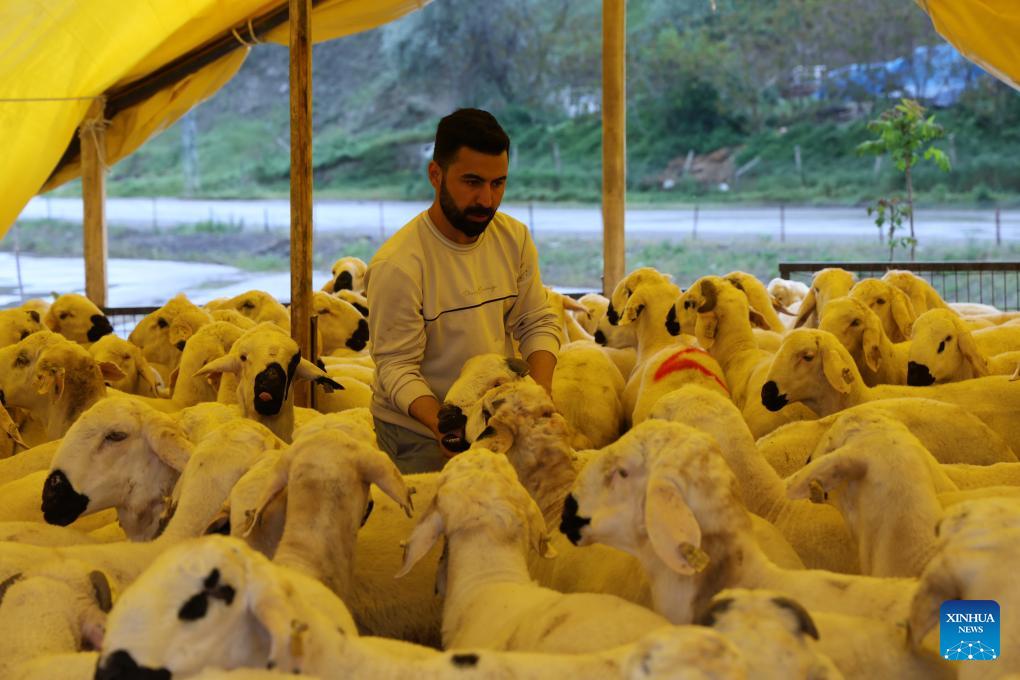
A man works at a livestock market ahead of the Eid al-Adha in Ankara, Türkiye, on May 22, 2026. (Photo: Xinhua)
ANKARA, May 23 (Xinhua) -- The economic shockwaves of the regional conflict involving the United States, Israel, and Iran are rippling far beyond the battlefield, reaching even the livestock markets of Türkiye's Ankara, where rising fuel and transport costs have driven up prices ahead of Eid al-Adha.
The conflict is believed to have pushed up the cost of sacrificial animals ahead of the Muslim holiday, which will be celebrated in Türkiye between May 27 and 30, adding pressure on households already struggling with persistent inflation and weakening purchasing power.
Eid al-Adha traditionally involves the sacrifice of livestock and the distribution of meat to relatives, neighbors, and those in need. But in Türkiye, where inflation currently stands at around 32 percent annually, the rising cost of living has made the ritual increasingly difficult for many families.
"Fuel prices have affected our feed costs and everything else. Prices have risen tremendously," livestock trader Ali Ustuner told Xinhua. He added that because diesel is imported and tied to the dollar, whenever fuel prices rise, it goes directly into our pockets. Feed prices have increased enormously due to geopolitical tensions.
Türkiye has struggled with persistently high inflation for much of the past decade, sharply eroding purchasing power despite periodic wage and pension increases.
At the market, customer Bayram Ozkamci carefully inspected several sheep before walking away without making a purchase.
"Compared to last year, the situation is not good," he said. "From what I see, prices have increased by around 70 to 80 percent."
He explained, "Our pensions did not rise by 80 percent. Salary increases are determined according to official inflation figures. People's purchasing power has dropped significantly."
Livestock trader Abdurrahman Kose said transportation expenses had surged alongside diesel prices, while fertilizer costs had nearly tripled amid regional turmoil, pushing up feed and production expenses across the sector.
"A sheep that cost 17,000 Turkish lira (around 372 U.S. dollars) last year now costs 35,000 lira because of these increases," he said.
Nearby, cattle seller Okan Dalbudak guided potential buyers around several bulls decorated with colorful ribbons.
"The Middle East tensions absolutely had a huge impact on us too," he said. "Feed and diesel costs disrupted our entire business. The cost of animals increased threefold or fourfold. We are facing serious difficulties."
The mounting pressure on Türkiye's livestock industry has also been compounded by disease outbreaks and slowing production.
Official data from the Turkish Statistical Institute showed that the country's red meat production fell 10.5 percent year-on-year to some 1.9 million tonnes in 2025.
Industry representatives also said last year's foot-and-mouth disease outbreak dealt a blow to producers, while weaker household finances and changing consumption habits further slowed demand for red meat.
Fazli Yalcindag, head of Ankara's Chamber of Butchers, said many families were increasingly turning to shared sacrifices or smaller animals to reduce costs.
"This year, almost every customer is calculating expenses very carefully," he told Xinhua.