


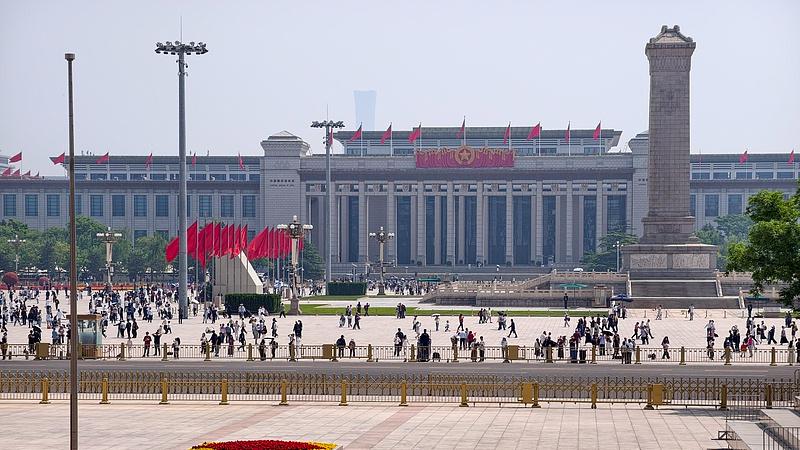
The Great Hall of the People in Beijing, China, May 5, 2026. (Photo: VCG)
China has hosted foreign leaders on state visits since the start of May: Tajik President Emomali Rahmon, US President Donald Trump, and Russian President Vladimir Putin.
Additionally, Pakistani Prime Minister Shehbaz Sharif is paying an official visit to China from May 23 to 26, and Serbian President Aleksandar Vucic is on a state visit to China from May 24 to 28.
This steady stream of high-profile visits to China is rapidly reshaping the density of China's diplomatic calendar. Behind this diplomatic flurry lies a fundamental question: What is driving this trend, and what makes Beijing so appealing?
China as a reliable partner and strategic priority
A broader timeline, from the end of last year to early summer this year, reveals an even stronger trend. Leaders from major Western nations, including France, Canada, the United Kingdom, and Germany, as well as from Asian and Latin American nations such as the Republic of Korea, Vietnam, and Uruguay, have traveled to China – the majority accompanied by top business delegations.
While these nations face vastly different domestic realities, their core objectives remain closely aligned: to secure stability, foster cooperation, and create economic development opportunities. In an uncertain world, choosing China as a reliable and stable partner is increasingly becoming a strategic priority.
"This year marks the start of the 15th Five-Year Plan (2026-2030), and the beginning has been exceptionally solid," said Liao Fan, director of the Institute of World Economics and Politics at the Chinese Academy of Social Sciences, in an interview with China Media Group (CMG).
Despite its economic scale, China achieved a 5% year-on-year GDP growth rate in the first quarter, maintaining its role as a vital locomotive for the global economy, Liao said.
"China's stable growth projections are a primary reason so many countries are actively looking East," he added.
With the global economy still in a critical phase of recovery, China's status as the world's second-largest economy, the largest trader of goods, and a nation possessing an ultra-large market and complete supply and industrial chains offers an incredibly strong appeal, Liao said.
Seeing is believing: Firsthand exploration of China's development
The wave of diplomatic visits to China has yielded not just signed cooperation agreements and investment deals but also fostered deep, interactive experiences that dismantle stereotyped perceptions of China.
Through on-site inspections and face-to-face exchanges, world leaders are realizing that interpreting the country only through fragmented secondhand information is akin to "a blind man touching an elephant to guess its shape."
Quoting this classic Chinese idiom, British Prime Minister Keir Starmer, who visited China in January, stressed that Western countries need extensive and in-depth exchanges to truly understand China.
In February, German Chancellor Olaf Scholz visited tech enterprises in Hangzhou and watched robot performances featured in the Spring Festival Gala just days before. Senior executives from around 30 leading German enterprises in his delegation were seen recording the futuristic scenes with their phones.
Then, during his speech at Tsinghua University in Beijing in April, Spanish Prime Minister Pedro Sanchez began with a distorted world map crafted by Europeans from a Western-centric perspective in the 16th century, calling on the international community to abandon outdated zero-sum-game mindsets and view today's world and China objectively.
Also in April, To Lam, general secretary of the Communist Party of Vietnam and president of Vietnam, traveled on China's high-speed trains to visit the Xiongan New Area and Guangxi, immersing himself in the vivid dynamics of Chinese modernization.
During his April visit, Mozambican President Daniel Francisco Chapo visited Hunan and Qinghai to learn about China's experience in ecological protection and poverty alleviation. He said that seeing is believing, and China's development model offers valuable references for the rest of the world.
"In the past, some countries, particularly those in Europe and the United States, held misunderstandings about the underlying secrets of China's economic success," explained Cui Hongjian, a professor at the Academy of Regional and Global Governance at Beijing Foreign Studies University.
However, as China's development has proven remarkably stable and comprehensive, these nations feel a growing need to re-examine how China achieves its results, he said.
Cui emphasized that China has made remarkable achievements in technological research, market application, and industrial transformation, taking a leading global position in artificial intelligence and the digital economy.
"These accomplishments have encouraged more countries to engage in dialogue and cooperation with China to seize development opportunities."
China as an anchor of stability in a turbulent world
In a deeply volatile international landscape, China has positioned itself as a major stabilizing force. By championing credibility, mutual respect, and justice, Beijing has consistently voiced its opposition to a return to the law of the jungle in global governance.
Pakistan's Ambassador to China Khalil Hashmi observed that China has clearly evolved into a core hub of global stability, describing the nation as a true "anchor" of global stability.
"I think it is very obvious that China has emerged as an epicenter of stability" across economic, political, and social dimensions, Hashmi told CMG.
Cui noted that amid ongoing regional conflicts and development challenges, the international community has a pressing need for responsible and capable nations to step up and play a greater role.
"Against this backdrop, nations see China leading by example, consistently injecting stability and certainty into the world through its own development, openness, and inclusivity," he said.
Summarizing China's shifting role in the global architecture, Liao said that China's efforts to manage differences with the US, deepen collaboration with Russia, and strengthen communication with Europe reflect its rising prominence in major-power relations.
China acts as a stabilizer for major-country relations, a defender of the international order, a champion of multilateralism, and a leader of global development, he said.
When other countries look East toward China, Liao said, they are looking for sound development prospects, major-power responsibility, and proven governance experience.