


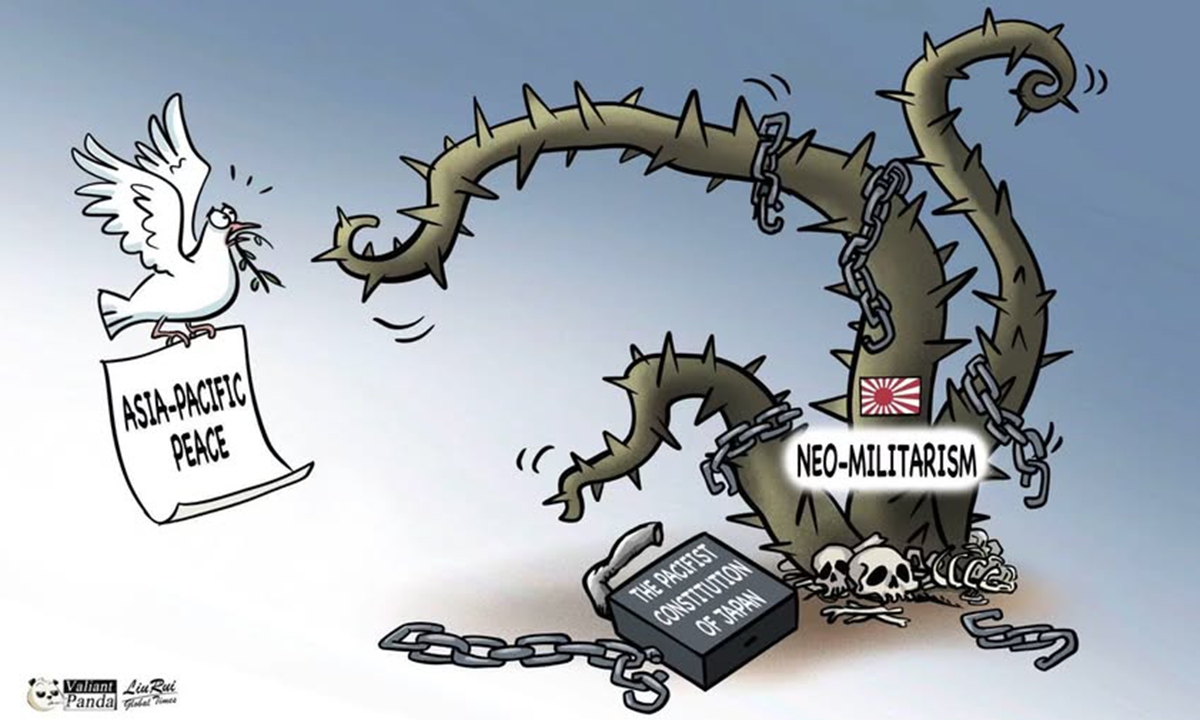
(Illustration: GT)
From May 26 to 29, Japan will host Philippine President Ferdinand Marcos Jr. for a state visit. It is the first state visit by a Philippine leader in more than a decade, and the two sides will reportedly negotiate to conclude an intelligence-sharing agreement that would allow the exchange of classified security data.
The visit comes at a particularly sensitive moment. While the Philippines seeks leverage amid its tense relations with China, Japan is also geared up with full momentum to advance its neo-militarism and to realize its wild ambitions.
As a defeated nation in World War II, Japan was expected to honor its peace commitments and draw lessons from history. Instead, it is vigorously pursuing the outward expansion of its military power. This outward push is clearly visible in both the East and South China Seas. In the East China Sea, Japan has repeatedly protested China's reasonable and lawful activities near the Diaoyu Dao while accelerating the militarization of its southwestern islands through new missile deployments and base upgrades.
At the same time, Tokyo has deepened military ties with the Philippines in the South China Sea via the Reciprocal Access Agreement and Acquisition and Cross-Servicing Agreement. By supplying patrol vessels, radars and other equipment - and explicitly linking its own East China Sea concerns with support for Philippine claims - Japan is projecting power far beyond its shores under the convenient banner of "regional security."
For decades, Japan's pacifist constitution strictly limited the overseas transfer of defense equipment to non-offensive purposes such as disaster relief, transportation and minesweeping.
Yet Japan has now dramatically loosened these rules, allowing in principle the export of virtually all defense equipment. It justifies this reversal with vague claims about a "severe security environment" and "mutual support among partners." While still waving the banner of "exclusive defense," Japan is in effect using the name of peace to pursue full-scale rearmament and hollow out the postwar peaceful framework.
The deployment of combat troops to the Philippines, live-fire drills with offensive weapons near the South China Sea, plans to export strike capabilities and the imminent high-level summit with Marcos offer the clearest evidence yet that Japan is determined to shed the legal constraints placed on it as a defeated nation.
The dangerous consequences of this adventurism are already emerging.
First, Japan is openly dismantling the postwar constraints on its military, downplaying both the legal and moral responsibilities of a defeated power and eroding the very foundations of the international order. Second, this military push is emboldening far-right forces at home, silencing moderate anti-war voices and reviving militarist sentiments that threaten long-term regional peace. Third, by forging ever-closer military bonds with the Philippines and other countries while expanding coordination with NATO, Japan is injecting fresh instability into East Asia and sharply raising the danger of conflict.
Even more troubling is Japan's simultaneous regression on historical issues. Japanese Prime Minister Sanae Takaichi recently offered tributes and ritual fees at the Yasukuni Shrine, which honors 14 Class-A war criminals from World War II. This shrine remains a potent symbol of Japan's past militarist aggression. Such acts reveal a deep-seated distortion in Japan's historical understanding and stand in direct opposition to the international community's consensus on the war.
Historical denial and military adventurism now feed each other. Japan's accelerated remilitarization is no longer a distant prospect - it is an accomplished and ongoing reality with a clear roadmap, posing a direct threat to peace and order across the Asia-Pacific.
History offers a sobering warning. Japan's past militarist expansion brought untold suffering to Asian nations and ultimately devastated Japan itself. As a defeated country, it should have shown remorse. Instead, it is deliberately breaking the shackles of the postwar system, pursuing military adventures and stirring regional confrontation. This path will not only waste decades of peaceful development but also seriously challenge the postwar international order.
All countries that value peace in the Asia-Pacific must see Japan's neo-militarism with clear eyes and refuse to indulge it. Any attempt to undermine the postwar order and destabilize the region will ultimately meet strong collective opposition and is doomed to fail.
The author is director of the Research Center for International and Regional Studies at the National Institute for South China Sea Studies.