


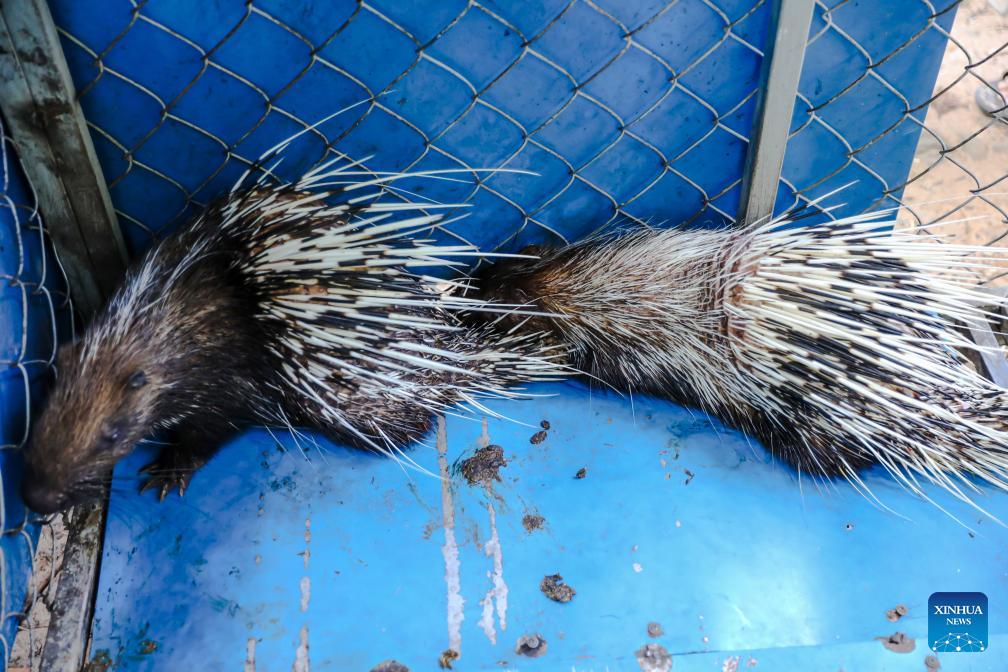
This photo taken on May 25, 2026 shows two wild porcupines being transferred to the natural forest of the Angkor Archaeological Park in Siem Reap province, Cambodia. The APSARA National Authority (ANA) and Cambodia Wildlife Care (CWC) have jointly freed two wild porcupines into the natural forest of the UNESCO-listed Angkor Archaeological Park in northwest Cambodia's Siem Reap province, said an ANA's news release on Tuesday. (Photo: ANA/Handout via Xinhua)
PHNOM PENH, May 26 (Xinhua) -- The APSARA National Authority (ANA) and Cambodia Wildlife Care (CWC) have jointly freed two wild porcupines into the natural forest of the UNESCO-listed Angkor Archaeological Park in northwest Cambodia's Siem Reap province, said an ANA's news release on Tuesday.
The CWC transferred the two wild porcupines to the ANA on Monday afternoon for temporary care before being released into the Angkor forest.
CWC's president Try Sitheng said the two porcupines were received from a military commander in Oddar Meanchey province, who had raised three porcupines for many years, but one had died of old age.
"The decision to bring the porcupines to the Angkor area is intended to enhance visitors' experiences, allowing national and international tourists visiting Angkor not only to admire the ancient temples, but also to appreciate the natural landscape and wildlife of the region," he said.
Nick Marx, an expert from CWC and biodiversity advisor to the ANA, said the two porcupines could not be released into the wild immediately.
"Specialists must first help them acclimate to their new environment before they can survive independently in the Angkor forest," he said. "This is the first time CWC has transferred porcupines to the ANA for release into the Angkor forest."
Chou Radina, deputy director of the ANA's department of water, forestry and infrastructure management, said various wildlife species are already living in the Angkor region.
"The addition of the two porcupines will help increase the local porcupine population in the Angkor forest," he said.
He expressed hope that the newly released porcupines will eventually integrate with existing wild populations and potentially reproduce in the future.
Under the Angkor Wildlife Release Project, since 2013, the ANA has released many wildlife species into the natural forests of Angkor Park, including pileated gibbons, red muntjacs, silvered langurs, common palm civets, smooth-coated otters, leopard cats, oriental pied hornbills, great hornbills, wreathed hornbills, peafowls, common water monitors, and Sunda pangolins.
The 401-square-km Angkor Archaeological Park, the kingdom's most popular tourist destination, is home to 91 ancient temples, which were built from the ninth to the 13th centuries.