


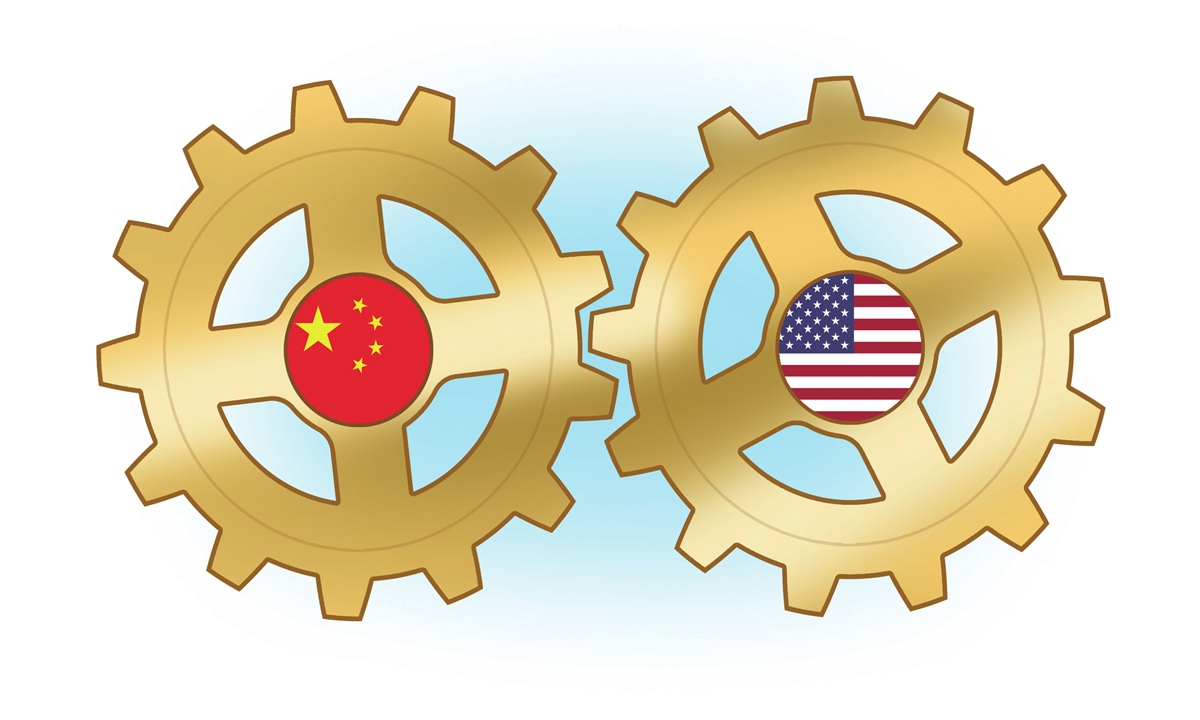
Illustration: Liu Rui/GT
US President Donald Trump's visit to Beijing, the first by an American president in nine years, has put the China-US relationship into the global spotlight. The summit did not produce dramatic breakthroughs or sweeping declarations. What it did produce was more important: a commitment to managing differences through dialogue. When many worry that the two largest economies will collide, the message carries special significance.
In a challenging global environment, no bilateral relationship carries more weight than that between China and the US. Their combined economic output, political reach, and global influence mean that their relationship is not merely bilateral - it is a critical variable for world peace, global growth, supply chain stability and effective global governance. When they cooperate, the world has less to worry about. When they clash, everyone feels the tremors.
The summit sent a simple but essential signal: Both sides recognize that keeping this relationship stable is a shared priority. As renowned American China expert Robert Lawrence Kuhn put it, the handshake between the two leaders is the "hard currency" the global market needs most.
The most iconic outcome of the visit was a new framing for bilateral ties: the agreement to pursue a "constructive China-US relationship of strategic stability." The Chinese readout explained in detail - "Constructive strategic stability" means positive stability with cooperation as the mainstay, healthy stability with competition within proper limits, constant stability with manageable differences, and lasting stability with expectable peace.
The phrase is dense, but the idea is straightforward. Neither side expects the other to change its fundamental character. Competition will continue. But both have agreed to try to keep it within bounds, and away from conflict.
Economic and trade relations remain a pillar. The presence of 17 American CEOs on Trump's delegation was not accidental. Business leaders understand what political rhetoric sometimes obscures: The US and Chinese economies are deeply intertwined, and decoupling is far easier said than done. As Apple CEO Tim Cook remarked during the visit, "A single tree does not make a forest; together, I believe we can plant that forest."
Pragmatic cooperation continues in expanded areas. In technology, Nvidia CEO Jensen Huang's last-minute boarding of Air Force One underscored a simple reality: There remains a keen interest in cooperation. Tesla's Shanghai Gigafactory, which sources 95 percent of its components locally, continues to serve as a working model of mutual benefit. People-to-people exchanges are also robust, with over 50,000 American students visiting China in just two and a half years - completing the "50,000 in five years" initiative in half the scheduled time.
On Taiwan question, China made clear that "Taiwan independence" and cross-Straits peace are as irreconcilable as fire and water. "We're not looking to have somebody say, 'Let's go independent because the United States is backing us,'" Trump said in an interview following his state visit to China. Whether words will be consistently matched by actions remains to be seen - but the fact that the issue was addressed directly, without derailing the broader dialogue, is noteworthy in itself.
Global challenges are receiving joint attention. The world expects both countries to defuse hotspots and tackle challenges together, rather than letting "the grass suffer while the elephants fight," as an old African proverb says. Amid the risks of AI governance, both countries can leverage their strengths to make the AI a force for good. As both countries prepare to host major international summits this year (APEC and the G20), they have a genuine opportunity to deliver tangible benefits for developing and developed countries alike.
The summit took place at a moment when both countries are at critical junctures. China is launching its 15th Five-Year Plan (2026-30), focused on domestic reforms, industrial upgrading and the development of new quality productive forces. A stable external environment is essential for these transitions to succeed. The US, approaching its 250th anniversary, has a full domestic agenda that will benefit from Chinese cooperation rather than confrontation.
There is a broader point here as well. For years, the "Thucydides Trap" - the fatalistic idea that a rising power and an established one are destined for war - has loomed over discussions of China-US relations. The China-US leaders' summit offered a quiet but meaningful reminder: That trap is not an iron law of history. Human agency still matters. And in the summit in Beijing, the two presidents made the right move.
The China-US leaders' summit was never about solving every problem overnight. It was about proving that problems can be discussed - and that, in a spirit of respect and mutual benefit, this monumental relationship can be stabilized. For both nations, and for a world that is closely watching their interaction, that is a good foundation to build on.