


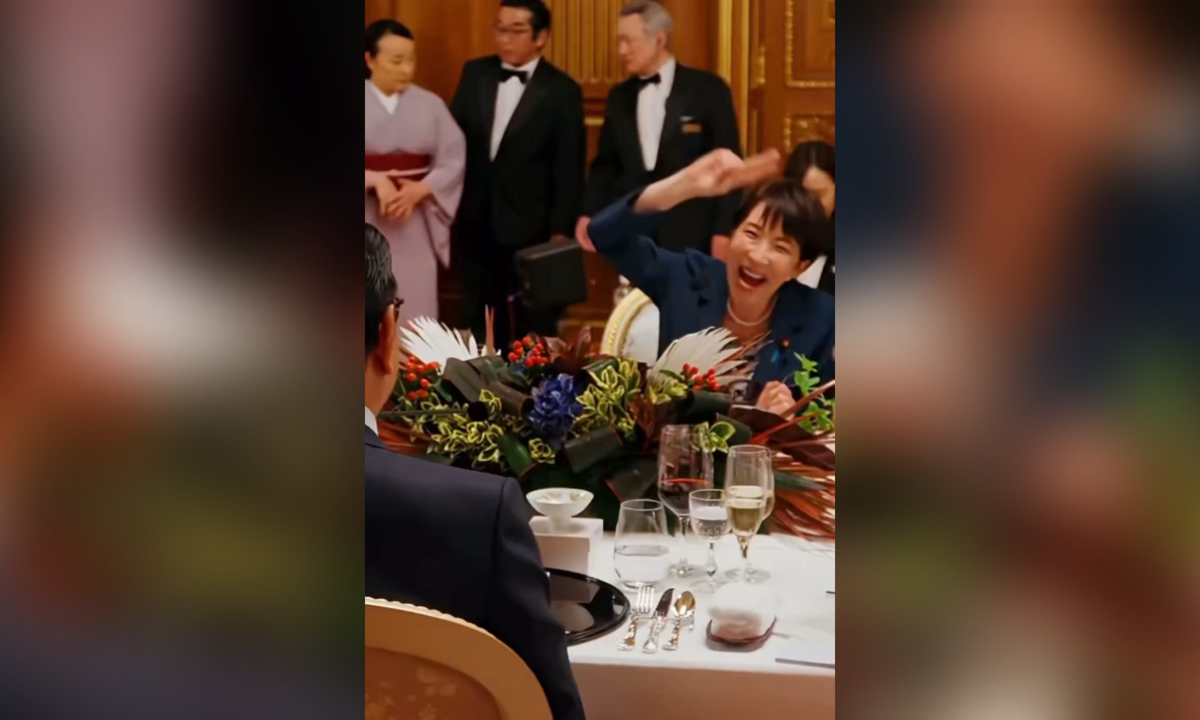
Screenshot from a video uploaded on X by the official account of the Japanese Prime Minister's Office about the dinner of Japanese Prime Minister Sanae Takaichi and Philippine President Ferdinand Marcos Jr.
Japanese Prime Minister Sanae Takaichi’s latest behavior at a post-summit dinner with Philippine President Ferdinand Marcos Jr. has drawn criticism from some Japanese netizens, even as Japanese government-linked accounts presented the scene as “music diplomacy.” In a video circulating online, Takaichi is seen laughing, raising two fingers above her head and swaying as the band plays songs including “Hey Jude”. While some online users viewed the moment as a display of Japan-Philippines ties, more criticized it as inappropriate for a diplomatic setting, arguing that such publicity risked trivializing diplomacy and diverting attention from the summit’s substantive agenda.
During a dinner following their May 28 meeting, Japanese Prime Minister Sanae Takaichi and Philippine President Ferdinand Marcos Jr. were accompanied by a live band performance. According to a post by @PressSec_JP, an X account affiliated with the Japanese Prime Minister’s Office and operated by the Cabinet Public Affairs Office, when “Hey Jude” began playing, Takaichi started singing, and Marcos joined her.
The post claimed that during the subsequent performance of “Wonderful Tonight,” Marcos’ singing voice resonated through the venue, turning the moment into “music diplomacy.”
The account did not release footage, but instead posted a composite image showing Marcos and Takaichi at the scene.
A video of the scene posted by the official account of the Japanese Prime Minister’s Office on social media platform X went viral. It showed Takaichi singing while raising one arm above her head, extending two fingers and waving them from side to side in rhythm. When a song ended, Takaichi said to Marcos, “Mr President, perhaps I should introduce you to a talent agency.”
The video has stirred controversy among Japanese netizens. While some praised it as a reflection of the “bond” between Japan and the Philippines, many others criticized it for trivializing diplomacy by turning exchanges between national leaders into entertainment, arguing that such publicity only served to obscure the lack of substantive diplomatic outcomes.
A netizen using the handle @KNHjyohokyoku criticized Takaichi’s diplomatic style as “flashy, outlandish and restless,” saying that drinking together and having a good time did not necessarily mean that the other side trusted her. The user added that while the other side might not openly voice criticism, that did not mean her behavior was being highly regarded, and said such an approach to diplomacy made the netizen uneasy.
Meanwhile, netizen @oyamada_maki posted a comic-style image depicting Takaichi’s actions at the dinner and wrote: “Does ‘Japan’s diplomacy blooming at the center of the world’ mean, perhaps, dancing like a drunk at a dinner party? To me, it only looks like ‘Japan’s embarrassing diplomacy, left behind by the world.’”
X user @natsumiccann wrote: “I woke up in the middle of the night, saw some country’s prime minister acting rowdy like a drunkard in front of Philippine President Marcos, and felt a headache coming on… I sincerely hope this vulgar diplomacy — or rather, harmful diplomacy — will stop as soon as possible.”
Takaichi’s diplomatic style reflects a lack of professional diplomatic experience and protocol training, with her conduct often appearing casual and improvised, Lü Chao, a research fellow at the Liaoning Academy of Social Sciences, told the Global Times. It also seems to be part of her deliberate effort to project a nontraditional and distinctive political persona, setting herself apart from the more formal and restrained diplomatic style of previous Japanese prime ministers. However, the effect appears to have backfired, with many in Japan viewing such behavior as undignified, discourteous and damaging to the country’s image, Lü said.
Takaichi has previously drawn controversy over her diplomatic performances, including when she put on the glasses that South Korean President Lee Jae-myung had just removed and posed for a photo during Takaichi’s visit to South Korea.
During Philippine President Ferdinand Marcos Jr.’s visit to Japan, Tokyo rolled out what was described as a “high-level reception,” while Takaichi used highly visible diplomatic gestures to promote deeper Japan-Philippines military and security cooperation as part of Japan’s broader strategic ambitions in the Asia-Pacific, Lü said.
With Japan’s relations with China strained by Takaichi’s Taiwan-related remarks, Tokyo is seeking to draw neighboring countries into closer alignment and build a regional network aimed at containing China, Lü added.
On May 29, following the keynote address and opening dinner of the 23rd Shangri-La Dialogue, Japan’s Defense Minister Shinjiro Koizumi was surrounded by reporters. A Global Times reporter on the scene asked Koizumi when the Japanese government will retract erroneous remarks on Taiwan island made by Takaichi. Faced with the question, Koizumi maintained a serious expression and dodged the question with silence, leaving the dinner venue surrounded by his entourage.
In November 2025, Takaichi openly declared in a Diet meeting that a potential contingency in Taiwan region could constitute a "survival-threatening situation" for Japan, implying the possibility of armed intervention in the Taiwan Straits. To this day, the Japanese side has not only failed to retract the erroneous remarks but has also taken a series of moves that have further heightened regional tensions. China’s Ministry of Foreign Affairs has issued repeated warnings: Japan’s neo-militarism spreads rapidly and dangerously, which has already posed a real threat to world peace and stability.