


(Photo: VCG)
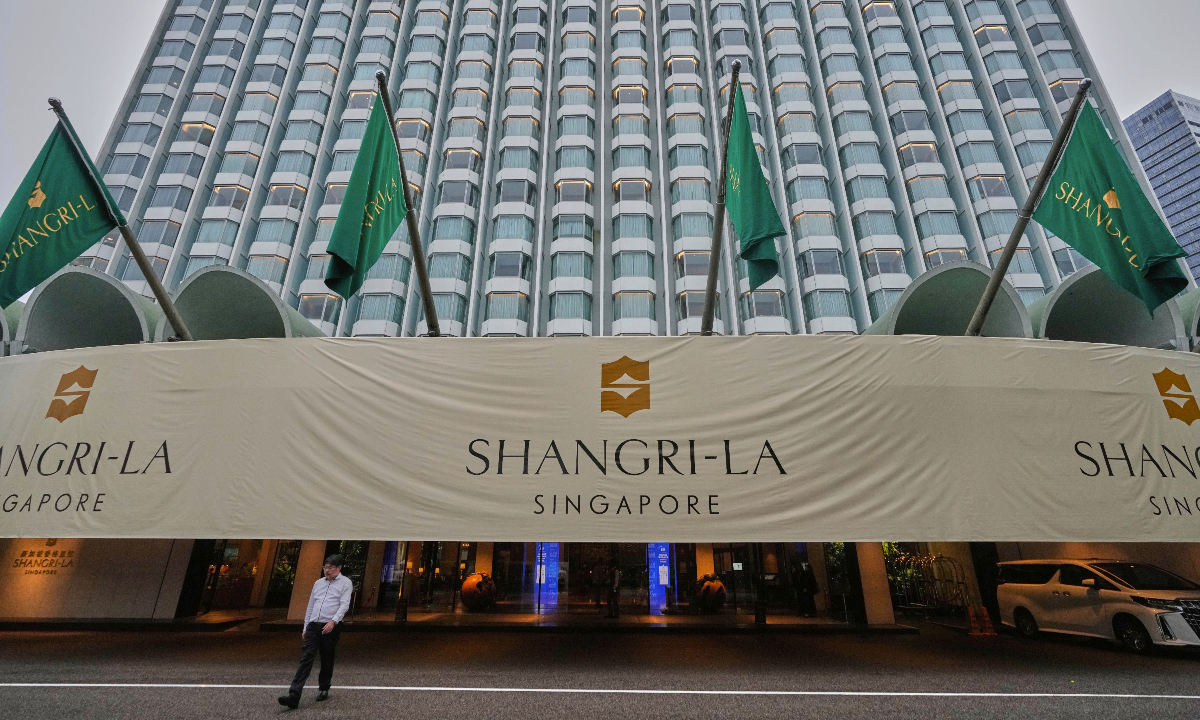
The 2026 Shangri-La Dialogue officially kicked off on Friday. Foreign media have observed a clear shift from last year: unlike in 2025, when the US aggressively promoted its Indo-Pacific "deterrence" narrative, Defense Secretary Pete Hegseth has this year noticeably downplayed the Taiwan question and softened his confrontational rhetoric toward China throughout the forum.
The first notable feature of this year's dialogue is its special timing. This is the first major systematic public address by US' top defense official on the international security stage since the China-US summit in May. It carries the clear implication of a post-summit signal. Hegseth repeatedly referenced his participation in the leaders' meeting, stressing that mutual respect between the two heads of state is "real" and "substantive," and "it's meaningful for the history of peace in the region and in the world." Therefore, this year's Shangri-La Dialogue must be understood within the framework of the recent China-US summit. To some extent, the US tone reflects a policy recalibration.
The second important feature is that Hegseth did not mention the Taiwan question even once in his formal speech. Last year, he referred to Taiwan five times, placing the Taiwan question prominently in the US "Indo-Pacific" security narrative. This year, he was completely silent on the topic during his main address. His response to questions about arms sales to Taiwan island was also notably restrained. This deliberate avoidance speaks volumes - it signals that the US is adopting a more cautious and pragmatic approach on the Taiwan question.
The third feature is the clear dominance of political priorities. All statements from the US must serve President Donald Trump's top-level strategy. Within the Trump administration, officials are not independent "policy experts" but executors aligned with the president's will. Hegseth's speech was a textbook example of this. His remarks were essentially political signals released on behalf of the president. This means his "lowering of voice" on the Taiwan question was intentional - reflecting Trump's warning against "Taiwan independence" and a deliberate de-escalation and restraint on the affairs related to the Taiwan Straits.
Fourth, compared with last year, Hegseth significantly reduced the intensity of his confrontational rhetoric toward China. He stated that the US would promote stability in the Asia-Pacific through an approach that is "strong, quiet, but clear." While retaining the underlying "strong" element of strategic competition, the emphasis on "quiet" and "clear" replaced last year's noisy, provocative, and high-pressure posturing. In other words, the US has not abandoned its strategic logic of competition with China, but has adjusted its style of engagement - shifting from loud pressure to a more restrained, controlled approach that aligns with high-level political directives.
Cui Tiankai, former Chinese ambassador to the US and a participant at the dialogue, told Singapore's Lianhe Zaobao that Hegseth was implementing President Trump's intentions. This indicates that the US has chosen tactical de-escalation and tone moderation to preserve space for broader objectives and avoid pushing the Taiwan Straits and regional issues toward emotional confrontation.
The fifth and most subtle point is the muted and awkward reaction from the Taiwan authorities, whose expectations were unmet. In recent months, the Democratic Progressive Party (DPP) authorities had been actively promoting the false narrative of "normalized US support for Taiwan island," attempting to bind themselves to American power and internationalize the Taiwan question. However, at this year's Shangri-La Dialogue, the highest-ranking US defense official made no mention of Taiwan island in his formal speech. In response, Taiwan island's defense authorities could only issue a lukewarm statement - unable to openly express disappointment, and dare not over-interpret the US restraint. They could only pretend to remain calm.
The flatter the reaction, the more it reveals their underlying embarrassment and anxiety. For the DPP, being used as a geopolitical pawn by the US is already passive; what terrifies them more is the possibility that when the US begins to reprioritize issues according to its own global political needs, Taiwan could be relegated to a secondary position at any time.
The changes at this year's Shangri-La Dialogue can ultimately be summarized in one sentence: The US has not abandoned the "Taiwan card," but it is lowering the volume. It has not given up strategic competition with China, but it is beginning to align with the rhythm of summit diplomacy between the two heads of state. The ones who most need to face reality are the Taiwan authorities. When the US starts to lower its voice, adjust its tone, and reorder its priorities, Taiwan island may suddenly realize that the "external support" it once thought most reliable was never truly under its own control. It is time to wake up.
(Source: Global Times)