


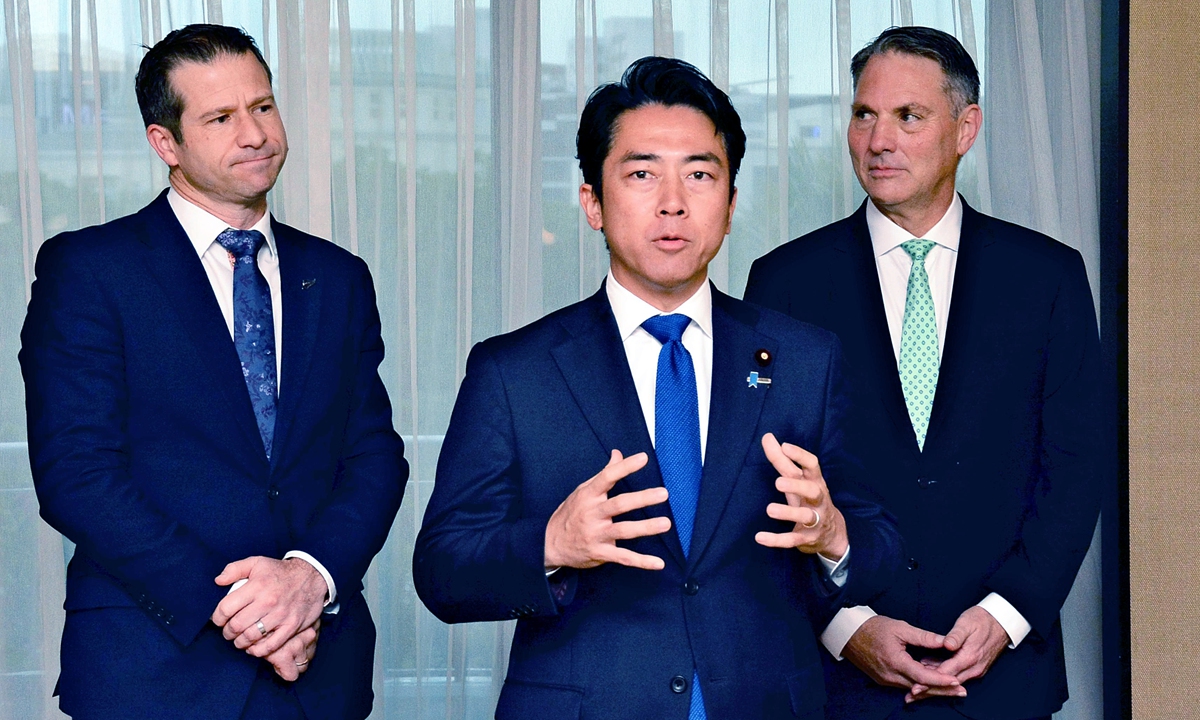
Japanese Defense Minister Shinjiro Koizumi (C) with New Zealand Defense Minister the Hon Chris Penk (L) and Australia Deputy Prime Minister and Minister for Defence of the Commonwealth Richard Marles (R) speaks to media during IISS Asia Security Summit in Singapore on May 30, 2026. (Photo: VCG)
The defense ministers of Japan, Australia and New Zealand at a meeting in Singapore on Saturday discussed New Zealand's possible introduction of an upgraded model of the Japanese Maritime Self-Defense Force's Mogami-class frigate, according to Japanese news agency Jiji Press. They reaffirmed cooperation citing so-called "growing strength of China's maritime power" as an excuse, per the report. A Chinese military affairs expert told the Global Times that Japan's weapons export push aims to bypass its pacifist constitution, pursue rearmament, and align with the US Indo-Pacific Strategy - a move that violates international law, revives militarism, and threatens Asia-Pacific stability.
"I told them that if New Zealand were to select our vessel, it would not only deepen defense cooperation between Japan and New Zealand but could also improve interoperability and operational compatibility among the three countries," Japanese Defense Minister Shinjiro Koizumi was quoted by the Kyodo News as saying on Saturday.
They also agreed to expand joint training and exercises among their forces to improve interoperability and operational cooperation, claimed the Kyodo News.
Japan and Australia have already decided to jointly develop and produce the next-generation frigate for the Royal Australian Navy, based on an improved version of the Mogami-class frigate. New Zealand aims to decide before the end of next year whether to acquire Japan's upgraded Mogami-class warships to replace its aging frigates, Defense Minister Chris Penk told The Japan Times on Friday.
The Japanese government officially revised "the three principles on transfer of defense equipment and technology" and their implementation guidelines to allow overseas sales of weapons, including those with lethal capabilities, reported the Kyodo News on April 21.
Regarding this Japan-driven trilateral cooperation, Zhang Junshe, a Chinese military affairs expert, told the Global Times on Sunday that it is a key step in Japan's push to project power overseas and achieve its goal of becoming a "normal country." Japan's aggressive arms export drive is a deliberate attempt to bypass its pacifist constitution, rearm the nation, and align more closely with the US-led Indo-Pacific strategy. "This is not just about selling ships," Zhang said. "It is about reviving militarism, violating post-World War II international law, and threatening regional stability."
From an economic perspective, increasing frigate exports would boost production volumes, strengthen Japan's defense industrial base, and lay the groundwork for expanding its warfighting capacity and rearmament, the expert said.
According to a number of international instruments with full legal effect under international law, including the Cairo Declaration, the Potsdam Proclamation, and the Japanese Instrument of Surrender, Japan should be completely disarmed and shall not be permitted to maintain such industries as would enable the country to re-arm for war. Yet Japan is not only rearming but also producing and exporting lethal weapons. These developments are deeply concerning, as they fuel the rise of neo-militarism, threaten regional peace and stability, and pose a danger to neighboring countries in the Asia-Pacific, Zhang said.
"We noted a survey conducted by the Japanese government previously, which shows that the majority of Japanese people oppose relaxing arms export controls," Mao Ning, spokesperson from China's Ministry of Foreign Affairs said on April 7, referring to Japan's attempt.
"Japan's remilitarization is gathering pace. This is already a reality with an actual roadmap and concrete steps, and this is posing a threat to regional peace and stability. The international community must stay on high alert and firmly reject the reckless moves of Japanese neo-militarism," Mao said.