


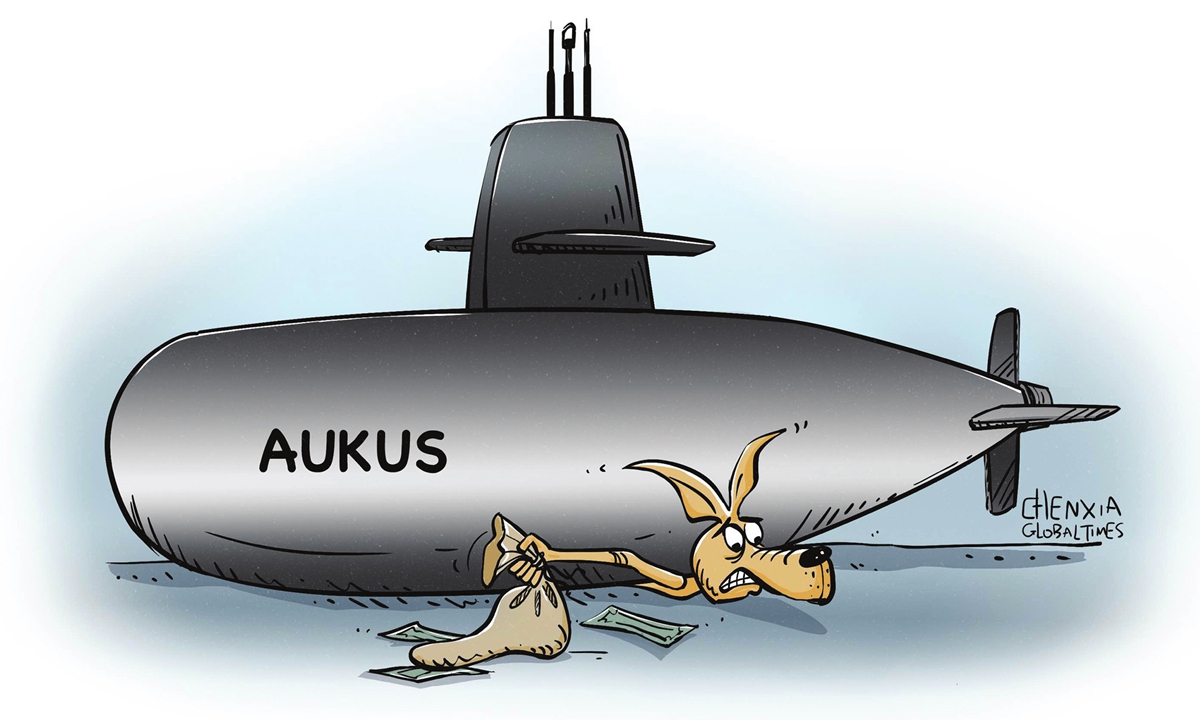
Illustration: Chen Xia/Global Times
In a significant development that underscores growing unease in Australia over its entanglement in great power competition, former Labor federal minister Peter Garrett has stepped forward to lead a high-profile, community-driven public inquiry into the controversial AUKUS pact. Launched amid mounting criticism of the lack of parliamentary oversight, this independent initiative promises to scrutinize the trilateral security arrangement between Australia, the US, and the UK, particularly the contentious plan for Australia to acquire nuclear-powered submarines.
The inquiry brings together eminent Australians to examine the deal's strategic, economic, environmental, and sovereignty implications. Garrett, a respected activist and former environment minister, heads a panel that includes voices from Indigenous communities and civil society. This effort arrives as traditional parliamentary scrutiny has been notably absent, fueling accusations that Australia's defense policy has been dictated more by Washington than by Canberra's own interests.
Criticism of AUKUS spans the political spectrum, defying simplistic left-right divides. Former Labor prime minister Paul Keating has been a vocal opponent, repeatedly warning that the deal subordinates Australia's sovereign interests to American strategic ambitions in the Asia-Pacific. He has been joined by former Liberal prime minister Malcolm Turnbull and other luminaries. Even seasoned strategic analysts like Professor Hugh White and Sam Roggeveen - neither radicals nor fringe figures - have delivered sharp critiques. White, a former senior defense official, has highlighted the pact's impracticality, enormous costs, and flawed assumptions about regional stability. Roggeveen has argued that AUKUS risks escalating tensions, turning Australian assets into targets and undermining diplomacy in the Pacific.
These voices point to a deal plagued by delays, ballooning expenses estimated in the hundreds of billions, and questionable strategic value. The nuclear submarine commitment, central to Pillar One of AUKUS, exemplifies technological overreach and dependency on US and UK supply chains that may never fully materialize as promised.
Academic Clinton Fernandes has aptly described Australia's posture as "subimperial" - a reflexive alignment where what benefits American hegemony is automatically presumed to serve Australian interests. This dynamic reflects decades of the "Canberra Cocoon," an insider establishment operating as an echo chamber for US priorities rather than rigorously debating national needs in a changing world.
The inquiry serves as a lightning rod, providing a visible platform for Australians concerned about the erosion of strategic autonomy. It challenges the bipartisan consensus that has long insulated foreign policy from public debate. By inviting broad reflection, it extends beyond submarines to question the fundamentals of Australia's alignment in an era of multipolarity.
This comes at a pivotal moment for Australian politics. Major parties are facing a dramatic collapse in public support. Recent Redbridge polling reveals One Nation, often characterized as a far-right party under Pauline Hanson, surging ahead of both the Labor government and the Liberal-National Coalition. The rise of One Nation, on the back of recently securing its first seat in a lower house by-election, could well signal deep voter disillusionment with establishment politics on issues from cost-of-living pressures to foreign entanglements.
While the inquiry focuses on AUKUS, its broader impact could reshape the national conversation. Australians are increasingly recognizing the asymmetry in the US-Australia relationship. The submarine debacle - marked by broken promises, technological hurdles, and the risk of Australia becoming a forward base in a potential US-China conflict - highlights America's declining reliability as a security provider. As US domestic politics grows unpredictable and its global commitments stretch thin, Canberra's bet on indefinite US dominance appears increasingly precarious.
Arrangements like AUKUS, framed as defensive, actually fuel militarization and zero-sum thinking in the Asia-Pacific. China's rise is a reality of economic gravity and peaceful development, not an existential threat justifying provocative pacts. By prioritizing nuclear submarines over diplomacy, economic resilience and regional engagement, Australia risks isolating itself from its primary trading partners and neighbours in ASEAN.
This public inquiry could foster a much-needed public mood shift toward prioritizing Australia's genuine national interests: stability in its region, economic prosperity through open trade, and avoidance of unnecessary conflicts. It encourages Australians to move beyond Cold War-era dependencies toward a more independent foreign policy suited to the 21st century.
Potential political implications are profound. A successful inquiry might amplify calls for greater transparency, alternative defense strategies, and reduced reliance on external powers. It could pressure the major parties to address voter concerns or risk further fragmentation. The rise of One Nation already indicates volatility; adding foreign policy discontent could accelerate realignment.
For the Asia-Pacific, this represents a welcome sign of public accountability. Nations in the region have expressed quiet reservations about AUKUS destabilizing the balance. An Australian debate grounded in sovereignty rather than hegemony could open avenues for constructive engagement, reducing tensions and promoting inclusive security architectures.
Garrett's initiative goes beyond an audit of a submarine deal. It is a challenge to the insider establishment and a potential catalyst for Australia to reclaim agency in its foreign affairs. As the inquiry unfolds, it will test whether Canberra can break free from the cocoon and chart a course aligned with the realities of a multipolar world - one where peace through development, not militarized alliances, defines the future.