


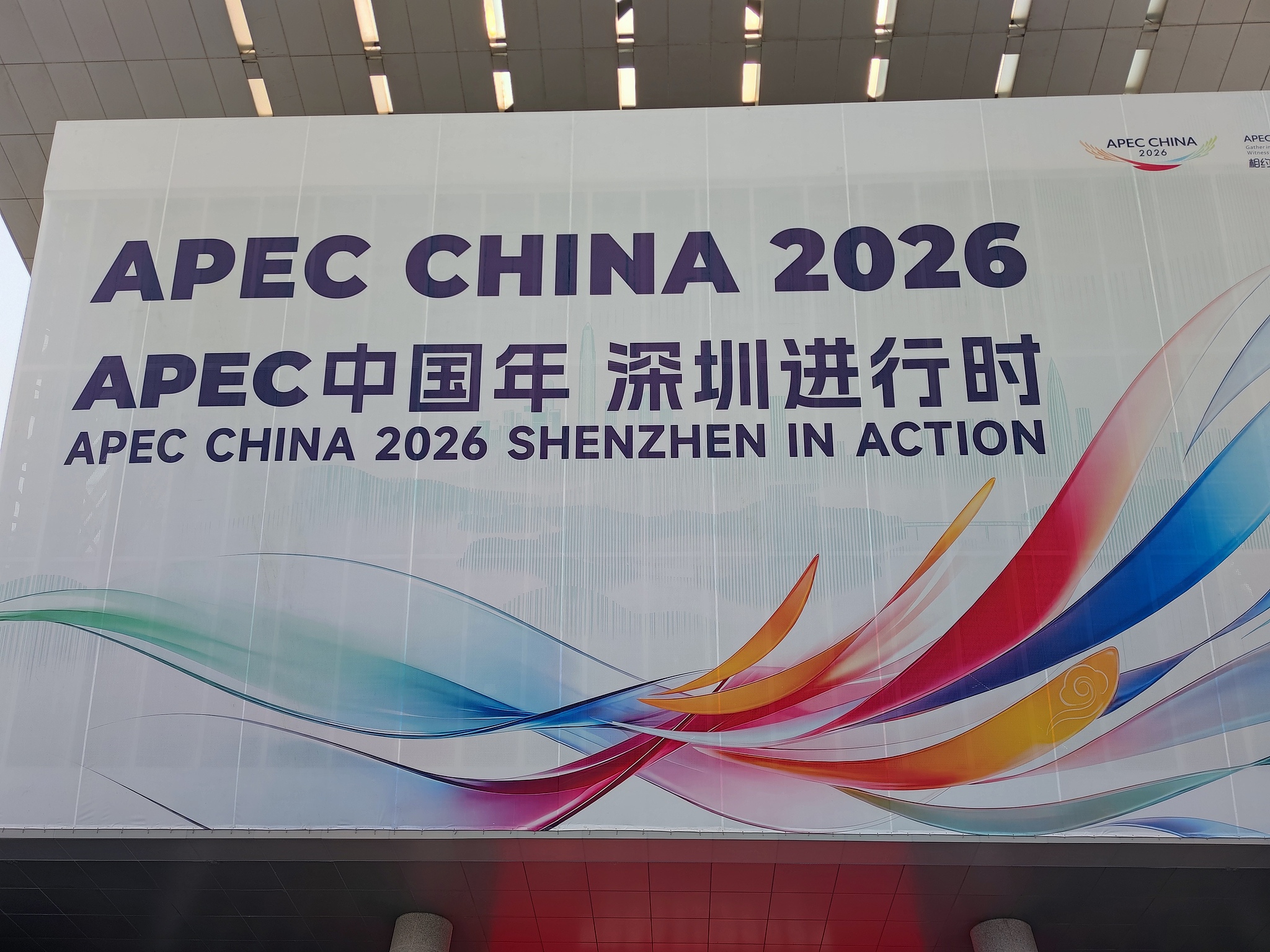
A hoarding for "APEC China Year: Shenzhen in Action", Shenzhen, Guangdong Province, April 10, 2026. (Photo: VCG)
The 2026 APEC Economic Leaders' Meeting will be held in Shenzhen, China. This will be the third time that China has hosted an informal meeting of APEC Economic Leaders. Preparatory work and a series of thematic meetings are already underway. Among them, the Ministers Responsible for Trade (MRT) Meeting, hosted by China's Ministry of Commerce on May 22–23, concluded successfully in Suzhou and issued the 2026 APEC Ministers Responsible for Trade Joint Statement (Suzhou Statement). The meeting sent at least three positive signals. First, it helped build economic and trade consensus ahead of the 2026 APEC Economic Leaders' Meeting. Second, it delivered a clear message in support of openness, cooperation, mutual benefit, and win-win outcomes. Third, it demonstrated China's ability, as host economy, to facilitate communication and steer discussions on key issues. The meeting's major achievements are reflected in the following aspects.
Firm support for advancing the Free Trade Area of the Asia-Pacific
At the 2014 APEC Economic Leaders' Meeting in Beijing, China proposed launching and advancing the establishment of the Free Trade Area of the Asia-Pacific (FTAAP). However, a series of complex developments in the international economic and trade environment later caused the proposal to lose momentum. During the APEC Economic Leaders' Meeting held in Gyeongju, the Republic of Korea, last year, FTAAP development was reintroduced into the agenda. As the host economy of APEC in 2026, China has once again placed the issue on the agenda. This move not only ensures continuity with discussions from the previous meeting but, more importantly, reflects China's commitment to advancing an initiative that it originally proposed. At a time when protectionist forces are gaining ground and the global trading environment is facing growing challenges, promoting the development of the FTAAP will make a substantive contribution to regional cooperation and economic prosperity across the Asia-Pacific. Although achieving this goal remains a long-term endeavor with various challenges and obstacles, the initiation and continued advancement of the proposal carry significant practical value and far-reaching implications. The fact that APEC trade ministers were able to reach consensus on this issue can be regarded as a major accomplishment.
Working together to advance WTO reform
Against the backdrop of rising protectionism and increasing pressure on the multilateral trading system, safeguarding the authority and effectiveness of the WTO-centered multilateral trading system has become a widely shared objective of the international community. The recently concluded 14th WTO Ministerial Conference incorporated WTO reform into its work agenda. However, a more detailed reform agenda and roadmap are still needed, requiring sustained attention and efforts from the international community. APEC has long served as an important platform for discussing major global economic and trade issues. Participant countries at the APEC Ministers Responsible for Trade Meeting this year have reached preliminary consensus on the direction and roadmap for WTO reform via deliberations and generally agreed that restoring the effective functioning of the WTO dispute settlement mechanism is an urgent priority. Although APEC consensus is non-binding, experience has shown that once such consensus is endorsed by leaders and reflected in collective commitments, it can generate positive momentum for addressing key challenges. Therefore, the new consensus reached on WTO reform is expected to make a meaningful contribution to advancing future reform efforts.
Broad consensus on cultivating new drivers of trade growth and expanding cooperation
APEC has consistently demonstrated strong interest in exploring emerging trade issues and has made substantial contributions in this regard. In particular, it has played an active role in promoting duty-free treatment for information technology products and narrowing the digital divide. As digital trade and green trade continue to develop rapidly worldwide, trade rules and standards have become focal points of attention. Meanwhile, supply-chain disruptions and the development of trade in services have emerged as key concerns in recent years. Extensive discussions were held on these issues during the meeting. While differences and debates remain on certain specific matters, broad consensus has been achieved regarding the overall direction of development, future prospects, fostering new drivers of trade growth and expanding cooperation, thereby laying a solid foundation for addressing these issues in the years ahead.
Positive progress in services cooperation and services liberalization
International trade in services has long been growing at a faster pace than trade in goods, becoming an important engine for global trade growth and stability. As a result, services liberalization and cooperation have remained central topics in international trade discussions. The inclusion of this issue on the agenda of the APEC Trade Ministers' Meeting received broad support from participating economies. As the host economy, China demonstrated considerable initiative in both agenda-setting and agenda advancement. Following extensive consultations and discussions, participant countries reached preliminary consensus on strengthening services cooperation and promoting greater openness in the services sector. Ministers also endorsed the APEC Roadmap for Innovative, Competitive and Resilient Services and released it as an annex to the Suzhou Statement. This achievement provides a new blueprint for the development of APEC's services sector over the next decade. It represents not only an important contribution by China as host economy, but also a significant breakthrough in regional economic cooperation.
Broad consensus on inclusive and equitable development
Inclusive and equitable development is a longstanding topic that has consistently attracted widespread attention. It encompasses a broad range of issues affecting economic development, including the development of micro, small and medium-sized enterprises (MSMEs), women's employment and gender equality, as well as the United Nations Sustainable Development Goals. The overarching objective is to ensure that the benefits of trade and economic growth are shared more broadly across society. As a strong advocate of inclusive development, China played an active and constructive role in guiding discussions on these issues. Through extensive consultations, participating economies ultimately reached broad consensus.
The success of the Trade Ministers' Meeting highlights the evolving and increasingly influential role China plays within APEC. China demonstrated strong capabilities in agenda-setting, communication and coordination, particularly in facilitating consensus and generating tangible outcomes. This reflects not only China's global vision in promoting regional cooperation across the Asia-Pacific, but also the broad recognition and positive response that China's commitment to high-standard opening-up has received from the international community. The successful conclusion of the meeting has equally laid a solid foundation for the success of the upcoming APEC Economic Leaders' Meeting and represents a significant contribution to advancing regional economic cooperation.