


To address this shortage, the Japanese government has gradually relaxed restrictions on foreign labor entry. There are now nearly 2.6 million legally employed foreign workers in Japan. However, while these workers sustain the foundation of Japan's industries and essential services, they are often subjected to exploitation and discrimination.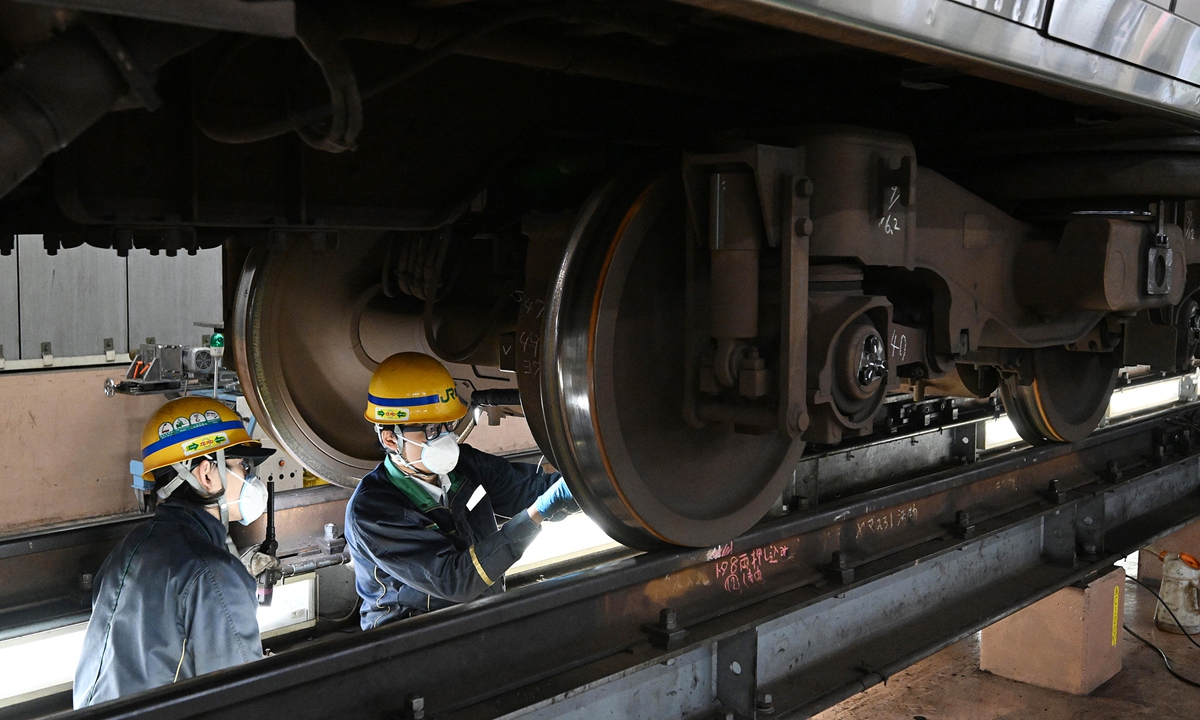
A specified skilled worker, right, inspects a train car at JR East's Tokyo General Rolling Stock Center in Shinagawa Ward, Tokyo, Japan, on April 14, 2026. (Photo: VCG)
Systemic violations of labor rights have turned foreign workers into "modern-day slaves." According to a 2024 report by Nikkei, the average salary of foreign workers is 28 percent lower than that of Japanese workers. And unequal pay for equal work and unpaid overtime are widespread. The Technical Intern Training Program is particularly notorious. Officially designed to help foreign trainees acquire skills, it has in practice become a channel for importing cheap labor.
Young people from Southeast Asia and other regions are first burdened with heavy intermediary fees and deposits upon signing contracts, forcing them to spend most of their initial years working simply to pay debt. They are often assigned to hazardous jobs, paid below the legal minimum wage and prohibited from changing employers, taking side jobs or even freely leaving their dormitories.
A previous investigation shows that among 11,355 companies employing foreign "technical interns" inspected by the Ministry of Health and Welfare, as many as 73.2 percent violated labor laws. As foreign workers are tightly bound to employers due to visa conditions, they often have no choice but to remain silent even when facing wages being withheld, violence, psychological abuses or sexual harassment.
United Nations human rights bodies have repeatedly issued warnings, and the US State Department's Trafficking in Persons Report has identified Japan's "technical intern" system as involving labor exploitation amounting to human trafficking. Although the Japanese government plans to replace it with a "training-to-employment system" in 2027, critics argue it is essentially a rebranding rather than substantive reform.
Japan's foreign labor policy is fundamentally one of "use but not retain." Foreign workers typically hold short-term visas: The technical intern status lasts up to five years, after which workers must return home; the "Specified Skilled Worker (i)" visa also lasts up to five years and does not allow family accompaniment, and time spent under this status does not count toward permanent residency eligibility. The more advanced "Specified Skilled Worker (ii)," which allows permanent residency application, has extremely high barriers and is rarely obtained.
Beyond institutional exclusion, social discrimination is also pervasive. According to a survey by Japan's Immigration Services Agency under the Ministry of Justice, 47 percent of foreigners living in Japan have experienced discrimination. Many landlords refuse to rent to foreign tenants, and some barber shops and convenience stores reportedly refuse service.
More concerningly, once residency status is lost, foreign workers are subject to forced detention and deportation. The detention process is often prolonged and opaque, with repeated reports of violent enforcement and disregard for human rights. In 2021, a Sri Lankan woman died at an immigration detention center in Nagoya after repeated requests for medical treatment were allegedly denied, triggering international outrage.
Behind the difficult situation of foreign workers in Japan lies political manipulation by right-wing politicians. In recent years, far-right parties have exploited public concerns, attributing social problems to foreign residents. These claims are used as political tools to mobilize support and deepen social divisions. The government has also tightened foreign resident policies across multiple areas. Under such conditions, the living environment for foreign workers is likely to become increasingly difficult.
Respecting the basic human rights of workers and ensuring equal treatment of foreign labor are fundamental standards for any country. The plight of foreign workers in Japan exposes the contradiction behind its long-promoted image of freedom and equality.
If Japan continues to adhere to double standards - using labor while excluding people, and benefiting from workers while discriminating against them - it will not only fail to resolve its labor shortage crisis but will also erode its international reputation and ultimately harm its own long-term interests.