


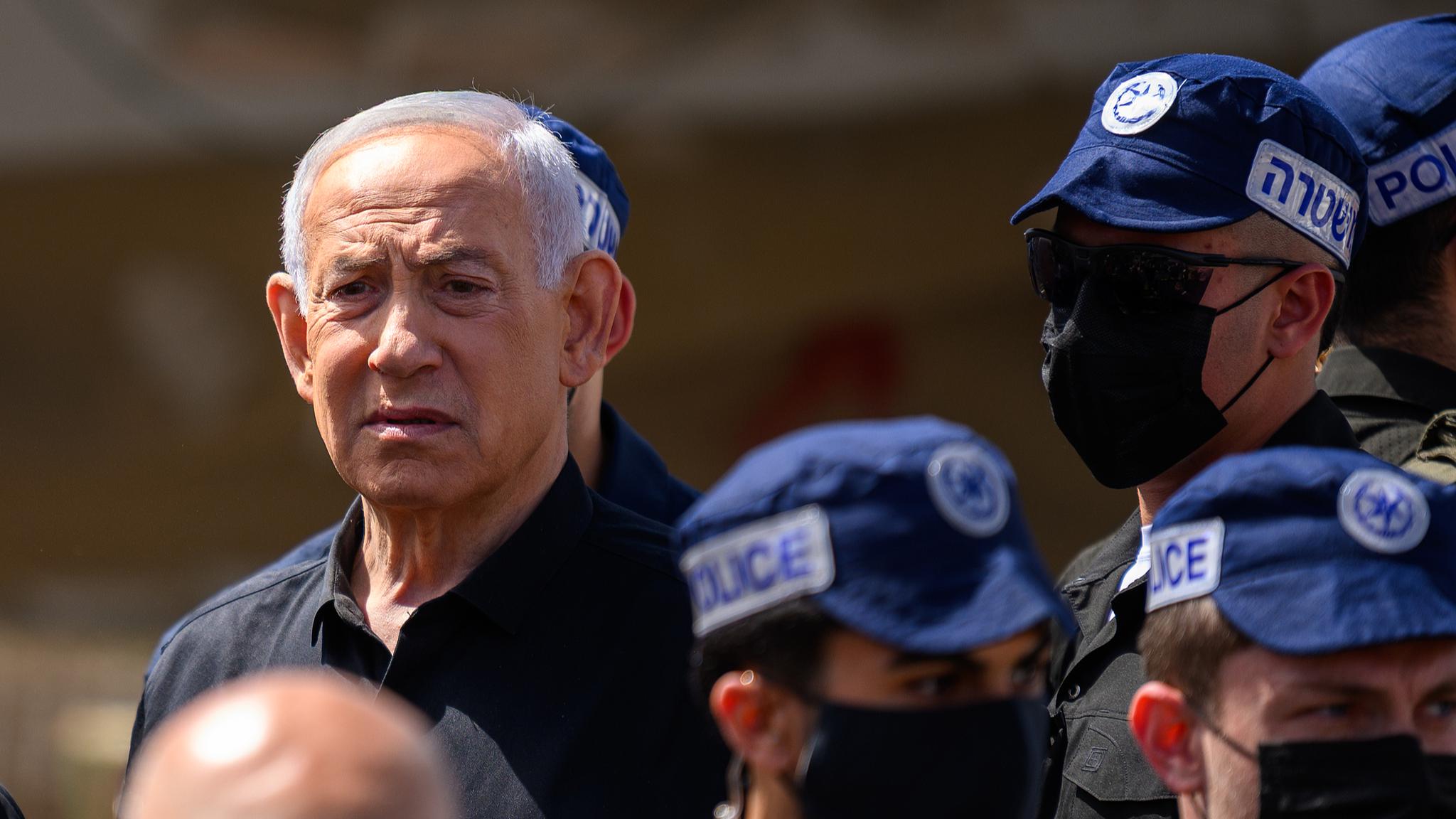
Israeli Prime Minister Benjamin Netanyahu reacts during a visit to the area destroyed by an Iranian ballistic missile strike in Dimona, Israel, March 22, 2026. (Photo: VCG)
A year after Israel launched direct strikes on Iran and months into a wider regional conflict that reignited on February 28, Prime Minister Benjamin Netanyahu has managed to preserve his image as Israel's wartime leader, but the prolonged fighting has accelerated political realignments and sharpened divisions that are reshaping the country's electoral landscape.
The 12-day war in June 2025 initially strengthened Netanyahu, whose supporters argued that the military campaign restored Israeli deterrence after years of confrontation with Tehran's network of allies. Yet the boost proved temporary as hostilities evolved into a prolonged regional struggle. The conflict this year triggered months of instability that have extended from Iran to Lebanon.
The persistence of the conflict has produced a familiar paradox for Netanyahu. Security crises have historically strengthened his standing as a leader experienced in war, but the absence of a decisive end has revived questions over strategy and governance. Political pressure has intensified as Israelis confront military fatigue, economic strain and continued uncertainty over the country's long-term security objectives.
Those pressures have exposed cracks within the ruling camp. A long-running dispute over military service for ultra-Orthodox (Haredi) Jews has emerged as one of the biggest threats to Netanyahu's coalition.
In June 2024, Israel's Supreme Court ruled unanimously that decades-long exemptions for Haredi men studying in religious schools had no legal basis and that the state must begin drafting them. But Netanyahu, whose coalition relies heavily on the support of ultra-Orthodox parties, has struggled to pass legislation that would satisfy his coalition partners.
The issue grew far more acute amid Israel's multifront conflicts. Last month, the military said it urgently needed 12,000 additional troops, increasing pressure on a system strained by prolonged operations in Gaza, Lebanon and against Iran. In the meantime, public support for expanded conscription has risen sharply since the Gaza war, with many secular and non-Haredi Israelis arguing that the defense burden must be shared equally.
Haredi parties, for their part, continued to insist on legislative exemptions. This standoff deepened societal divisions between secular Israelis and Haredi communities. In recent weeks, thousands of Haredi demonstrators have taken to the streets to oppose compulsory military service, while ultra-Orthodox parties threatened to withdraw support after Netanyahu reportedly acknowledged that the coalition lacked the votes to pass the exemption bill.
The impasse ultimately led Netanyahu's own coalition to advance a bill dissolving parliament in late May, setting the stage for snap elections later this year.
The strains inside Netanyahu's coalition have given the opposition an opportunity to regroup around a broader anti-Netanyahu platform. In April, former prime ministers Naftali Bennett and Yair Lapid unveiled the Together alliance, with Bennett taking the lead, betting that a united front stood a better chance of challenging Likud than a fragmented opposition. Opinion polls have since shown the bloc emerging as one of Netanyahu's strongest rivals.
Bennett's return has reshaped the opposition landscape. Unlike Lapid, who is closely associated with Israel's center-left, Bennett brings credentials as a former right-wing prime minister and has sought to appeal to voters who remain hawkish on security but have become increasingly dissatisfied with Netanyahu's leadership. Calls for term limits, a state inquiry into the failures surrounding Hamas' October 7 attack and constitutional reforms have allowed him to position himself as an alternative without abandoning conservative positions on national security.
His re-emergence has also complicated the dynamics within Israel's broader right-wing camp. Some conservative voters who once rallied behind Netanyahu have drifted toward Bennett and former military leaders, including former army chief Gadi Eisenkot, whose newly formed party is polling neck-and-neck with the Bennett-Lapid alliance. Their rise points to growing unease over the government's handling of the war and the influence wielded by far-right and ultra-Orthodox parties within the coalition.
Analysts note that for many right-wing voters, the debate is no longer centered on whether Israel should maintain a hardline approach towards its adversaries, but on who is best equipped to lead it. That question has fed into wider arguments over Israel's post-war direction. Centrist and left-leaning politicians have called for a clearer strategy for Gaza and greater emphasis on diplomacy, while Netanyahu's supporters have argued that sustained military pressure remains necessary to secure Israel's objectives.