


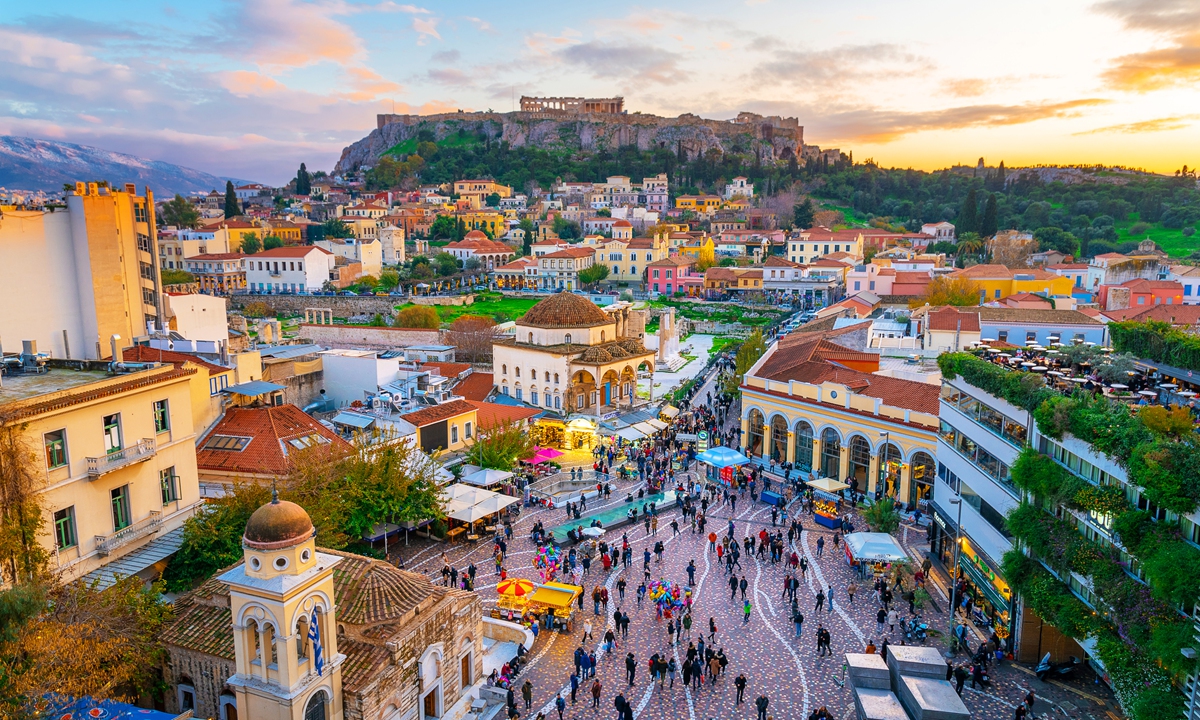
The Acropolis and Plaka of Athens, Greece (Photo: VCG)
"What does a honeymoon in Greece truly feel like?" I asked a friend who had just returned. I was expecting tales of Santorini's famous blue-and-white cliffside houses, the shimmering turquoise waters of the Aegean, or the timeless grandeur of the Acropolis in Athens. Instead, she began with a story from a humble little restaurant she wandered into by chance.
One afternoon, while exploring the streets, the couple entered a cozy little restaurant. They ordered their meal, only to discover the card machine had broken down - and they had no cash. The owner smiled kindly and told them not to worry. "Just enjoy the meal."
The following day, my friend went back to pay the bill. Beaming, the owner said in his imperfect Chinese: "China, friends." That simple, heartfelt gesture of trust and kindness, she later told me, touched her more than the scenic beauty.
On Chinese social media, Greece is frequently praised as one of the most China-friendly countries in Europe - and this warmth is far from new.
Flash back more than two decades ago, when a Chinese merchant's newly purchased aircraft carrier Varyag was trapped in the Black Sea, blocked by Turkey. Greece came to the rescue, offering national backing and deploying its most powerful tugboat to guide the vessel safely through turbulent waters.
In 2011, as chaos engulfed Libya, Greece transformed Crete into a vital evacuation hub for stranded Chinese nationals. The Greek prime minister personally welcomed Chinese citizens on-site, while local authorities established fast-track green channels to ensure every Chinese citizen could pass through - even with incomplete paperwork, as long as they could be identified as Chinese. A similar act of kindness emerged years later during the Syria evacuation.
In 2017, Greece blocked an EU statement at the UN criticizing China's human rights record. Its foreign minister at the time offered a thoughtful and principled response: Selective criticism is unproductive.
From guiding the Varyag across turbulent seas to providing a safe haven in moments of danger, to bravely speaking out on the world stage - these gestures have woven a profound bond between China and Greece. And this friendship has never flowed in only one direction. It is a beautiful reciprocity.
When Greece faced the brink of bankruptcy caused by the global financial crisis that started in 2008, China responded with strategic vision. Its investment in the Port of Piraeus brought expertise, personnel, technology and management know-how.
Despite inevitable frictions over the port along the way, both sides navigated them with patience and mutual respect. The once-quiet, rundown port has been revitalized into the vibrant heart of the Mediterranean. Container throughput has surged dramatically, and thousands of jobs have been created.
While Europe's distinctive products flow toward the Asia-Pacific, Chinese manufacturing travels along the new corridors to take root in European markets. This single port and its expanding networks have become a vital bridge enriching two great continents. Its success underscores a deeper truth: differences and frictions, when approached with wisdom and goodwill, can transform into powerful drivers of shared prosperity.
Today, on Chinese social media platforms, it's easy to see vlogs by Chinese travelers who make special trips to Piraeus. One visitor captured the contrast beautifully: Athens carries the solemn grace of ancient civilization, while just next door, Piraeus pulses with the vibrant energy of departures and arrivals.
In the photos and videos they share, giant cargo ships dock with quiet confidence, towering cranes operate with precision, and along the waterfront, yachts mingle with lively cafes and stylish boutiques. For Chinese visitors, Piraeus has emerged as a compelling new landmark; for locals, it is the thriving heartbeat of daily life.
Cooperation extends far beyond the port. Chinese enterprises support Greece's green transition through investments in power generation and wind energy. Chinese electric vehicles are increasingly common on Greek roads. Just this month, Chinese and Greek firms signed a landmark agreement for the construction of 12 large ocean-going vessels - elevating the partnership from port infrastructure into high-end shipbuilding.
Unlike relations between countries that are often driven by calculated interests or political positioning, there is something deeper behind the China-Greece relationship. It combines tangible mutual benefits, heartfelt support in crises, and profound appreciation between two ancient civilizations.
At the end of our conversation, my friend said, "I really must return to Greece someday. Once is simply not enough. There, it feels like journeying back to the very childhood of human civilization."
Her words sounded familiar, as I encountered nearly identical sentiments in the news from the president of the Athens City Council in Greece, who was visiting Beijing in early June: This was her first time in Beijing, but it would certainly not be her last.
She said she was awestruck by Beijing's immense scale, modernity, and vibrant pace, yet she was even more eager to experience firsthand the rich history she had long known only through books.