


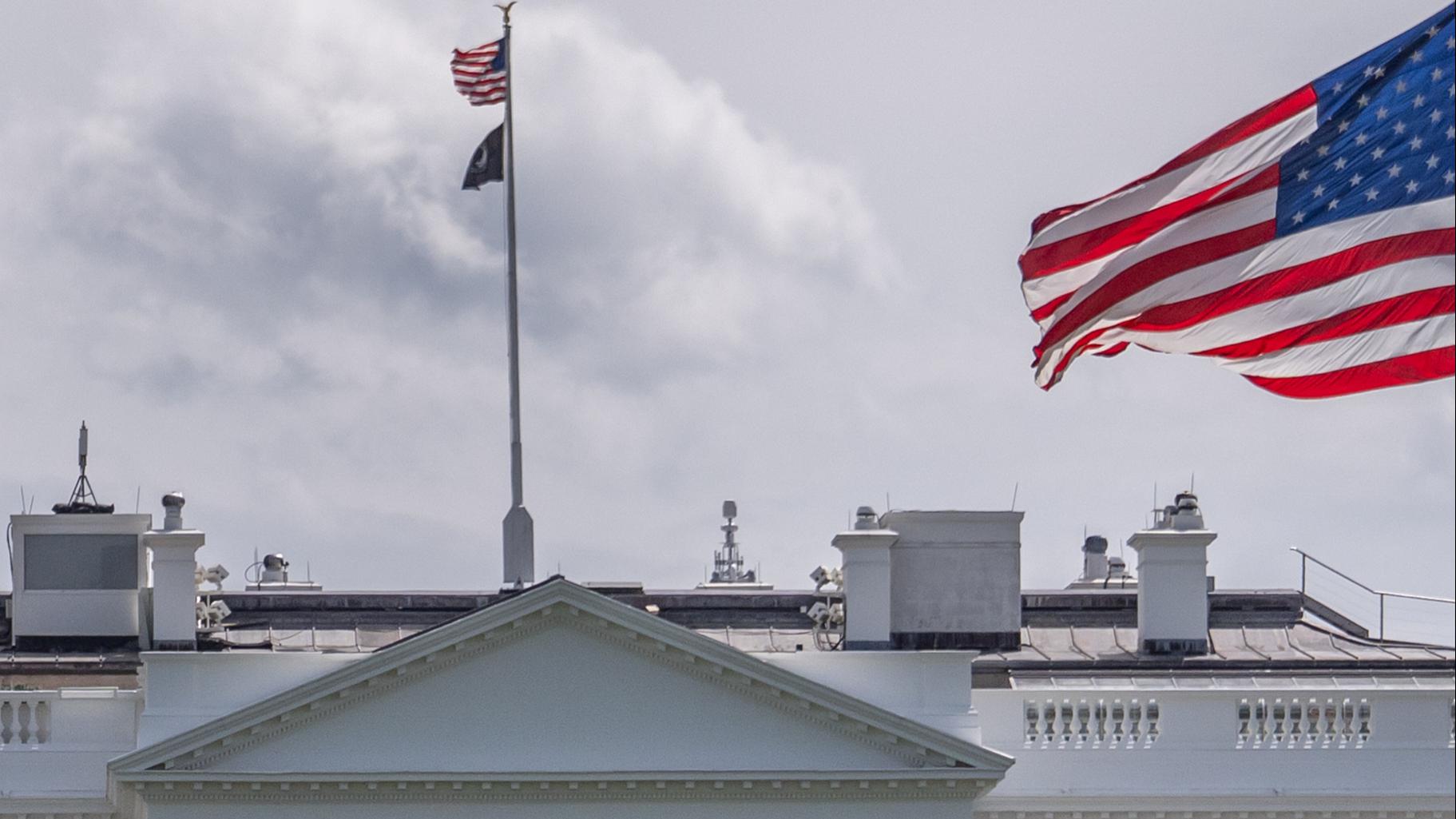
A national flag flies above the White House, April 19, 2026, in Washington, DC (Photo: VCG)
As the United States and Iran reach a memorandum of understanding, the US-Israeli military operation against Iran that persisted for more than three months is finally showing signs of winding down. The prolonged conflict and strategic contest surrounding the Strait of Hormuz has not delivered the expected gains to the United States. According to a global online survey conducted by CGTN, 90.8% of respondents believe that the US government has failed to achieve its expected strategic objectives and has instead further exposed the reality of its continued decline in global strategic influence.
At the outbreak of fighting, the United States sought to maintain its regional dominance with limited investment and to reshape the regional order through military deterrence. However, after its fundamental objective of toppling the Iranian regime proved unattainable, and as the conflict dragged on and its spillover effects continued to expand, Washington gradually lost control over ending the war. A total of 89.1% of respondents agreed with this assessment. Furthermore, 93.0% of respondents said that a series of US interventionist and destabilizing policies toward both the Palestinian-Israeli issue and Iran were key drivers of the sharp deterioration in Middle East security. 93.4% of respondents believe that the conflict further accelerates the decline of US influence in the Middle East.
In recent years, the United States has shown a clear trend of strategic contraction globally, while attempting to maintain its dominant position at a limited cost. In this regard, 92.5% of respondents believe that rapid, limited military interventions and economic coercion have become the primary means by which the United States seeks to sustain its hegemony at a relatively low cost. However, as military action continued to escalate, Washington' strategy of maintaining its dominance in the Middle East through backing regional allies and engaging in limited military intervention ultimately fell apart. According to the survey, 92.3% of respondents agreed with this assessment. Additionally, 89.0% of respondents believe that the essence of the United States' low-cost approach to maintaining hegemony lies in shifting the costs onto its allies and target countries while retaining strategic control, a practice that ultimately undermines the interests of its allies. 93.0% pointed out that if the United States were to become trapped in a protracted Middle Eastern conflict, its regional strategy would collapse altogether.
In fact, the conflict has forced the United States to pay a heavy price for its hegemonic approach. Triggered by the Middle East turmoil, the average price of gasoline in the United States rose by 35% in March 2026, while the US Consumer Price Index posted its largest monthly jump in nearly four years. 91.7% of respondents believed that the conflict has had a significant impact on the US economy.
At the same time, sustained military engagement has eroded confidence in US strategic guarantees, as evidenced by the refusal of several allies to provide military support during the conflict. A total of 86.2% of respondents believe that this has exposed the fragility of America's global alliance network and underscored its declining influence. Furthermore, 93.2% of respondents believe that the United States' military intervention, driven by a hegemonic calculus, has seriously undermined the international rules-based order and global strategic stability.
The survey was released on CGTN's English, Spanish, French, Arabic, and Russian platforms, attracting 9,849 respondents worldwide within 24 hours to participate and share their views.