


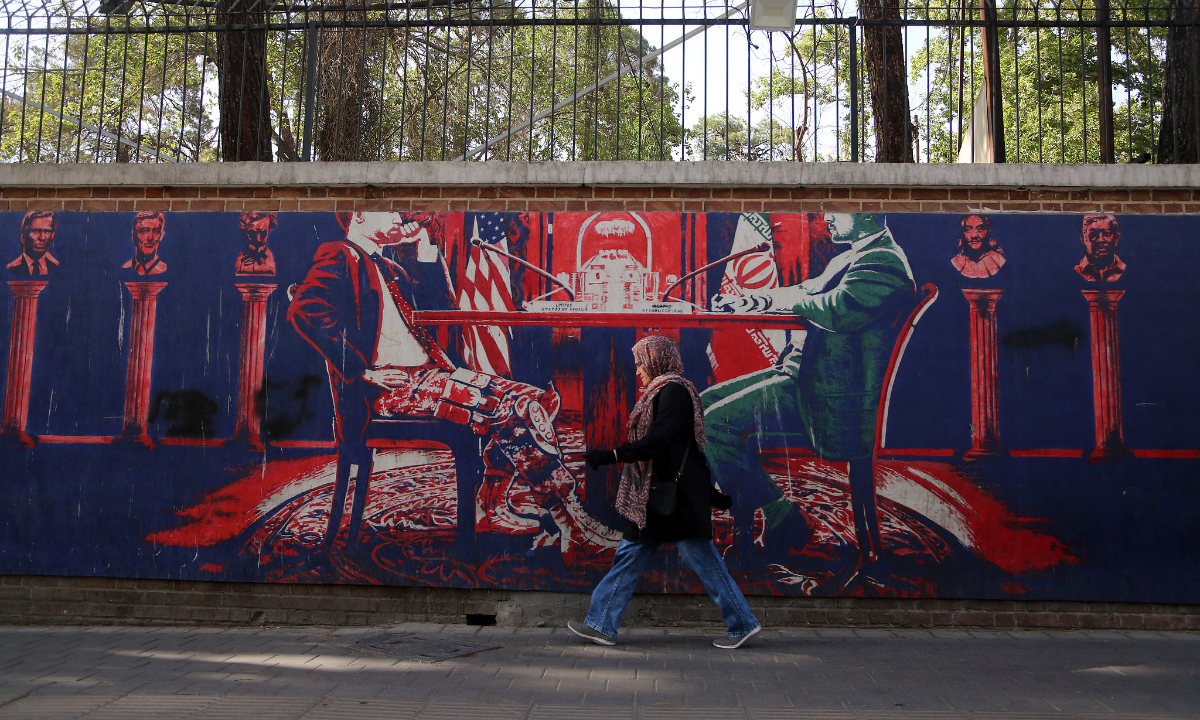
Streets and squares reflect a sense of normalization in Tehran, Iran on June 18, 2026, as hopes grow for economic recovery following the signing of a memorandum of understanding between the US and Iran. (Photo: VCG)
The White House said Thursday night that Vice President JD Vance was delaying a trip to Switzerland to lead a new round of negotiations with Iran over its nuclear program, which US media said raising questions about what's next for the tentative agreement to end the war, US media ABC reported.
Chinese analysts said a major hurdle to prospective US-Iran agreement is still Israel. Any continuation of Israel's military actions in Lebanon could cloud progress of US-Iran peace talks, and potentially erode the limited trust between Tehran and Washington, the analysts said, noting that whether a durable ceasefire can be achieved hinges on the willingness of countries that wield considerable influence over the parties concerned to play a more proactive role in advancing peace.
It said the team lead by Vance had been ready to leave but was postponing, citing difficult logistics for negotiations. The announcement followed a report from Al-Mayadeen, a pan-Arab satellite channel that is politically allied with the Iranian-backed Lebanese militant group Hezbollah, that Iran was delaying sending its delegation to Switzerland over Israel's ongoing military campaign in Lebanon, according to the ABC report.
"As of now, the Vice President is not departing tonight," a White House spokesperson said. "The logistics of these negotiations have never been simple or predictable." "We look forward to beginning technical talks as soon as possible," the spokesperson said, per the Xinhua News Agency.
Swiss foreign ministry confirmed that talks that had been planned for Friday between the US and Iran at the Burgenstock mountaintop resort in Switzerland will not take place, Reuters reported.
The US and Iran reached a preliminary agreement this week to reopen the Strait of Hormuz and end the monthslong conflict. The two sides are still working to reach a final peace deal, and an extendable 60-day negotiation period began on Tuesday, according to Vance, the Hill reported.
White House officials shared an official read-out of the 14-point memorandum of understanding (MOU) on Wednesday, which included sanctions relief and a $300 billion reconstruction fund for Iran.
But the initial agreement has drawn sharp criticism from some in the US — including a few congressional Republicans — who worry Washington ceded too much to Iran with relief from sanctions and a potential $300 billion fund to help with rebuilding, per ABC.
Iran's Supreme Leader Mojtaba Khamenei said on Thursday that despite having a different opinion, he issued the permission for signing a peace memorandum of understanding (MoU) between Tehran and Washington, per Xinhua.
He made the remarks in a message addressed to Iran's people, which was carried by Iranian media, hours after Pezeshkian and his US counterpart, Donald Trump, signed the MoU on ending the war.
Meanwhile, Iran's Foreign Ministry spokesman warned Thursday that a continued Israel Defense Forces (IDF) presence in southern Lebanon would mean the "annulment" of the memorandum of understanding it signed with the US, as Israel doubled down on its plans to keep troops in the area amid its ongoing conflict with the Hezbollah terror group, according to Times of Israel.
Speaking to the Hezbollah-aligned Lebanese news outlet Al Akhbar, Esmaeil Baghaei said the continuation of Israel's offensive would be a violation of the memorandum of understanding between Washington and Tehran that was signed this week.
Vance, asked at a White House news briefing about a report that Israeli prime minister Benjamin Netanyahu was fuming over the agreement, said he had not heard such comments from Netanyahu but criticized members of the Israeli leader's cabinet, who he said have attacked the deal and personally attacked Trump, according to the Guardian.
"My message to them would be twofold. No 1: Donald J Trump is the only head of state in the entire world who is sympathetic to the nation of Israel at this moment in time," Vance told reporters.
"If I was in the cabinet of the Israeli government, I might not be attacking the only powerful ally that I have anywhere left in the entire world."
The biggest obstacle to the tentative US-Iran agreement remains Israel. If Israel continues its military operations in Lebanon, it could further erode trust between Tehran and Washington, Wang Jin, an associate professor at the Institute of Middle Eastern Studies at Northwest University in Xi'an, told the Global Times, noting that Iran may also cite the absence of a ceasefire in Lebanon as evidence of unresolved disagreements with the US, complicating efforts to reach a broader understanding.
Rather than openly sabotaging a future US-Iran agreement, Israel might be more likely to respond with cautious and limited cooperation, said Wang Lixin, assistant research fellow at the Institute of International Relations at the Shanghai Academy of Social Sciences.
Throughout the diplomatic process, Netanyahu's government has worked to safeguard what it sees as three non-negotiable interests: maintaining pressure on Iran, preserving its political position at home, and protecting the strategic US-Israel partnership. How those priorities evolve could become one of the most important uncertainties after any solid agreement is reached, said Wang.
On the question of ending the conflict, Israel's position differs significantly from those of both the US and Iran. Israel has little interest in seeing the fighting come to an end and is therefore likely to continue lobbying within the US and maintaining military operations in Lebanon. Ultimately, achieving a lasting ceasefire will depend on whether countries with significant influence over the parties involved are willing to take a more active role in pushing for peace, said another expert who declined to be named.
China's envoy to the UN on Thursday expressed concerns about the moves of Israel in expanding its military occupation and enlarging the so-called "yellow line" in Gaza, as well as its stated intention to take control of 70 percent of the enclave's territory.
China called on all relevant parties, Israel in particular, to fully comply with the ceasefire agreement and refrain from any reckless actions that could undermine it. China also urged Israel to fulfill its obligations under the international humanitarian law and ensure the entry of urgently needed humanitarian supplies into Gaza, said China's Permanent Representative to the UN Fu Cong, according to a statement on the website of China's Permanent Mission to the UN.