


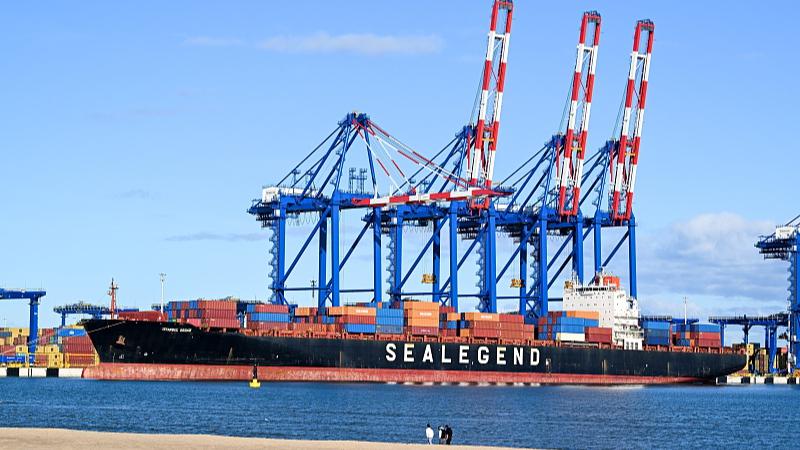
The container ship Istanbul Bridge during unloading in the port of Gdansk, Poland, October 19, 2025. (Photo: CFP)
As debates over de-risking continue within Europe, an important reality often receives less attention: Despite political discussions about new and tougher measures against "growing trade deficit with China," economic ties between China and Europe remain deeply interconnected and mutually beneficial. At a time when global growth is slowing, investment flows are weakening and protectionist tendencies are increasing, China's vast market continues to provide European companies with one of the world's most significant sources of demand, revenue and long-term growth opportunities.
The numbers tell a compelling story. In 2025, trade between China and the EU remained among the largest bilateral economic relationships in the world. According to Eurostat, the EU exported 199.6 billion euros ($228.17 billion) worth of goods to China while importing 559.4 billion euros, making China one of Europe's most important trading partners and the EU's largest source of imports. China accounted for approximately 22% of all EU imports in 2025, underlining the centrality of the relationship to European supply chains and industrial production.
The investment picture reinforces the same conclusion. Despite ongoing discussions surrounding economic security and diversification, European companies continue to expand their presence in China. Germany provides the clearest example. German investment has accounted for more than half of all EU investment into China in recent years, reaching 57% of total EU investment in the first half of 2024. German firms continue to invest heavily because China remains critical to their global business strategies.
The automotive sector illustrates this dynamic particularly well. Companies such as BMW, Mercedes-Benz, Volkswagen and BASF have invested billions of euros in China over the past decade. For many European multinational corporations, China contributes a substantial share of global sales, profits, research activities and innovation partnerships. Even as competition intensifies, these companies continue to view China as a market too significant to ignore.
The reason is simple: No other market combines China's scale, industrial sophistication and consumer potential. China today possesses a population exceeding 1.4 billion people and one of the largest middle-income groups in human history.
This demographic reality is fundamentally reshaping consumption patterns. Chinese consumers increasingly demand premium automobiles, luxury goods, healthcare products, cosmetics, advanced manufacturing equipment, green technologies, education services and digital products, areas in which European companies possess strong competitive advantages.
The size of China's consumer market is equally impressive. In 2025, total retail sales of consumer goods reached 50.1 trillion yuan (approximately $7 trillion), while online retail sales reached nearly 16 trillion yuan. Online sales alone accounted for more than 26% of total retail consumption, creating enormous opportunities for international brands seeking direct access to Chinese consumers.

People visit the exhibition zone of BYD at the 2025 IAA Mobility in Munich, Germany, September 9, 2025. (Photo: Xinhua)
Furthermore, China continues to generate new areas of demand. Recent policy initiatives promoting artificial intelligence (AI) integration, smart consumption, intelligent household products, digital services and advanced technologies are expected to create entirely new markets in the coming decade. China's Ministry of Commerce recently introduced 17 measures designed to accelerate AI-driven consumption and support the development of emerging industries, including humanoid robotics and intelligent consumer electronics.
For European exporters, these developments represent opportunities rather than challenges. Germany's advanced manufacturing sector, France's luxury and aerospace industries, Italy's premium consumer goods producers and Northern Europe's technology companies all stand to benefit from China's transition toward higher-value consumption.
This opportunity becomes even more significant when viewed against Europe's current economic circumstances. Europe faces slower economic growth, demographic aging, productivity challenges and declining foreign investment inflows. According to United Nations Conference on Trade and Development, foreign direct investment into Europe fell by 58% in 2024, with major declines recorded across Germany, France, Italy and Spain. Meanwhile, surveys indicate that business confidence regarding investment opportunities in Europe has weakened amid growing concerns over competitiveness and industrial performance.
Under such circumstances, reducing access to one of the world's largest and most dynamic markets would offer limited economic advantages while potentially increasing costs for European businesses. This does not mean that Europe should ignore legitimate concerns regarding supply-chain resilience or economic security. Diversification remains a sensible objective. However, diversification should not be confused with disengagement. Successful economic resilience is built through broader partnerships and deeper market access, not through the contraction of commercial opportunities.
Indeed, recent investment trends suggest that businesses themselves increasingly recognize this reality. Chinese investment into Europe rose by 67% in 2025 to 16.8 billion euros, reaching its highest level in seven years. The growth occurred despite heightened political debates and trade tensions, demonstrating that commercial logic continues to drive economic cooperation.
History shows that Europe's prosperity has been built on openness, innovation and international engagement. At a moment when global economic fragmentation is becoming a growing risk, the most rational path forward is not to construct additional barriers, but to strengthen channels of cooperation, maintain market access and fully leverage the opportunities created by the world's second-largest economy and one of its most important consumer markets. The future competitiveness of Europe may depend not on how effectively it distances itself from China, but on how successfully it engages with it.