


CAIRO, June 19 (Xinhua) - The U.S.-Iran talks planned for Friday in Switzerland have been postponed, just one day after the digital signing of the memorandum of understanding (MoU).
The MoU, reached after more than three months of deadly clashes, is expected to end military operations on all fronts and begin a 60-day negotiating period.
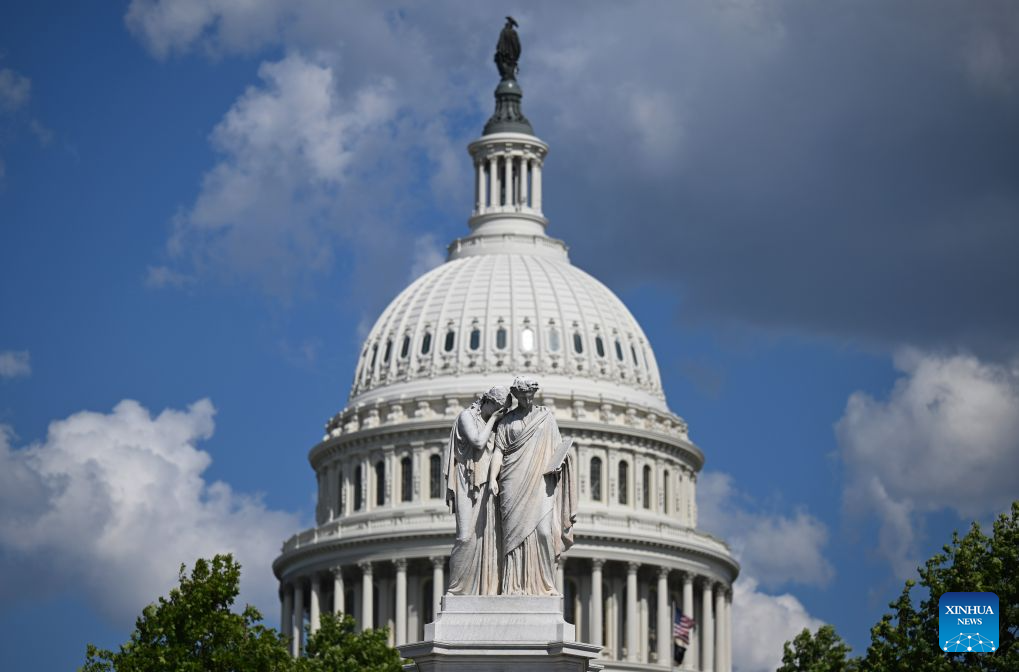
This photo taken on June 7, 2026 shows the Peace Monument with the U.S. Capitol building in the background in Washington, D.C., the United States. Pakistani Prime Minister Shehbaz Sharif said on Thursday that a Memorandum of Understanding (MoU) between the United States and Iran has been electronically signed by the leaders of both countries and has entered into force with immediate effect. (Photo:Xinhua)
Despite the delay in further negotiations, the willingness of Washington and Tehran to remain engaged appears to ease fears of further escalation, offering some relief to a global economy already rattled by the conflict.
However, analysts say that the MoU is little more than a scaffolding for future talks, rather than a solid guarantee of peace. Beneath its wording, the fundamental rifts between the two sides remain unhealed, and peace in the Middle East is still a long haul.
FAR FROM A DEAL
Iran, the United States and Pakistan announced early Monday that the text of the MoU had been finalized. However, it was not until Thursday, when Iranian President Masoud Pezeshkian and U.S. President Donald Trump signed the agreement, that the full text was made public.
The MoU covers several key areas, including the cessation of hostilities, maritime security and navigation, reconstruction and economic assistance, sanctions relief, nuclear-related commitments and an executive mechanism.
It said Iran and the United States commit to holding negotiations and reaching a final agreement within a maximum period of 60 days, extendable by mutual consent.
On the issue of ceasefire and security arrangements, Iran and the United States, along with their allies, agreed to end the war and military operations on all fronts, including Lebanon, and undertook "from now on not to initiate any war or any military operation against each other."
Regarding maritime security and navigation, Washington will lift its anti-Iran naval blockade, while Iran is committed to facilitating safe passage for commercial ships free of charge, for 60 days only, from the Gulf to the Sea of Oman and vice versa.
On matters related to Iran's reconstruction, the MoU said that the United States commits, along with its regional partners, to developing a definitive and mutually agreed-upon plan for Iran's reconstruction and economic development by providing at least 300 billion U.S. dollars.
As for nuclear commitments, Iran reaffirms its commitment not to develop or purchase nuclear weapons, while Tehran and Washington have agreed to resolve the issue on Tehran's stockpile of enriched uranium through a mutually agreed mechanism, with the minimum methodology to be down-blended on site, under the International Atomic Energy Agency (IAEA)'s supervision, according to the text.
According to the MoU, the United States has also agreed to lift all sanctions against Iran, issue waivers for the export of Iranian crude oil, release frozen Iranian funds and assets, and withdraw its military forces from areas around Iran within 30 days after the final agreement.
CONCESSIONS AND DIVISIONS
From the April 8 ceasefire to the signing of the memorandum, the United States and Iran, with mediation from Pakistan and other countries, navigated more than two months of arduous negotiations before reaching the present framework agreement.
Analysts say the document reflects hard-won compromises on both sides. Yet on several core points of contention between the United States and Iran, it does not offer any clear solutions.
To achieve the agreement, both sides have made "significant but unequal concessions," said Jumaa Mohammed, a politics professor at Iraq's Tikrit University.
The United States conceded on the naval blockade, oil exports, frozen assets, a 300 billion-dollar reconstruction plan, and full sanctions relief, amounting to an implicit acknowledgment that its "maximum pressure" plan had failed, noted Mohammed.
For Iran, he said, it made concessions on nuclear enrichment by agreeing to on-site down-blending under IAEA supervision, and on the management of the Strait of Hormuz through dialogue with Gulf states.
Khaled Al-Hroub, a professor of political science and international conflicts at Northwestern University in Qatar, holds a similar view.
The MoU means that "both parties have concluded that continued confrontation is too costly and that a transition toward testing political intentions is necessary," Al-Hroub said.
Despite the concessions, analysts noted that the agreement neither addresses the entrenched differences between the United States and Iran nor lays out a clear path for resolving them.
"Several issues have been deferred to future negotiations, most notably the details of the nuclear program and the mechanisms for handling highly enriched uranium," Iranian political analyst and writer Ali Qassem Najm said.
In the view of Abdul Majid Suwailim, a Ramallah-based political analyst, the agreement is vague not only on Iran's future uranium enrichment, including its scale and limits, but also on the future management of the Strait of Hormuz and the specific process for lifting U.S. sanctions.
"The main problem is that the agreement postpones rather than settles these issues fundamentally, so the future of negotiations could face significant obstacles," said Mokhtar Ghobashy, deputy chairman of the Cairo-based Arab Center for Political and Strategic Studies.
EARLY STRAINS
The United States and Iran were previously set to meet in Switzerland on Friday to discuss implementation of their agreement, but the White House said on Thursday that U.S. Vice President JD Vance's trip for the talks had been postponed.
"The plans for the upcoming technical talks have not been finalized, and the U.S. delegation has been prepared to depart at the first available opportunity," a White House spokesperson said. "We look forward to beginning technical talks as soon as possible."
Despite the agreement to end military operations on all fronts, Israel continued its aggression against Lebanon. Hours after the two sides signed the agreement, Israel struck south Lebanon, killing three people, Lebanese state media reported.
Israel's military, meanwhile, announced the death of one of its soldiers the night before in an incident in southern Lebanon that also left seven others wounded.
On Friday, Israel Defense Forces said it struck throughout the night and continues to strike Hezbollah and infrastructure sites in several areas across southern Lebanon. The Lebanese Health Ministry's Public Health Emergency Operations Center said that at least 18 people were killed and 33 others injured in a series of Israeli airstrikes on residential areas in southern Lebanon.
Beyond unresolved U.S.-Iran differences, analysts point to Israel as a major wild card. While not a signatory to the MoU, Israel is in fact present in every clause.
The MoU is unlikely to remove all Israeli concerns, "as Israel has long believed the issue extends to Iran's broader regional role," Sudanese expert Husam Al-Din Al-Sadiq said.
Baris Doster, an international relations expert at Marmara University in Türkiye, said that as Israel "now realizes it stands no chance of military success against Iran without U.S. forces directly on the battlefield," and its primary role will "be to provoke, incite, and pressure the United States back into a conflict."
Israel is not a direct party to the MoU, but its strategic calculations will influence the prospect for the final agreement, Palestinian analyst Suwailim said.
UNCERTAINTY AHEAD
For regional analysts, the path ahead is fraught with uncertainty.
Sudanese political analyst Abdul-Raziq Ziyada said the MoU has contained the most urgent issues, but has not settled the major questions disputed for decades.
Echoing Ziyada, Al-Sadiq said the MoU "does not represent a final solution to U.S.-Iranian disputes as much as it constitutes a framework for managing them."
Details of sanctions relief have been postponed to the final agreement, which means that "technical and legal disputes could later turn into political disputes," he said.
For Mohammed, a politics professor with Iraq's Tikrit University, the success of the MoU "hinges on translating these broad headlines into verifiable details within two months."
"Any deadlock could reignite tensions," he warned.
What compounds these concerns is the history of broken commitments. For example, the 2015 Iran nuclear deal was unilaterally abandoned by the United States in May 2018, a history which, as Ziyada noted, "remains fresh in Iran's memory."
"Any political change in Washington could affect the continuity of understandings. Therefore, the trust crisis -- the core of the U.S.-Iran conflict -- remains despite this memorandum," he said.
Meanwhile, the deal could have a major impact on how Republicans fare in November's midterm elections, given the sharp rise in U.S. gas prices.
"The big challenge of this agreement will be how long it takes for the Strait to reopen and oil to flow," said Brookings Institution Senior Fellow Darrell West. "It may take a while before gas prices come down ... The path to the midterms likely will remain complicated for Republicans."
Analysts also noted that the MoU leaves the region with a fragile pause, offering an opportunity to reshape its security environment but not yet a guarantee, and that it is still too early to talk about comprehensive peace in the Middle East.
"The agreement is evaluated not as a meaningful step toward lasting peace, but as a temporary, transactional truce born out of tactical necessity," said Doster.
"It is not accurate yet to speak of peace in the Middle East," Ziyada said. "Peace is not merely the absence of war between two states; it is the construction of a stable regional order that addresses the accumulated causes of tension and conflict."