


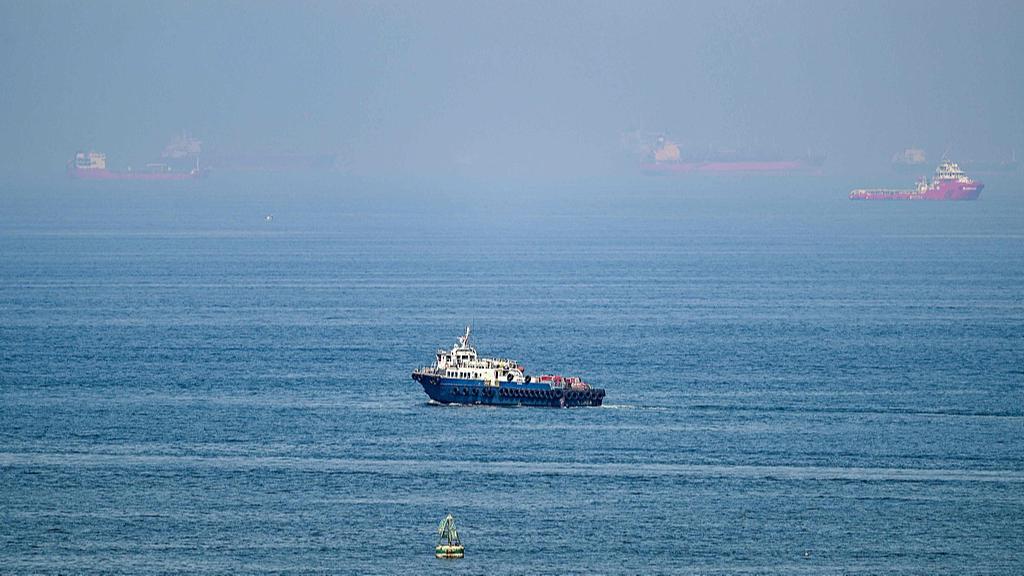
Cargo ships are pictured off the coast of the Khor Fakkan Container Terminal, located outside the Strait of Hormuz, in United Arab Emirates, June 19, 2026. (Photo: VCG)
Iran's Persian Gulf Strait Authority (PGSA), which oversees traffic through the Strait of Hormuz, announced Friday that all vessels must now submit transit requests at least 48 hours in advance.
In a post on social media platform X, the PGSA said that only vessels that comply with the requirements will be "cleared for passage promptly."
The authority also said that fees will be waived for 60 days under the US-Iran memorandum of understanding (MoU), with Tehran covering security, safety, environmental services and insurance costs.
As the two countries officially enter the countdown to a permanent agreement, US President Donald Trump said he expects Iran to close the deal within the 60-day negotiation window that started on Thursday.
If no permanent deal is reached within the time limit, "we will do things that won't make them happy," Trump said at Joint Base Andrews in Maryland. "But I don't think it's going to get to that."
While the US-Iran signing ceremony in Switzerland, originally scheduled for Friday, was called off, Trump's special envoy Steve Witkoff and Iranian Foreign Minister Seyed Abbas Araghchi are traveling to the country for the first round of talks on a potential nuclear deal, according to Axios, citing a US official.
Following a military escalation between Israel and Lebanon that preceded the cancellation of the scheduled US-Iran meeting in Switzerland, Israel and Lebanon reached a new ceasefire deal, which came into effect around 4 p.m. Lebanon time on Friday.
However, shortly after the ceasefire deal was announced, two Lebanese security sources said Israel carried out a dozen airstrikes, but none were recorded after 5 p.m.
Though the attacks were denied by an Israeli military official, a Reuters journalist in northern Israel witnessed airstrikes ongoing inside Lebanon at around 4:50 p.m.
(With input from agencies)