


GENEVA, June 20 (Xinhua) -- Participants at a UN session have called for greater solidarity within the international community amid growing threats to human rights safeguards.
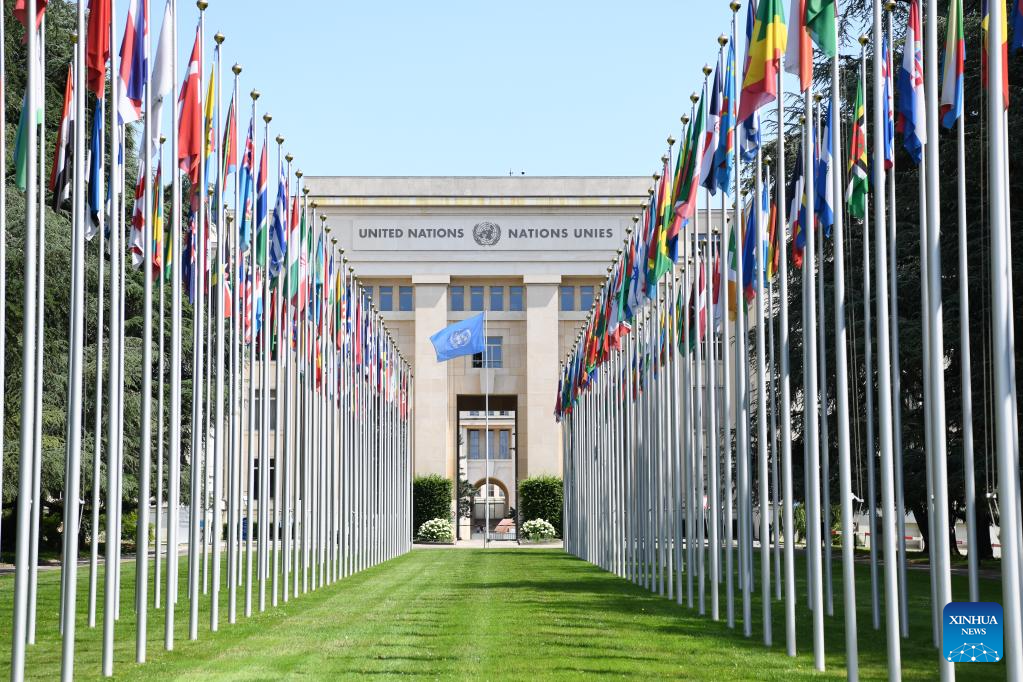
A United Nations flag is pictured at Palais des Nations in Geneva, Switzerland, June 16, 2025. (Photo: Xinhua)
At a side event themed "Human Rights in Global Governance" during the 62nd Session of the United Nations Human Rights Council, panelists noted that at present, geopolitical conflicts are flaring up in many parts of the world, global development remains unbalanced, ethical challenges in technology are becoming more acute, and the international human rights protections are under strain.
The international community should strengthen solidarity and cooperation to jointly promote and protect human rights, those panelists said. Countries should adhere to human rights development paths that align with national conditions and the needs of the people, oppose imposing one's own model on others, and reject the politicization and instrumentalization of human rights, they noted.
The event was co-hosted by the United Nations Association of China (UNA-China) and the Permanent Mission of China to the United Nations Office at Geneva. It was recently held at Palais des Nations in Geneva, and attended by some 50 representatives from diplomatic missions, the UN Office of the High Commissioner for Human Rights, and civil society organizations.
Minister Counselor of the Permanent Mission of China to the UN Office at Geneva Mu Jianfeng, Vice President of China Women's University Li Ying, Senior Research Fellow of the Shanghai Institute for International Studies Li Xin, and Executive Director of Universal Rights Group Marc Limon were among those who delivered keynote speeches at the event.
On Wednesday, China released a white paper titled "More Just and Equitable Global Governance: China's Proposals and Actions." The document once again demonstrates China's commitment to pursuing human rights through development, engaging in global human rights cooperation, and contributing to the building of a more just, equitable and inclusive global human rights governance system.
The white paper, in particular, illustrates China's commitment to safeguarding women's rights and interests, ensuring the fruits of modernization are shared more broadly and fairly among all ethnic groups, and respecting and protecting linguistic diversity of different ethnic groups while promoting the national common language.
Panelists stressed that the Global Governance Initiative has charted a course for advancing the reform of the global human rights governance system.
They called on the reform to focus on implementation, enhance quality and efficiency, and more effectively promote people's livelihoods and development. It should uphold the principles of Member State leadership and extensive consultation, joint contribution and shared benefits, and increase the representation and voice of developing countries, they added.
They called for efforts to strengthen the exchange and mutual learning of practices in the field of human rights, assist developing countries in capacity-building, and enhance the effectiveness of global human rights governance.
The panelists appealed to the UN Human Rights Council for revisiting its founding mission of "promoting and protecting human rights," upholding universality and impartiality, maintaining a non-politicized and non-selective approach, and truly serving as a platform for dialogue, exchange, solidarity and cooperation among all countries.