


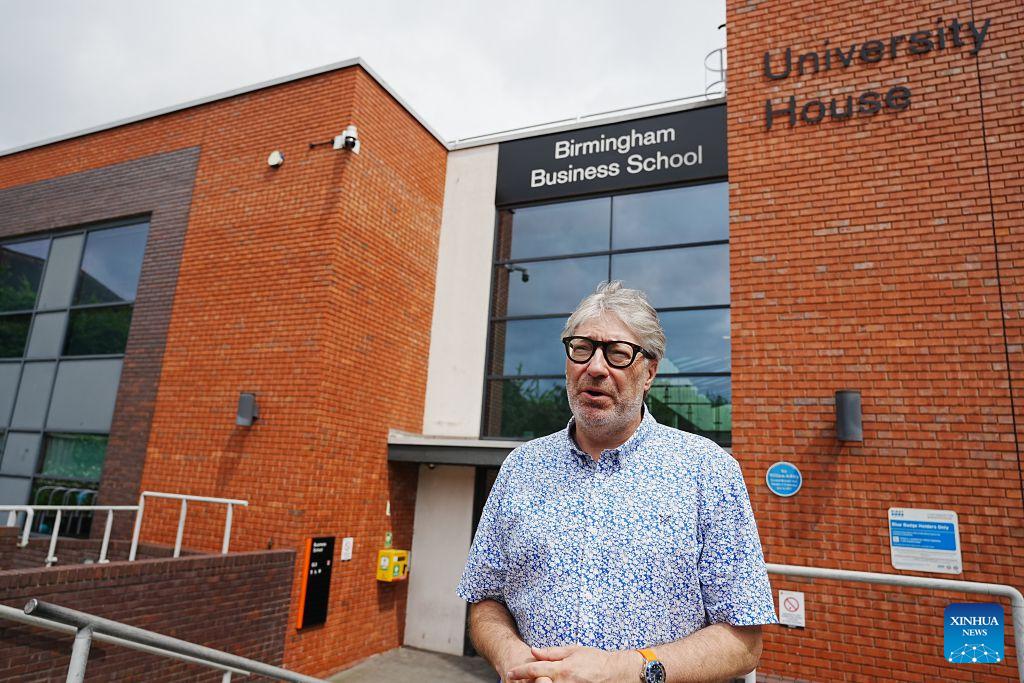
This photo taken on June 18, 2026 shows David Bailey, a professor at the University of Birmingham's business school, in Birmingham, Britain. (Photo: Xinhua/Zhao Jiasong)
BOSTON, Britain, June 23 (Xinhua) -- Ten years ago today, British voters went to the polls in a referendum that set their country on a new course. The result ended David Cameron's premiership, while Keir Starmer's resignation on the eve of the anniversary put Britain on course for its seventh prime minister in a decade.
When the ballots were counted the following day on June 24, 2016, 51.89 percent of voters chose to leave the European Union (EU), beginning a long and often divisive process that has reshaped Britain's economy, politics and relations with Europe.
Nowhere was the verdict more emphatic than in Boston, a market town in eastern England. There, 75.6 percent voted Leave, the highest share among the country's 382 local counting areas.
Town with Highest leave vote
At Boston Men's Shed, a community workshop where local men repair things, work with wood and talk over tea, the mention of Brexit quickly stirred the room, as the suggestion that Britain might rejoin the EU is dismissed at once.
Most turned first to immigration. They said newcomers brought their own customs but often had too little contact with the established community. Their concern was not only about numbers, but about a town changing faster than some residents feel able to absorb.
"I don't think we have seen the economic benefits people were promised," said Phil, a retired financial-services professional who has spent much of his career working across Europe. Yet he remained convinced that leaving was the right decision, arguing that Brexit had restored Britain's ability to "govern the UK" and decide its own course.
For Phil, "the UK governing the UK" meant having the freedom to set its own economic and trade policies. "For most people, the priorities are always the same: the economy, the cost of living and the basic everyday problems they want to see fixed, rather than lofty political ideals," he said.
Another resident, Bill Risbridger, said immigration and weak integration had created tension in the town. He acknowledged that both sides in the referendum campaign made distorted claims and that many promises from 2016 were never fulfilled. Still, he saw no case for reversing course.
"We made a decision," he said. "We should carry on."
Pro-EU voice
To the west of Boston lies Sleaford, another town where a very different view of Britain's place in Europe is on display.
Inside the home of Carole Hagan, chair of pro-European movement group "Lincolnshire for Europe," piles of leaflets, newspapers and campaign booklets covered the table.
Among the material were several display boards from recent street campaigns. Passers-by were invited to place star-shaped stickers beneath one of three choices: support rejoining the EU, remain undecided, or oppose rejoining.
Hagan was particularly interested in the results from Spalding. The town lies in South Holland, a district where 73.6 percent voted Leave in 2016. In April, her group set up a board in the town and invited passers-by to place a sticker under one of three options. Of those who took part, 57 percent supported rejoining the EU.
In the eyes of Hagan, the response in one of England's strongest Leave-voting districts suggested that some people were reconsidering what Brexit had brought.
"Spalding is the true story," she said. To her, the change was rooted in everyday costs, including more customs paperwork for businesses, fewer opportunities for young people in Europe, and higher prices and energy bills for families.
Her observations reflected a broader change in public opinion. A survey released by the European Council on Foreign Relations on Sunday found that three-quarters of Britons wanted closer ties with the EU, while 65 percent believed Brexit had hurt the economy.
Birmingham's divided verdict
Unlike Boston, Birmingham split almost evenly in 2016. About 227,000 people voted Leave and 223,000 voted Remain, a difference of only some 3,800 votes.
David Bailey, a professor at the University of Birmingham's business school who grew up in the city, said the result could not be understood without looking at Birmingham's industrial past.
In the 1970s, roughly one-third of local jobs were linked to the motor industry. "As factories were closed and manufacturing employment declined, many workers lost stable, well-paid jobs. Some never returned to work; others found employment that was less secure and less rewarding," he said.
He said that for part of the electorate, the Leave vote was also a protest against globalization, industrial decline and years in which prosperity appeared to pass their neighborhoods by.
Birmingham has changed markedly since its industrial heyday, but the gains have been uneven, and many communities have yet to recover from the loss of manufacturing jobs.
According to the Office for National Statistics, the West Midlands, the region that includes Birmingham, had an employment rate of 73.3 percent from February to April 2026, below the country's average of 75 percent. Its unemployment rate was 5.3 percent, compared with 4.9 percent nationwide.
"Brexit had weakened trade, investment and growth," he said, adding that new commercial ties with Australia and other distant markets offered opportunities, but could not fully replace lost trade with the large market "on Britain's doorstep."

This photo taken on June 19, 2026 shows Bill Risbridger (L) and Phil in Boston, Lincolnshire, Britain. (Photo: Xinhua/Zhao Jiasong)