


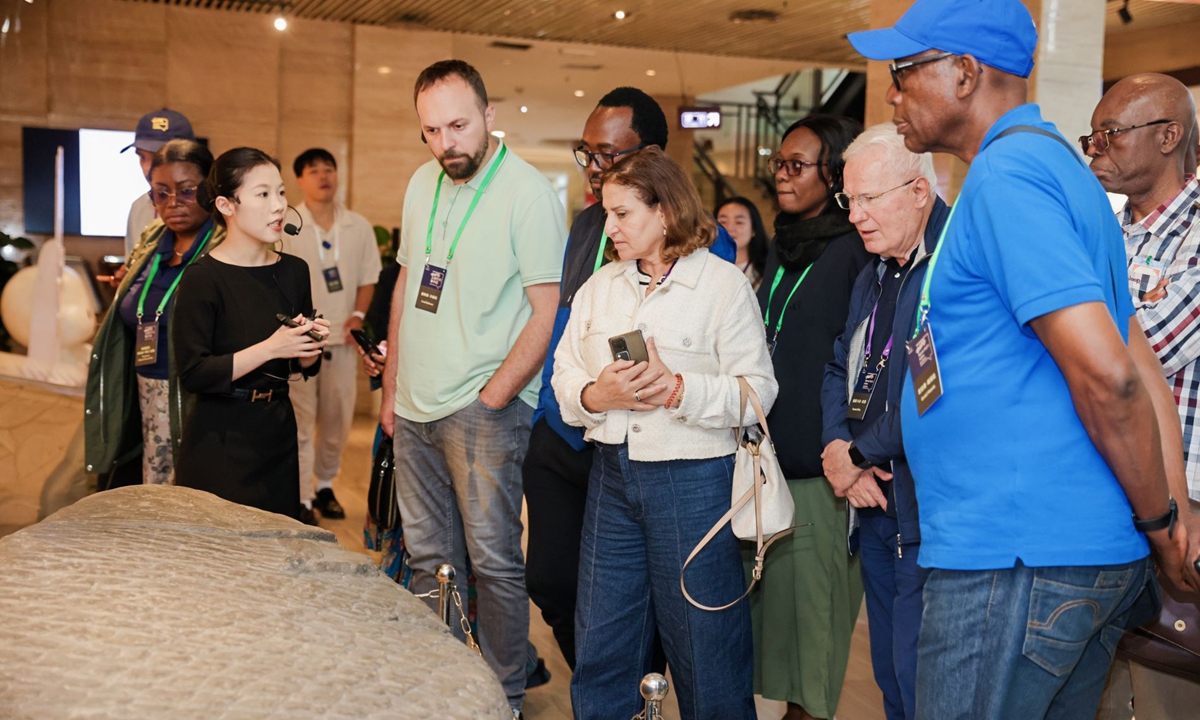
A delegation of officials and experts visits the Baiheliang Underwater Museum in Southwest China's Chongqing. (Photo: Chongqing Luhai International Communication Foundation)
"This is Egypt's Nilometer!" An Egyptian expert paused abruptly before an exhibit panel at the Baiheliang Underwater Museum in Southwest China's Chongqing, pointing excitedly at the image on display. His exclamation laid bare an extraordinary cross-continental parallel between two iconic hydrological heritage sites from the Nile and Yangtze civilizations.
Earlier this month, I accompanied a delegation of officials and experts from 20 countries and international organizations on a visit to Chongqing. One of the highlights was Baiheliang Underwater Museum. Baiheliang is a 1,200-year-old natural stone ridge in the Yangtze River engraved with more than 160 inscriptions recording water levels. When the Three Gorges Dam raised the river level and submerged the ridge in 2003, China built an underwater museum at the original site to preserve this cultural relic.
What struck our Egyptian guest the most was its striking similarity to Egypt's Nilometers - ancient gauges built along the Nile to measure water levels and predict floods and droughts. The parallels with Baiheliang are remarkable: Both served for centuries as indispensable tools for monitoring rivers, both became obsolete after hydraulic projects, and both have since been preserved as treasured cultural heritage.
A museum guide told us that the sites of the Rawda Island Nilometer in Egypt and China's Baiheliang Ancient Hydrological Inscription are applying for a joint World Heritage title in 2026.
After the tour, the Egyptian expert expressed his deep impression of how two civilizations, separated by continents, had developed remarkably similar wisdom in response to environmental challenges. Both Chinese and Egyptian ancestors created sophisticated methods for observing and interpreting nature - not to conquer it, but to better people's lives and foster a more harmonious relationship between human society and the environment. Equally remarkable, he noted, is that both countries have invested significant efforts in preserving these ancient heritages long after they ceased to serve any practical purpose. "For me, this is a testament to the greatness of both our civilizations and to why Egypt and China are natural friends," he said.
His words resonated with me. Baiheliang and Egypt's Nilometers stand as powerful examples that civilizations need not compete for primacy. Instead, they can collaborate to preserve shared records of millennia-long climate shifts, fill gaps in global hydrological heritage, and collectively pass down the ingenuity of river civilizations. This bond is far more than a story of ancient engineering - it embodies a shared Sino-Egyptian civilizational ethos: reverence for history, confidence in cultural identity, and a shared commitment to cross-civilizational mutual learning for humanity's collective progress.
This spirit of exchange is rooted in decades of solid bilateral ties. Egypt became the first Arab and African state to establish diplomatic relations with China in 1956. Over the past seven decades, the relationship between the two countries has evolved into a vibrant example of civilizational exchange and mutual learning. As two of the world's oldest civilizations, China and Egypt share not only pride in their own rich cultural heritage, but also a belief that dialogue among civilizations fosters mutual understanding and trust.
Today, heritage preservation sits high on both national agendas: China integrates cultural confidence and relic protection into its modernization drive and 15th Five-Year Plan, while Egypt anchors cultural growth in its Vision 2030 alongside initiatives like Industrial Egypt. Both sides also fully embrace the Global Civilization Initiative, turning the vision of cultural connectivity into tangible joint action centered on heritage cooperation.
The Egyptian expert offered a final reflective observation as we prepared to leave the museum. Unlike many Western nations that frame history in decades or centuries, Egypt and China operate with a millennial long view, he said, emphasizing that this timeless perspective guides not only our respective heritage conservation work, but also our shared stance on global governance and international affairs. He voiced hope that the two nations will keep bringing this unique ancient wisdom to global discourse.
I later read his inscription in the museum guestbook, whose final line captured our core theme: "Cultural heritage is a testament to the ancient ties that bind our two historical nations."
Heritage is not merely a record of the past - it is a living force shaping our shared future. The parallel stories of Baiheliang and the Nilometers are just the opening chapter of deeper Sino-Egyptian cultural collaboration, bound together by parallel river wisdom born of two of humanity's oldest civilizations.