


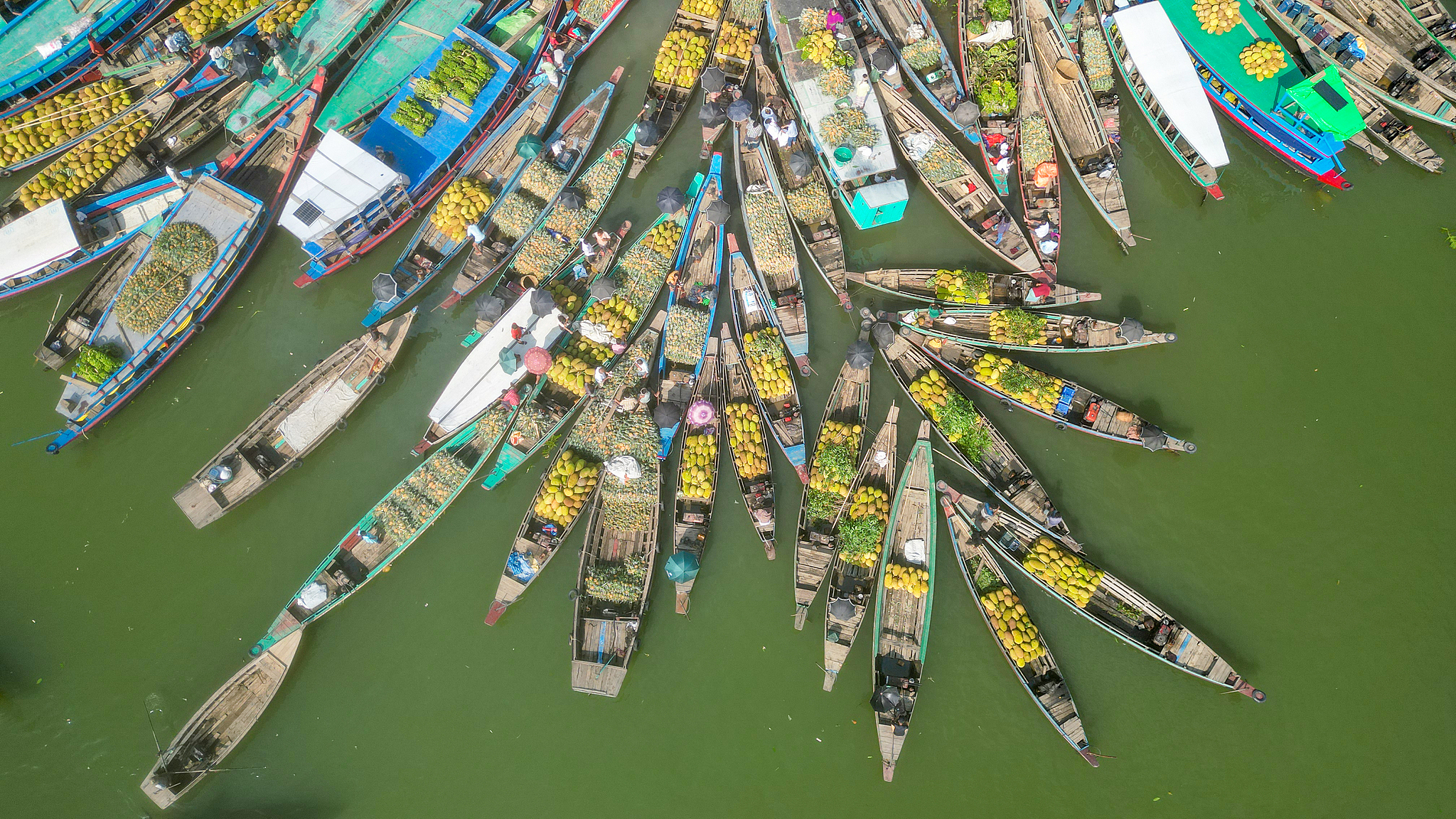
A congregation of boats are seen moored together as part of a floating fruit market in Rangamati, Bangladesh, on May 30, 2026. (Photo: VCG)
Bangladesh's Prime Minister Tarique Rahman arrived in Beijing on Wednesday for an official visit through June 26, his first overseas trip since taking office.
Before arriving in the Chinese capital, Rahman attended the 17th Annual Meeting of the New Champions, also known as the Summer Davos Forum, in China's northeastern coastal city of Dalian. The gathering brought together political and business leaders from around the world to discuss growth, innovation and emerging technologies.
Economic and trade ties have long underpinned China-Bangladesh relations. Since establishing diplomatic ties in 1975, the two countries have steadily expanded cooperation across trade, investment and infrastructure. In 2024, bilateral ties were elevated to a comprehensive strategic cooperative partnership.
Trade lays the foundation
Economic and trade cooperation continues to anchor China-Bangladesh ties. Bangladesh was among the first countries to join the Belt and Road Initiative and has become one of its most active partners.
China has been Bangladesh's largest trading partner for 16 consecutive years from 2010 to 2025.
Bangladesh mainly exports garments and agricultural products to China, while importing machinery, industrial materials and other manufacturing equipment.
The textile and apparel industry illustrates the complementary nature of the two economies. China supplies machinery and equipment for Bangladesh's textile sector, while Bangladesh exports finished garments and textile products to China.
Trade ties received another boost after China granted Bangladesh zero-tariff treatment on 100% of tariff lines from December 1, 2024. The policy has made it easier for Bangladeshi agricultural and other products to enter the Chinese market.

The first shipment of Bangladeshi mangoes to China departs from Hazrat Shahjalal International Airport in Dhaka, Bangladesh, May 28, 2025. (Photo: VCG)
Investment powers development
As trade continues to grow, investment has become another major pillar of bilateral cooperation.
China is Bangladesh's second-largest source of foreign investment, according to Chinese Ambassador to Bangladesh Yao Wen.
Nearly 700 Chinese companies are registered in the country, with businesses spanning power, energy, transport, textiles and information and communications technology. Their investments have created hundreds of thousands of local jobs, Yao said.
Chinese-built power projects, ranging from coal-fired plants to solar and wind farms, now have a combined installed capacity of more than 1 gigawatt, helping strengthen Bangladesh's electricity supply and support local industrial development.
Ahead of Rahman's visit, Bangladesh approved an infrastructure project for the Chinese Economic and Industrial Zone in Chittagong, according to Reuters. The project is expected to create around 100,000 jobs and attract more than $500 million in foreign direct investment during its initial phase.
Future cooperation gathers pace
The visit is expected to inject fresh momentum into bilateral cooperation.
For Bangladesh, attracting more Chinese investment is high on the agenda. Bangladeshi foreign ministry officials told The Daily Star, one of Bangladesh's top newspapers, that investment promotion will be one of the main priorities during Rahman's visit.
The two sides are expected to sign around a dozen memorandums of understanding covering green energy, electric vehicles, port modernization and industrial parks, expanding economic cooperation beyond traditional trade and infrastructure into greener and higher-value sectors.
Nahian Rahman Rochi, head of Business Development at the Bangladesh Investment Development Authority, told Xinhua that ensuring sustainable energy supplies remains one of the country's biggest challenges. He described China as an ideal partner in helping Bangladesh develop solar, wind and hydropower.
Bangladesh is also expected to announce its decision to join the Global Development Initiative proposed by China, according to The Daily Star. The initiative aims to advance international development cooperation and accelerate the implementation of the UN Sustainable Development Goals.
Ahead of Rahman's visit, China said it looks forward to working with Bangladesh's new government to strengthen strategic communication, advance high-quality Belt and Road cooperation, expand practical cooperation and enhance coordination on multilateral affairs, Chinese Foreign Ministry spokesperson Guo Jiakun said at a regular press briefing.