


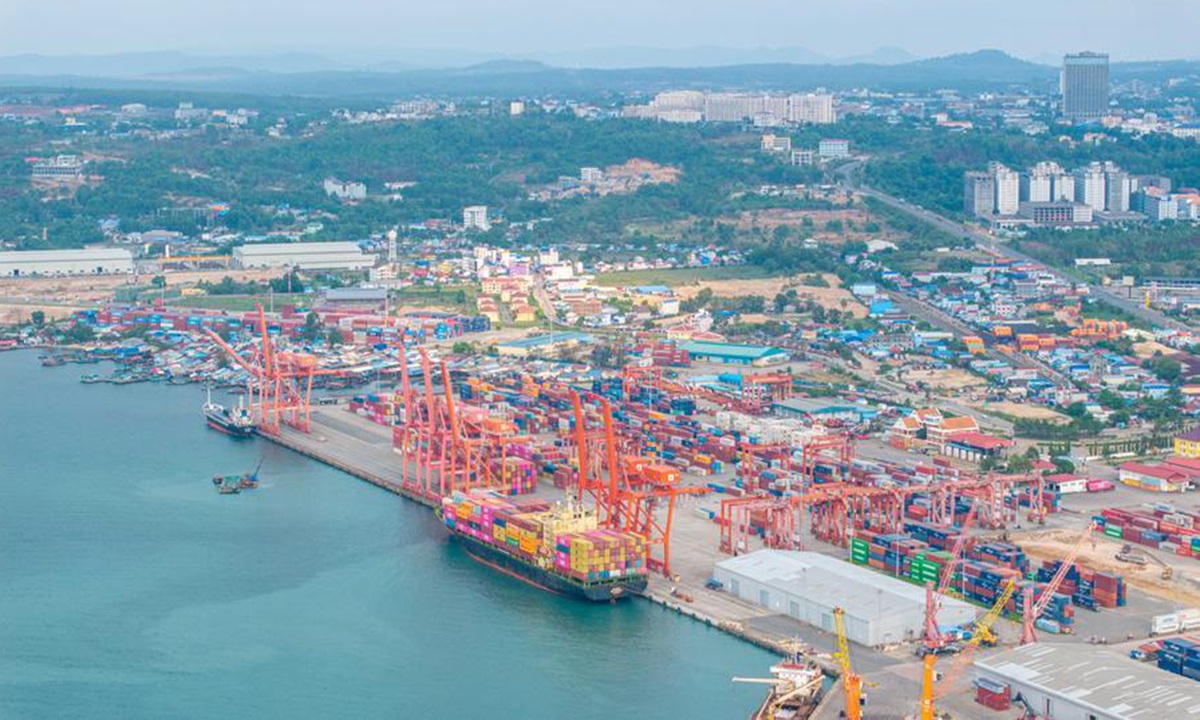
An aerial drone photo taken on March 16, 2025 shows a view of Sihanoukville Port in Cambodia. Photo: Xinhua
"The rice has a special flavor. Where did you buy it?"
My friend, Mr. Huang, asked the moment he walked into the kitchen and caught a whiff of the delicate jasmine aroma. In the rice cooker, the grains were slender and white, each one plump, distinct, and beautifully separate.
I took a bag of rice out of the cabinet and pointed to the packaging. On the front, it proudly displayed "Cambodian Jasmine Rice," accompanied by vertical lettering that read: "A Grain of Rice, the Smile of Angkor."
"Does Cambodia really produce rice this good?" my friend asked, a bit surprised.
To be honest, the first time I cooked it, I was surprised as well. I clearly remember buying a small bag from a high-end imported supermarket in Beijing three years ago, where a salesperson recommended it, saying that "this rice is from Cambodia, an agricultural country. It has a distinctive jasmine aroma and superior texture, and it's grown without pollution." Out of curiosity, I did some research and found that Cambodian Jasmine Rice has won the "World's Best Rice" championship multiple times.
Nowadays, this Cambodian rice has made its way onto more and more supermarket shelves across China. It is also readily available online, with a growing number of brands appearing on major Chinese e-commerce platforms - increasingly competing directly with long-dominant Thai rice.
Prices have become more affordable. During this year's 618 shopping festival, I casually placed an order on my phone and noticed that the 5-kilogram bag costs only around 100 yuan. When I stood in the kitchen with the freshly delivered bag in hand, I deeply sensed that one tiny grain of rice was gently linking two friendly neighbors — China and Cambodia — and bringing them closer to each other.
On January 1, 2022, the China-Cambodia Free Trade Agreement and RCEP took effect on the same day. This was a landmark moment for China-Cambodia agricultural cooperation: rice departed from Cambodia's Sihanoukville Port, shipped across the South China Sea straight to major ports along China's southeastern coast, where tariffs on Cambodian rice exports were sharply reduced and customs clearance procedures were significantly streamlined.
This was one of the changes that have facilitated Cambodian rice's expanding presence in China's vast consumer market, which has been undergoing a consumption upgrade.
Official statistics show that in 2025, Cambodia's rice exports jumped 45 percent to 940,000 tons, with exports to China reaching 231,000 tons, accounting for 24.56 percent of the total volume.
Rice trade is just the first dimension of China-Cambodia agricultural cooperation. The deeper dimension of connectivity lies in the entire industrial chain integration - from a single seed to a steaming bowl of rice.
In the paddies, Yuan Longping, China's "father of hybrid rice," once led a scientific research team to Cambodia to promote hybrid rice. After the harvest, Chinese companies also invest in building rice drying, storage and warehousing facilities, helping to address the long-standing issue of rice storage faced by local farmers and assisting Cambodia in achieving its goal of exporting at least 1 million tons of rice a year in the future. In processing plants, Sino-Cambodian joint ventures turn paddy into premium packaged rice.
In terms of logistics connectivity, China-built infrastructure under the Belt and Road Initiative is expected to inject new dynamics into bilateral collaboration. At the beginning of 2026, Cambodia and Laos signed an agreement on transporting Cambodian agricultural products via Laos, potentially opening a new corridor that leverages the China-Laos Railway to further boost the competitiveness of Cambodian exports to China.
A Cambodian proverb says, "Trust is like a tree." The tree of China-Cambodia friendship was planted in 1958 when the two countries established diplomatic relations. Over the past 67 years, they have weathered storms together, and today it stands with deep roots and luxuriant leaves.
When the roots grow deeper, the fruits naturally become more abundant. In China's supermarkets, what once felt like exotic Cambodian produce is now an everyday option for many Chinese families.
What began as trade is evolving into shared prosperity: On the one hand, Cambodia gains stable export markets not only for grain but also for a variety of products such as cassava, fruits and vegetables, along with higher farmer incomes, and accelerated agricultural modernization. Southeast Asia - blessed with abundant waterways and fertile plains - is moving steadily toward the vision of becoming a true "land of fish and rice." On the other hand, China secures diversified, high-quality agricultural supplies, and Chinese enterprises expand overseas investment opportunities and apply their technological strengths.
That day, my friend, Mr. Huang, finished two bowls of Cambodian rice at my home, and he immediately placed an online order for several bags of Cambodian jasmine rice. I believe the next time the aroma fills his kitchen, what he will be tasting is more than just a bowl of good rice - it's the sunshine and the soil of Tonlé Sap Lake, the fruit of a friendship between "ironclad friends" that has spanned more than half a century, and the vivid flavor of the deep market connection between China and ASEAN.