


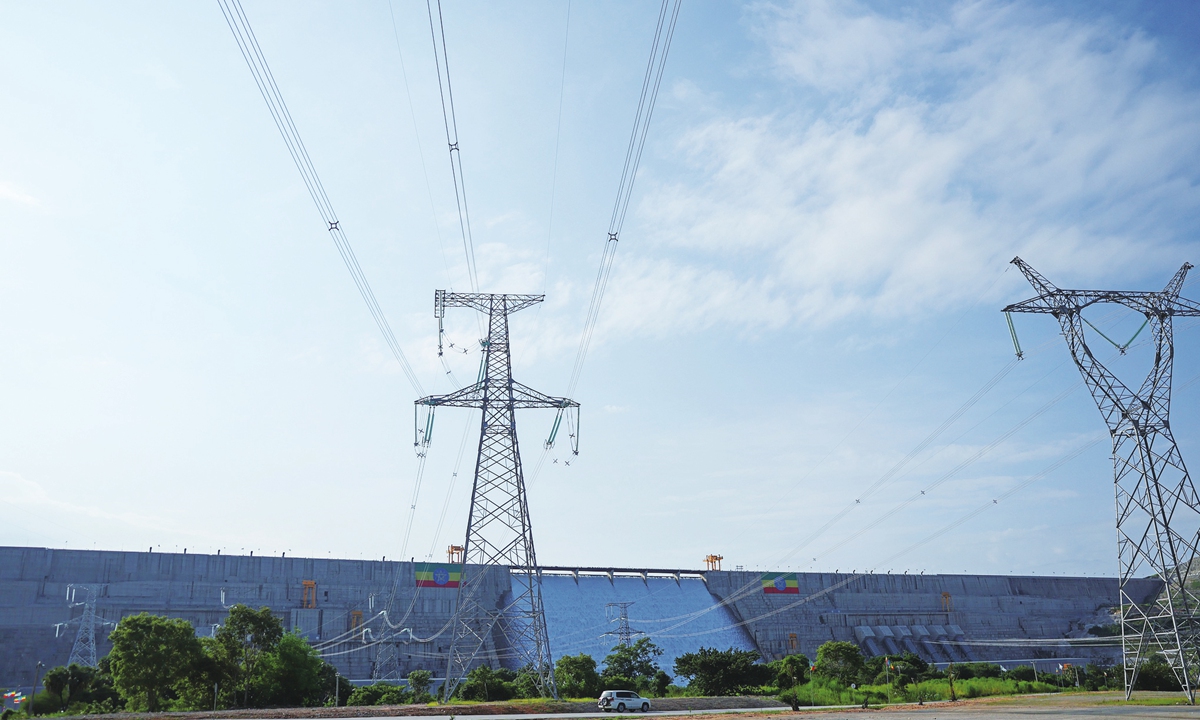
A view of the Grand Ethiopian Renaissance Dam at the Blue Nile River in the Benishangul-Gumuz Region, Ethiopia Photo: VCG
The year 2026 marks the 105th anniversary of the founding of the Communist Party of China (CPC). For over a century, the CPC has united and led the Chinese people in writing the most magnificent chapter in the millennia-long history of the Chinese nation. From the days when Edgar Snow broke through blockades to reach Yan'an to the present day exploration of Chinese modernization that has charted an entirely new path, a growing number of people around the world are asking: What does China's path mean for the rest of humanity? The Global Times invites Chinese and foreign observers to unpack this question. This is the third installment of the series.
Fu Xiaoqiang, president of the China Institutes of Contemporary International RelationsAs changes unseen in a century accelerate across the globe, unilateralism and hegemonism continue to rise, bringing four major deficits - in peace, development, security, and governance - into sharp focus.
Facing the defining question of our era - "What kind of world should we build, and how should we build it?" - China has successively proposed the Belt and Road Initiative (BRI) and four global initiatives. Together, these form a systemic approach that integrates practical frameworks, values, and top-level design. This Chinese approach breaks free from the obsolete Western mentality of zero-sum games and clashes of civilizations. It blazes a new trail for reforming the global order and advancing the collective development of humanity.
First, China has fostered inclusive cooperation to rebalance global development. Through the Global Development Initiative (GDI), China has actively aligned its efforts with the UN 2030 Agenda for Sustainable Development. China does not export its own institutional model, nor does it impose a fixed path to development. In the face of anti-globalization headwinds like "small yard, high fences" and "decoupling," China continues to expand the pie of shared global interests, steering economic globalization toward a more open, inclusive, balanced, and win-win future.
Second, China has updated security paradigms to build a foundation for lasting peace. The Global Security Initiative (GSI) shatters the law of the jungle where the strong prey on the weak. It introduces a new vision of common, comprehensive, cooperative, and sustainable security. Its core mission is to reject the zero-sum fallacy of placing one's own security above that of others, establishing instead a paradigm where the security of all nations is interdependent and indivisible.
Third, China has championed mutual learning among civilizations to forge a consensus on coexistence. The Global Civilization Initiative (GCI) inherits the traditional Chinese wisdom of "harmony without uniformity" and "appreciating all civilizations' beauty."
Recognizing civilizational diversity as an intrinsic trait of human development, it constructs a new cultural outlook based on equality, inclusivity, and mutual learning. It dismantles the monopolistic narrative of Western-centrism and its self-proclaimed civilizational models, maintaining that the history, culture, and development path of every country carries unique value and stands on equal footing.
Fourth, China has reformed governance architecture to guide a just transformation of the international order. The Global Governance Initiative (GGI) marks the institutional elevation of the Chinese approach and serves as the core pillar for transforming the international order. Centered on sovereign equality, the international rule of law, and true multilateralism, this initiative maps out a clear path for global governance reform in three dimensions: upholding sovereign equality, drawing a clear line between true and false multilateralism, as well as expanding and upgrading governance mechanisms.
Unlike the Western governance model, which prioritizes bloc confrontation and self-interest, the Chinese approach anchors the common well-being of all humanity. It transcends national self-interest and ideological divides.
Looking ahead, China will continue to deepen the implementation of these four initiatives, remain committed to the path of peaceful development, and work hand-in-hand with all nations to steadily march toward a new horizon of human civilization characterized by "universal harmony" and a shared future.
Endalkachew Sime, former state minister of the Planning and Development Commission of EthiopiaAs the CPC marks its 105th anniversary, two questions matter deeply to the developing world: What does the century-plus footprint of the CPC look like? And how can the CPC continue to champion the ever-changing global order?
The CPC has pursued a path of independent exploration - from revolutionary struggle to reform and opening-up. Almost around the same time, the Washington Consensus - formally articulated nearly 40 years ago - has represented a much shorter but deeply disruptive chapter: a set of neoliberal prescriptions (privatization, deregulation, fiscal austerity) that, when imposed on developing countries, delivered debt, deindustrialization and dependency rather than prosperity.
Today, China offers a different path forward: from the BRI to the GDI, GSI, GCI, and finally the GGI. Together, these proposals form a coherent system of global public goods and the foundation of what I call a "Global South Consensus" - an alternative framework rooted in mutual respect, national ownership and pragmatic cooperation.
My own experience provides concrete evidence. In 2022, I arrived at Peking University's Institute of South-South Cooperation and Development (ISSCAD) carrying a puzzle. Ethiopia and Vietnam launched industrial park programs at roughly the same time. Today, Vietnam operates over 300 parks, with manufacturing contributing nearly one-third of its GDP. Ethiopia, however, despite having some of the world's lowest industrial electricity tariffs (approximately 3 US cents per kWh), an abundant young labor force and vast cotton land, sees manufacturing account for less than 10 percent of its GDP. Why?
My journey at the ISSCAD enabled me to have a professional and policy-relevant answer for the puzzle.
Ethiopia did not lack physical infrastructure. Rather, it lacked a coordinated ecosystem where industry, policy, talent and logistics evolve together. Fieldwork in Xi'an showed what works: 15,000 technology enterprises and 19,000 small and medium-sized tech enterprises formed tightly integrated supply chains; a zipper factory next to a garment manufacturer; university research flowing directly onto factory floors… This reveals the true promise of the BRI: evolving from a simple infrastructure provider into a catalyst for systemic change.
The subsequent global initiatives address the gaps that infrastructure alone cannot fill. The GDI puts development back at the centre of global cooperation, accelerating the UN's 2030 Agenda. The GSI offers a framework for common, comprehensive and sustainable security - an urgent alternative to zero sum geopolitics. The GCI champions embracing diversity against the clash of cultures. And the GGI, proposed in 2025, seeks to make global governance genuinely inclusive of the Global South's rising voice.
China is not offering a rigid blueprint but a method: Build infrastructure and nurture ecosystems; pursue security through cooperation; respect every civilization's right to define its own future; and reform global governance to reflect the world's true diversity.
From the BRI to the four global initiatives, China is championing a more balanced, multipolar order, one where the Global South has both agency and hope. As an Ethiopian scholar and pragmatic optimist, I have seen that future taking shape. Now it is time to build it.