


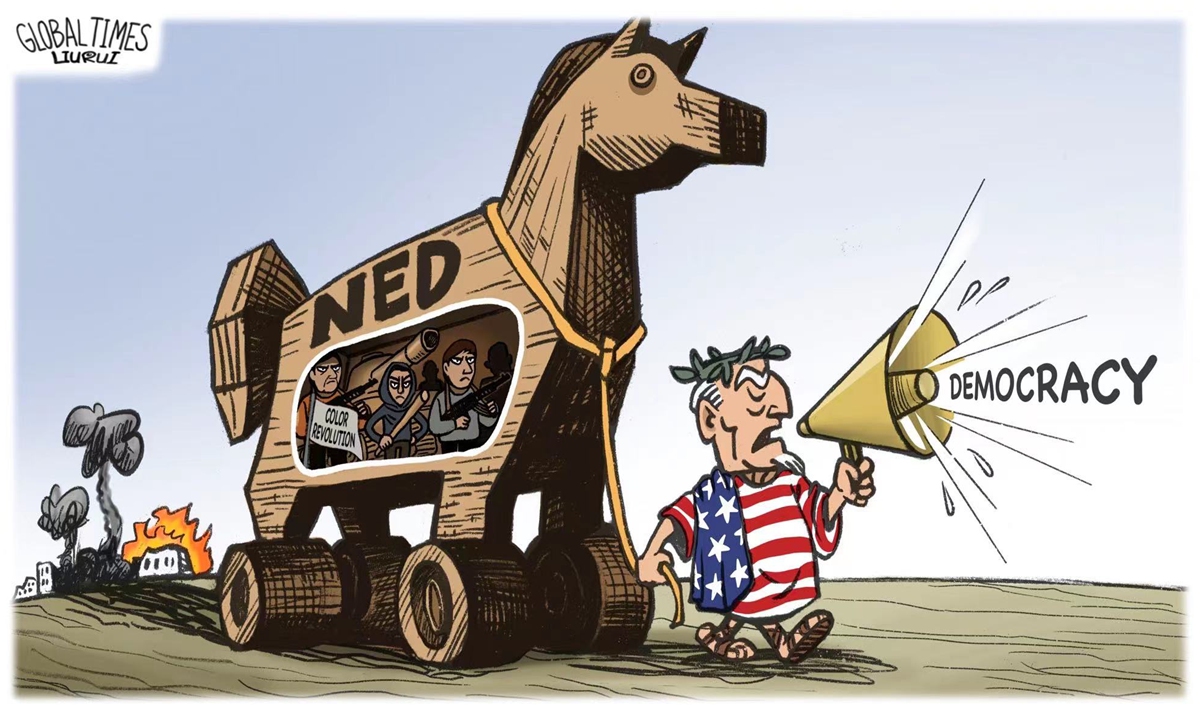
Is that a gift? Illustration: Liu Rui/Global Times
The US has long styled itself as the "guardian of democracy." Yet under the cloak of this high-sounding narrative lies a meticulously engineered political apparatus geared toward maximizing America's geopolitical interests. Among its many instruments, the National Endowment for Democracy (NED) stands out for its highly deceptive yet effective workings.
Founded in 1983, NED presents itself as an independent non-governmental organization whose purported mission is to strengthen democratic institutions and values around the world.
But the reality is a far cry from its claims: it relies heavily on congressional funding and operates in close alignment with Washington's foreign policy agenda.
"A lot of what we do today was done covertly 25 years ago by the CIA. The biggest difference is that when such activities are done overtly, the flap potential is close to zero. Openness is its own protection," said Allen Weinstein, a co founder of NED, in an interview with The Washington Post in 1991.
This blunt admission lays bare NED's true nature: It is no champion of democracy, but a political agent cloaked in a non governmental facade.
Over the past four decades, NED's footprint was seen wherever major political turmoil erupted. From the upheavals in Eastern Europe to Georgia's "Rose Revolution," Ukraine's "Orange Revolution" and the "Arab Spring," a strikingly similar pattern has been discerned: funding opposition groups, training activists, manipulating media narratives, stoking social division and ultimately pushing for regime change. What was branded as "democracy assistance" had too often left behind a swathe of instability, economic decline and fractured societies.
In the Middle East and North Africa, some countries have fallen into long-term conflicts as a result of foreign intervention. Libya descended from one of Africa's more prosperous states into a war-torn land. Yemen became the site of one of the world's worst humanitarian crises. Egypt endured years of political turbulence.
In all cases, we saw the same story play out: The beautifully packaged US "democracy template," once unwrapped, did not bring the much-touted stability and prosperity; instead, it unleashed disorder and chaos like a Pandora's box.
Latin America has faced similar scenarios. In Venezuela, Nicaragua and Bolivia, NED has been repeatedly accused of channeling resources to pro-US political actors, meddling in elections and nurturing anti-government movements. Sovereign nations found themselves trapped in endless political confrontation while development opportunities slipped away.
China has long been a target of NED. Over the years, it has funded anti-China separatist organizations and peddled false narratives under the guise of "human rights" and "freedom" to interfere in China's internal affairs and tarnish its image.
Perhaps most concerning is the subtlety of its methods. NED is never open and above board in executing missions. It employs "Trojan horses" — awards, forums, training programs, academic initiatives and media partnerships — to conceal their true purposes. It often packages political intervention as civil society support and strategic penetration as value promotion. This is not idealism, but a carefully calculated exercise of power in realist garb.
True democracy should be independently explored and exercised by the people, not exported and imposed by external forces. True freedom ought to bring development and dignity, not conflict and division. Every country has the right to choose its own development path based on its unique history and realities and adapt it to its evolving needs.
The track record of NED speaks volumes: what it promotes is not genuine democracy, but selective democracy; what it upholds is not real freedom, but America-first hegemonic logic. As more and more countries come to see this clearly, NED's pretense as a "beacon of democracy" will inevitably fall apart.