


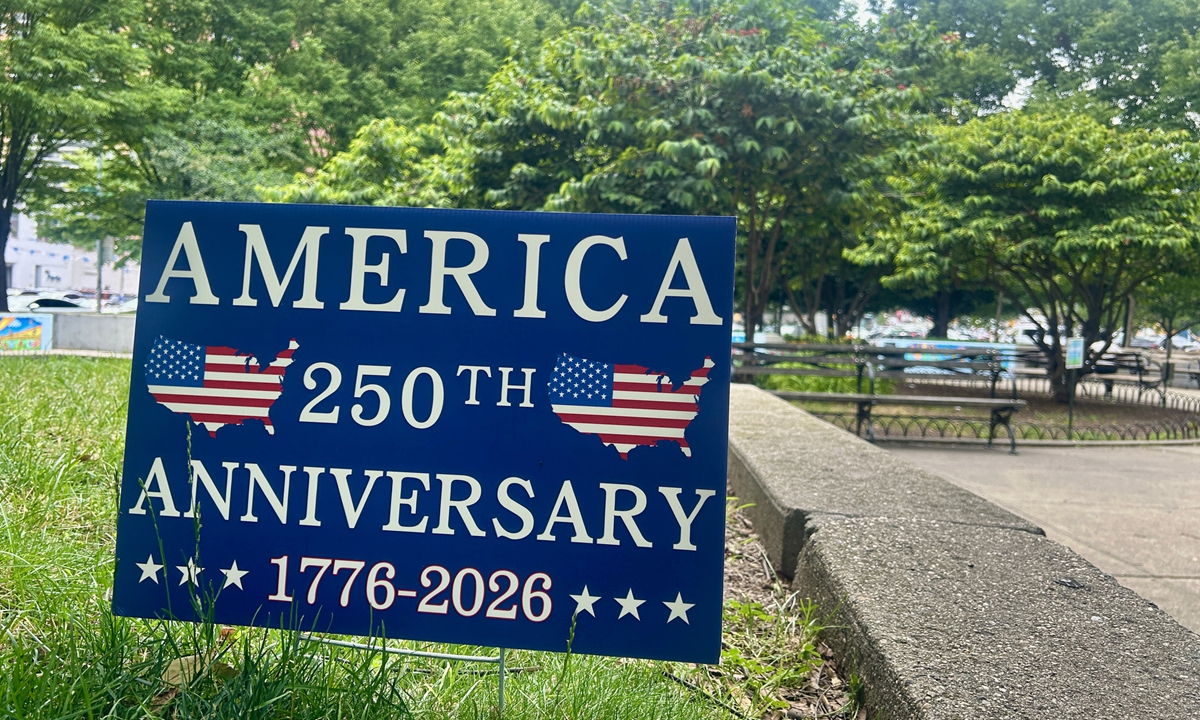
America 250th Anniversary 1776-2026 sign in McDonald Park, Forest Hills, Queens, New York. Photo: VCG
The first document ever to use the phrase "United States of America" was the Declaration of Independence, drafted by Thomas Jefferson and signed in Philadelphia on July 4, 1776 - exactly 250 years ago. The system of government established at the end of the 18th century is still in effect, albeit considerably amended. This makes the USA one of the oldest governments on the planet, even if, in terms of nationhood, it is very young compared to most of Europe and Asia.
Maintaining such continuity for a quarter of a millennium is no small feat, which is why this Fourth of July was supposed to be extra special. In addition to the regular parades, fireworks and concerts around the country, a "Great American State Fair" was set up on the National Mall in Washington, while New York City will stage the largest maritime and aerial gathering in American history. According to the congressional commission tasked with organizing the festivities, the goal is to get all 350 million or so Americans excited about their country's jubilee.
There is only one small problem: What does it mean to be "American" today?
Let's take a look at 50 years ago, when the country celebrated its 200th birthday. In 1976, there were around 218 million Americans, of whom less than 5 percent were foreign-born. Today, that figure stands at over 15 percent. For many of them, "America" is viewed as an economic zone, a source of wealth, a refuge from troubles at home - but not as a distinct nation, with a history, traditions or values they need to assimilate into.
The idea of a "melting pot" has been replaced with "multiculturalism," to the point that some politicians routinely declare immigrants to be more American than the native-born.
Though immigration is a major fault line in US politics, the problem transcends the political and goes right to the issue of identity. Successive administrations have tried to redefine this elusive national identity, yet their efforts have all fallen flat, leaving the question of "what it means to be American" unresolved and even more confusing.
Like the bicentennial in 1976, this year's celebration is again unfolding amid political polarization and competing visions of America's past. Today, critics argue that officially organized festivities downplay slavery, civil rights struggles, the experiences of Native Americans and "diverse" identities.
This divide has extended even to the institutions themselves, with nearly a dozen Democrat-led states declining to send official representatives to the "Great American State Fair" in Washington. Meanwhile, the National Mall has become a flashpoint for political expression, drawing counter-protests and demonstrations aimed directly at the administration's curation of the festivities.
Rather than providing a shared national story, the anniversary has itself become another arena where competing versions of America confront one another.
For years, the ethnic, racial, political and other fissures in American society were often masked by the promise of plenty. But while the US certainly seems like a land of abundance to visitors from abroad attending the World Cup, Americans struggling to make ends meet are more cynical. To them, the promises of a "golden age" ahead always seem just out of reach.
Without a common vision of the future, even the grandest anniversary risks becoming another battleground over the past. One major difference this time is that many Americans, faced with these competing visions of America, no longer care about criticism. Acknowledging historical imperfections of the US has been "done to death," they say, and has not brought the nation together but instead divided it more than ever - so why bother?
The sentiment from that quarter is that America is done apologizing for itself, both at home and abroad. They are more likely to embrace the current government's vision of America, however vague, than to revisit competing narratives of what it means to be American.
Today, on the eve of its 250th birthday, America is divided once again - and it seems less likely than ever to bridge those divisions.