


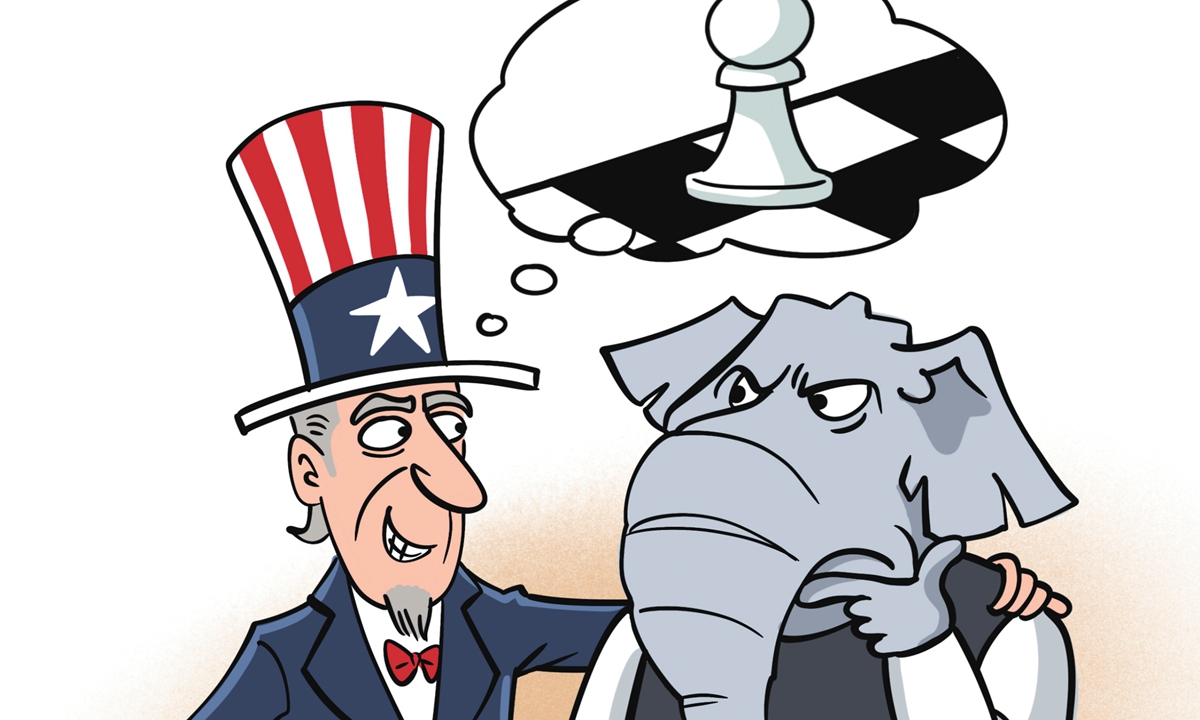
Illustration: Liu Rui/GT
"Much better than it sounds" was once used by Mark Twain to describe the music of Richard Wagner. In a recent article by Foreign Policy (FP), the phrase was repurposed to characterize US-India relations. However, in this case, the opposite might be true: while some US politicians and media outlets repeatedly project goodwill and try to make the US-India relationship sounds great, the reality is that many think the relationship might be - to borrow a phrase from FP - "coming apart."
Washington has recently staged some overtures of friendliness. US Senator Steve Daines, speaking at the US-India Strategic Partnership Forum Leadership Summit in Washington, held up his phone as an example, claiming that he would not bring it to China but that he does not have to worry about it when traveling to India. He praised India as a "highly trusted ally and friend" and asserted that India could rival China's innovation network in partnership with the US.
The FP article also sought to talk up the China-India relationship, repeatedly emphasizing "cooperation" and asserting that "the partnership has acquired sufficient institutional depth, economic interdependence, technological cooperation, and societal connectivity to absorb repeated shocks."
Yet such "sweet talk" has done little to ease India's concerns, according to Long Xingchun, a professor from the School of International Relations at Sichuan International Studies University.
"Even with repeated signals of goodwill from different groups in the US, India remains cautious and is adjusting its approach toward Washington," Long told the Global Times, adding that based on recent exchanges he had with Indian officials in Guangzhou, it's clear that "the series of measures introduced under the US administration has clearly made India anxious and reinforced perceptions that the US is unreliable."
Such perceptions are by no means unfounded. "There is indeed a strand of thinking within the US that seeks to court India and jointly counterbalance China. But the dominant guiding principle remains 'America First,' and the core policies of the US administration are not tilted in India's favor," Long noted.
In the trade sphere, last summer, Washington imposed a 25 percent punitive tariff on India over its purchase of Russian oil, placing significant pressure on New Delhi. The tariff was only lifted in February this year after India agreed to limit such purchases, according to the New York Times.
Strategically, the US decision to revert the US Indo-Pacific Command back to the US Pacific Command - removing the word "Indo" - sparked strong reactions within India. India's strategic community feels that it has been "abandoned" or even "betrayed" by the US.
US Ambassador to India Sergio Gor attempted to downplay the issue, asserting that the "name on the letterhead" does not matter and India still conducts more military exercises with the US than any other country and has regular bilateral visits of defense officials.
Actually, the US is not being inconsistent; rather, its actions are consistent with the logic of "America First." Whether pressuring India or courting it, Washington's moves ultimately serve its own interests. Even during the Joe Biden era, when the US was willing to invest resources to elevate India as a central pillar of its so-called Indo-Pacific strategy, such diplomatic efforts were still fundamentally driven by American gains.
India once leaned heavily toward the US, deeply engaging in mechanisms such as the Quad in hopes of leveraging American power for its own rise. And India's apparent disappointment today highlights the unrealistic expectations some in New Delhi placed on Washington. After repeated episodes of policy volatility, India now faces the need to recalibrate its approach toward the US. If it truly seeks the "strategic autonomy" emphasized by Indian Prime Minister Narendra Modi, this adjustment will be crucial.
Looking ahead, cooperation between India and the US will likely continue, but with clearer boundaries. "India will take the initiative to maintain some distance from the US and will not align as comprehensively as it did during the Biden era. It has realized that simply leaning toward Washington has not delivered tangible benefits, and given the volatility of US policies, future cooperation will be more carefully delimited," Long added.
Ultimately, alliances built on "sweet talk" cannot withstand repeated tests of real interests. When promises and actions diverge, trust is inevitably eroded. For India, recalibrating its understanding of the US, moving away from passive dependence, and safeguarding strategic space amid a complex international landscape may well be the only viable path toward genuine independence.