


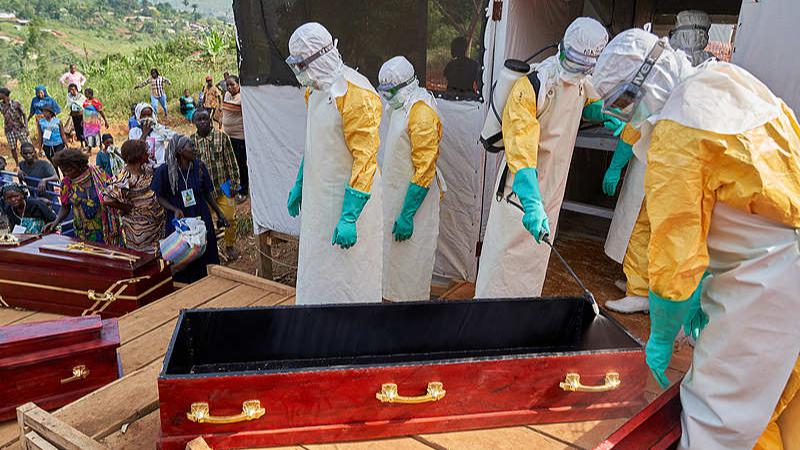
Hospital staff disinfect the coffin of an Ebola victim before returning it to his family in Ituri Province, Democratic Republic of the Congo, June 26, 2026. /CFP
The Democratic Republic of the Congo (DRC) has recorded 1,406 confirmed Ebola cases, including 438 deaths, as authorities intensify efforts to contain the outbreak concentrated in the country's conflict-affected eastern provinces.
Government figures show that 192 patients have recovered from the disease, while 609 others remain under treatment or medical care.
Health officials say response operations have been reinforced in the worst-affected provinces of Ituri, North Kivu and South Kivu, where surveillance, contact tracing and case management efforts have been expanded.
To strengthen containment measures, authorities have deployed additional vehicles and ambulances, increased the supply of medicines and personal protective equipment, and intensified public awareness campaigns and community mobilization initiatives.
The DRC declared the Ebola outbreak in mid-May. Since then, health authorities and international partners have warned that persistent insecurity, population displacement, overstretched health facilities and gaps in contact tracing continue to complicate efforts to halt the spread of the virus.
Amid growing concern over the outbreak, South African President Cyril Ramaphosa arrived in the Democratic Republic of Congo on a high-level African Union solidarity mission aimed at strengthening the continent's response to Ebola.
Ramaphosa, who serves as the African Union's Champion for Pandemic Preparedness, was expected to hold talks with Congolese President Felix Tshisekedi on enhancing regional cooperation, improving cross-border preparedness and accelerating outbreak containment efforts.
The visit underscores increasing efforts by African leaders to coordinate responses to public health emergencies, amid concerns that regional instability and population movements could further complicate efforts to bring the outbreak under control.
Health experts have emphasized that sustained surveillance, rapid response mechanisms and strong regional collaboration are critical to preventing further spread of the disease and bringing the outbreak to an end.