


Japanese Defense Minister Shinjiro Koizumi's recent visit to South Korea once again highlights the underlying dynamics behind the defense cooperation between the two countries. On the surface, the two sides discussed exchanges of aerobatic flight teams and defense technology cooperation. Beneath the surface, Tokyo's true objective is to gradually pull Seoul into its military cooperation network, opening a pathway through the Korean Peninsula for Japan's militarist push.
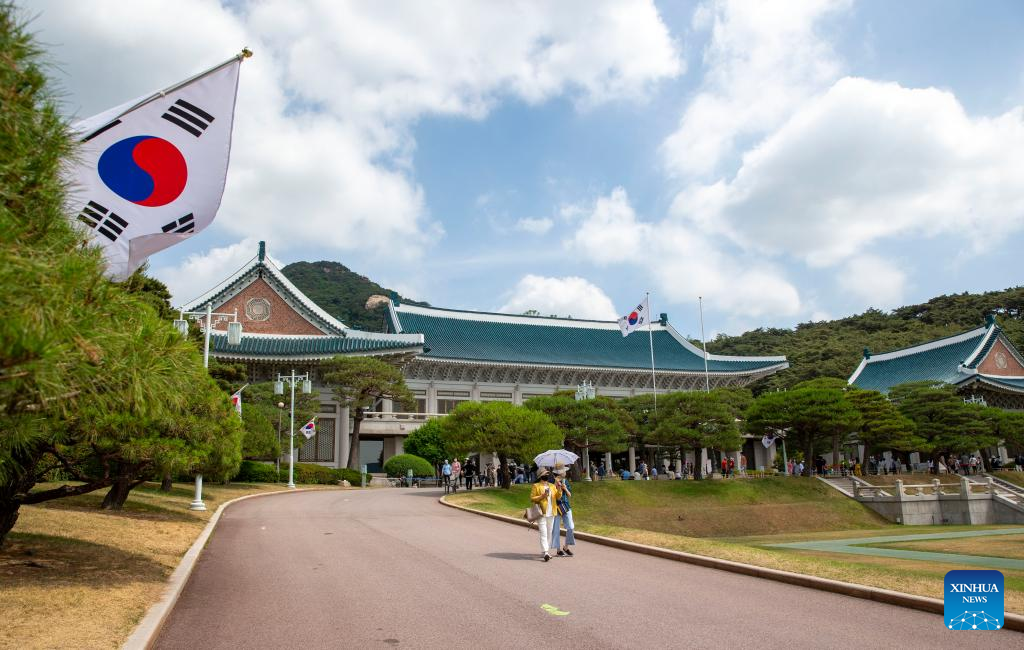
People visit the Main Office Building of Cheong Wa Dae in Seoul, South Korea, June 8, 2022. (Photo: Xinhua)
In recent years, Japan has revised three national security documents, developed "counterstrike capabilities," relaxed restrictions on arms exports and promoted military cooperation arrangements such as the Reciprocal Access Agreement (RAA) and the Acquisition and Cross-Servicing Agreement (ACSA) with countries including Australia, the UK and the Philippines. These are not ordinary defense modernization efforts for a normal country, but rather Japan's systematic military expansion against the backdrop of unresolved historical issues and the incomplete eradication of militarist thinking. Now, Japan has set its sights on South Korea as a key target and is making every effort to promote an ACSA.
The ACSA is by no means an ordinary technical agreement. It involves the core support capabilities required for military operations, including fuel, ammunition, food, transportation and maintenance. Once South Korea and Japan conclude an ACSA, it would mean that the two countries could establish an institutionalized mechanism for mutual logistical support in both peacetime and wartime. Then Tokyo is likely to continue pushing for an arrangement similar to the RAA to address the legal and procedural issues surrounding the entry of the Japanese Self-Defense Forces into the Korean Peninsula and surrounding areas.
The South Korean Air Force Black Eagles aerobatic performance team stopped at the Japan Air Self-Defense Force's Naha Air Base to refuel this year, which could be seen as a concrete rehearsal of military logistical interoperability between the two countries. During his visit, Koizumi also made a special visit to the Black Eagles unit, demonstrating Japan's intention to portray this as a "successful cooperation" and further promote the regularization of refueling support, exchanges between aerobatic teams and mutual logistical support.
No progress was made on the ACSA during this visit, but Japan will not give up. It sees the agreement as an institutional instrument for extending Japan's transformation into a major military power onto the Korean Peninsula. Second, it regards the agreement as an important step toward further strengthening trilateral military cooperation among the US, Japan and South Korea. Third, Japan hopes to use it to draw South Korea closer while driving a wedge between China and South Korea.
Japan also has a deeper political ambition: to use South Korea to "whitewash" its own military expansion. If South Korea accepts establishing high-level military cooperation with Japan, then Japan could claim that even an Asian victim state recognizes Japan's security role, and that accusations of Japanese militarism revival are "misunderstood" by the outside world. Therefore, the ACSA is not just a military issue but a historical issue, a political issue and a regional order issue. Once South Korea concedes on this matter, it may be used by Japan to cover up its true ambition of becoming a major military power.
Meanwhile, the South Korean government has its own calculations. It may seek to use the ACSA as leverage to obtain Japanese concessions on other issues, such as support for its accession to the G7 or the Comprehensive and Progressive Agreement for Trans-Pacific Partnership. It is also possible that South Korea hopes to enhance its own strategic value between Washington and Tokyo. However, such a strategy carries significant risks. If South Korea treats military cooperation with Japan as a bargaining chip, it may find itself locked into the regional military confrontation structure jointly shaped by Japan and the US, rather than gaining greater strategic autonomy.
Ultimately, what South Korea truly needs is strategic sobriety. South Korea should not become a springboard for Japan's defense expansion, nor should it become a fig leaf for Japan's military power ambitions.