


A mass funeral in Tehran for Iran's late Supreme Leader Ali Khamenei has become a test of Iran's diplomatic standing, as large public mourning and a mixed foreign turnout offered an early indication of how regional and international partners are positioning themselves after months of war launched by the US and Israel.
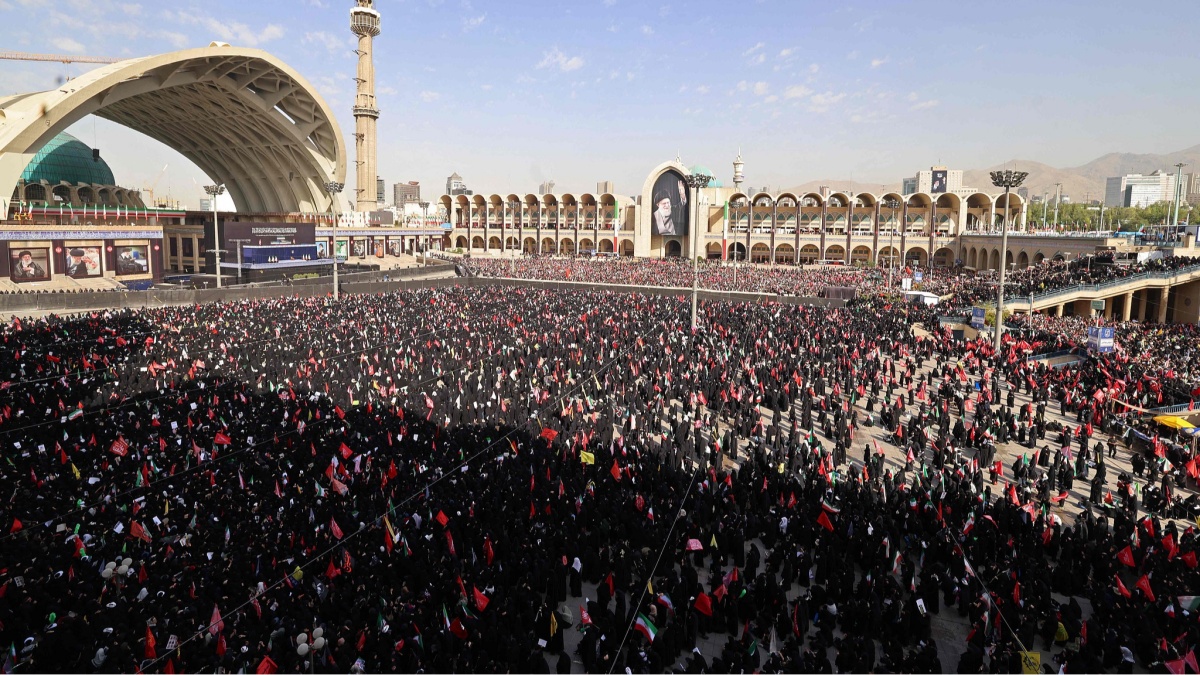
Mourners gather at the Grand Mosalla to pay their final respects to Iran's late Supreme Leader Ali Khamenei at the start of his funeral ceremonies in Tehran, Iran, July 4, 2026. /VCG
Khamenei, who led the Islamic Republic for more than three decades, was killed on February 28 in a US-Israeli airstrike during a wider escalation that pushed the region toward open conflict before a fragile ceasefire took hold. His death triggered a constitutionally mandated succession process, with his son Mojtaba Khamenei having assumed the role of Supreme Leader in March, though his public visibility has remained limited.
The week-long funeral ceremonies began on Friday in Tehran's Grand Mosalla, where the coffin was placed for public viewing before planned processions through key religious cities including Qom and Mashhad, with additional symbolic stops in Iraq's Shiite holy sites. Authorities have described the events as among the largest state funerals in Iran's modern history, with a domestic turnout expected to reach unprecedented levels.
Representatives from countries including China, Russia, Türkiye and several Gulf states such as Saudi Arabia, Qatar and Oman, attended parts of the ceremonies, alongside heads of state or government from Pakistan, Tajikistan, Armenia and Georgia. Western governments were largely absent, highlighting diplomatic divisions that have deepened since the conflict and years of sanctions on Tehran.
Wang Jin, director of the Center for Strategic Studies at Northwest University in China, said Iran's ability to bring together millions of mourners reflected continued internal cohesion and strong mobilization capacity through religious and political networks, even if its formal diplomatic isolation has not been fully overcome.
He said the presence of non-Western states showed that efforts to isolate Iran had not achieved their intended effect, pointing to sustained engagement from countries outside the Western bloc and to Iran's ability to maintain ties through a more multipolar international environment.
Regional dynamics have also shifted in ways that frame the funeral as more than a domestic political moment. In recent years, Gulf states have pursued a cautious rapprochement with Iran, including the China-brokered Saudi-Iran agreement in 2023, while several regional governments have prioritized economic stability and de-escalation over confrontation.
The funeral became one of the first major diplomatic gatherings since the conflict, offering a glimpse of how regional governments are managing ties with Tehran. Notable among those attending the event was Saudi Deputy Foreign Minister Waleed Al-Khuraiji, whose presence some media outlets described as unexpected after the Sunni kingdom came under repeated Iranian airstrikes during the US-Israeli conflict with Tehran.
Analysts say Al-Khuraiji's attendance suggested that the Saudi-Iran rapprochement has largely held, with Gulf states continuing to prioritize stability and dialogue despite recent military escalations.
"These developments reflect a broader shift toward pragmatic diplomacy in the Middle East, where states increasingly seek to balance relations rather than align exclusively with Washington," Wang said.
This gradual diversification of partnerships has coincided with a relative decline in US unilateral influence in the region, he added.
The funeral has also carried symbolic weight for Iran's internal politics, projecting continuity at a moment of leadership transition while signaling cohesion within its Shiite clerical establishment and allied networks. Even so, the funeral left open questions about how far Iran can expand its diplomatic relationships and what role it will play in a Middle East where regional powers are increasingly pursuing independent foreign policies.