


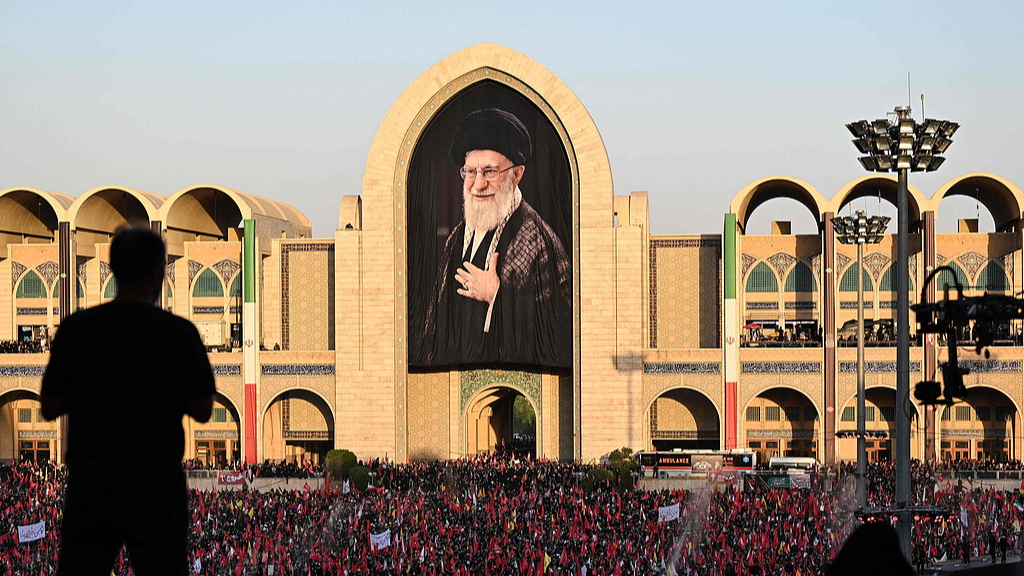
People gather to mourn Iran's slain Supreme Leader Ayatollah Ali Khamenei at the Grand Mosalla in Tehran, Iran, July 5, 2026. (Photo: VCG)
Massive crowds are expected on Monday for the funeral procession of late Iranian Supreme Leader Ali Khamenei in Tehran.
After lying in state in Tehran's Grand Mosalla religious complex for two days, Khamenei will be processed through the city for 10 to 12 hours starting at 6:00 a.m. (0230 GMT), organizers said.
Three sons of the late leader prayed beside his coffin and those of four other family members on Sunday, but Mojtaba, the son who succeeded him as Iran's supreme leader, did not make an appearance.
State TV showed Mostafa, Meysam and Masoud Khamenei praying behind the coffins. Their father, alongside several other members of the family, was killed in an air strike when the US and Israel launched attacks on Iran on February 28.
Crowds of Iranians, many weeping and some beating their chests, have thronged the Mosalla, including overnight. The Iranian metro railway network said it had clocked 7 million trips from late on Saturday to Sunday morning as people flocked to the center.
After the massive procession in central Tehran on Monday, the remains will be taken to the seminary city of Qom, the center of Iran's Shiite hierarchy, for ceremonies on Tuesday.
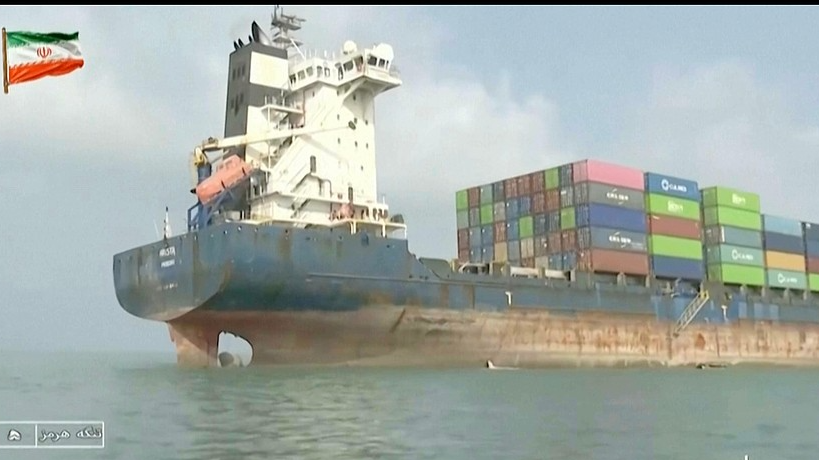
This frame grab of footage aired by Iranian state television shows a vessel that ran aground in the Strait of Hormuz, July 1, 2026. (Photo: VCG)
The broader Middle East conflict, which has caused widespread death and destruction across the region, remains on pause under a fragile ceasefire and an initial agreement reached with the United States.
US President Donald Trump told the Axios news website that peace talks had been paused for one week to accommodate events surrounding the funeral.
Meanwhile, Iranian negotiators reiterated that safe passage through the Strait of Hormuz would be permitted only via routes designated by Tehran. Iran is also seeking to impose transit fees on vessels passing through the strategic waterway.
Data released on Sunday by the US-led Joint Maritime Information Center showed that a total of 70 commercial vessels transited the Strait of Hormuz between July 2 and July 4, significantly below the pre-conflict daily average of 138 vessels.
Separately, Israeli Transportation Minister Miri Regev told Army Radio on Sunday that Israel had deployed an Iron Dome air defense battery to the United Arab Emirates during the early stages of the US-Israel-Iran conflict. Regev is the first Israeli official to publicly confirm the deployment of the missile defense system to the UAE, although US officials had previously acknowledged the move.
In southern Lebanon, the Israeli military said on Sunday that it carried out an air strike targeting a Hezbollah militant cell. According to the military, the militants' activities posed a threat to Israeli forces, prompting the strike.
The incident occurred despite a recently reached framework agreement between Lebanon and Israel aimed at ending hostilities along their shared border.