


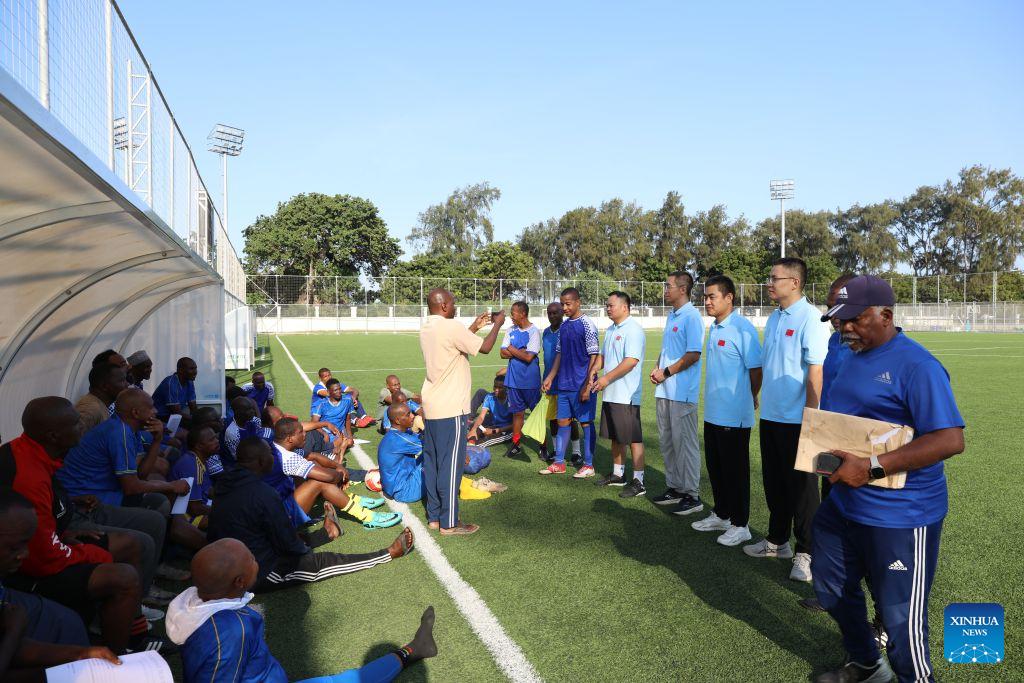
Chinese medical team members introduce sports injury prevention and healthy living knowledge to members of the Zanzibar Old Stars Football Club before a friendly football match in Zanzibar, Tanzania, July 5, 2026. (Photo: Xinhua)
ZANZIBAR, Tanzania, July 6 (Xinhua) -- On Sunday, as the late afternoon sun cast long shadows across a dusty football field on Zanzibar's Unguja Island, laughter, cheers and the rhythmic thud of a ball echoed through the air.
But this was no ordinary match. On one side stood seasoned football veterans of Zanzibar Old Stars Football Club, many carrying decades of experience and old injuries. On the other were unlikely teammates, doctors from China, dressed not in white coats but in football kits.
What unfolded was more than a friendly match. It was a vivid story of healing, shared passion and cultural connection, where medicine met sport, and strangers became friends.
Earlier that day, the 35th Chinese medical team in Zanzibar had gathered with members of Zanzibar Old Stars Football Club for a special health education session focused on sports injuries and healthy living. The initiative aimed to address a growing concern among aging athletes while fostering deeper people-to-people ties between China and Tanzania.
Football holds a unique place in Zanzibar's social fabric. It is more than a game, it is identity, tradition, and community. From crowded neighborhood pitches to organized competitions, the sport binds generations together. For the men of Zanzibar Old Stars, football is also memory, a reminder of youthful glory and national pride.
Founded in 1998 and officially registered by the Zanzibar government, the club brings together 97 former players aged 40 and above, many of whom once competed in top-tier leagues and represented the national team. Today, they continue to play for passion, but often at a physical cost.
"Muscle strains, joint pain and lingering injuries are common among our members," explained Abdulkadir Mohamed Tashi, 53, a former national team player and now secretary general of the club. "We love the game, but as we age, it becomes harder to play without proper guidance."
Recognizing these challenges, local medical professional Hassan Mkoko Hassan invited the Chinese medical team to provide expert advice and practical solutions. The response was immediate.
Led by team leader Bao Zengtao, a group of five specialists arrived with a mission to combine clinical expertise with community outreach in a way that would resonate with local needs. The team included Wang Kunpeng, Yuan Gang, Zhang Shuxian, and Zhou Fang.
Standing before a group of attentive players seated on wooden benches, Bao began with a message that blended science with empathy.
"Football is a wonderful sport, but it must be practiced safely," he said. "Hydration, proper warm-up and awareness of one's physical condition are essential, especially for older athletes."
His words struck a chord. Many players nodded in agreement, recalling times they had rushed onto the field without preparation, only to leave with injuries that lingered for months.
The session quickly evolved into an interactive exchange. Doctors demonstrated stretching techniques, explained the importance of balanced nutrition, and provided step-by-step guidance on handling common injuries such as sprains and muscle tears.
For many participants, it was the first time they had received structured education on sports health.
"I have been playing football for over 30 years, but no one ever taught us how to protect our bodies," said one veteran player. "Today, I learned things that will help me play longer and avoid unnecessary pain."
Particular attention was given to conditions affecting older players, including joint degeneration and chronic muscle strain. Zhou Fang introduced rehabilitation exercises rooted in traditional Chinese medicine, emphasizing gentle movement and consistency.
Players were especially intrigued by the integration of modern and traditional approaches. Some attempted the exercises on the spot, laughing as they tried unfamiliar movements, but clearly appreciating the effort.
Beyond theory, the medical team provided hands-on support. They conducted basic health checks, listened to individual concerns, and offered personalized advice. For players who had endured years of untreated injuries, this was a rare and valuable opportunity.
"One of our teammates has struggled with knee pain for years," Tashi said. "Today, he received a rehabilitation plan tailored to his condition. That kind of attention makes a big difference."
The impact extended beyond physical health. The session also opened a window into a broader concept: scientific exercise. By understanding how the body works and how to prevent injury, players began to see football not just as a passion, but as a lifelong activity that requires care and knowledge.
As the formal session concluded, the atmosphere shifted from classroom to playground. Boots replaced notebooks, and the field came alive.
The friendly China-Zanzibar football match that followed was spontaneous, energetic and deeply symbolic. Mixed teams of doctors and local players took to the field, breaking down barriers of language, profession, and nationality.
Passes were exchanged with enthusiasm, tackles softened by laughter. At one moment, a Chinese doctor sprinted down the wing, cheered on by teammates shouting in a mix of Kiswahili and English. At another, a veteran player executed a precise pass that drew applause from both sides.
In that shared space, differences faded. What remained was a universal language, football.
"Sport knows no borders, and friendship knows no distance," Bao said after the match, smiling as he wiped sweat from his face. "Today, we didn't just share knowledge. We shared joy."
For Tashi, the day carried profound meaning.
"We are very pleased that the medical experts came to advise us on health matters," he said. "As former athletes, maintaining good health is essential, and such guidance is invaluable."
As the sun began to set, players gathered once more-not for a lecture, but for reflection. Conversations flowed easily, with doctors and players exchanging stories, advice and even jokes.
And as the final whistle of the day faded into the evening breeze, one thing became certain: the bond formed on that field would endure far beyond a single match.
In the simple act of playing football together, doctors and veterans had built something lasting, a bridge of friendship, understanding, and shared humanity.
It is a reminder that sometimes, the most powerful connections are forged not in conference rooms or clinics, but on open fields, where passion meets purpose, and every pass tells a story.