


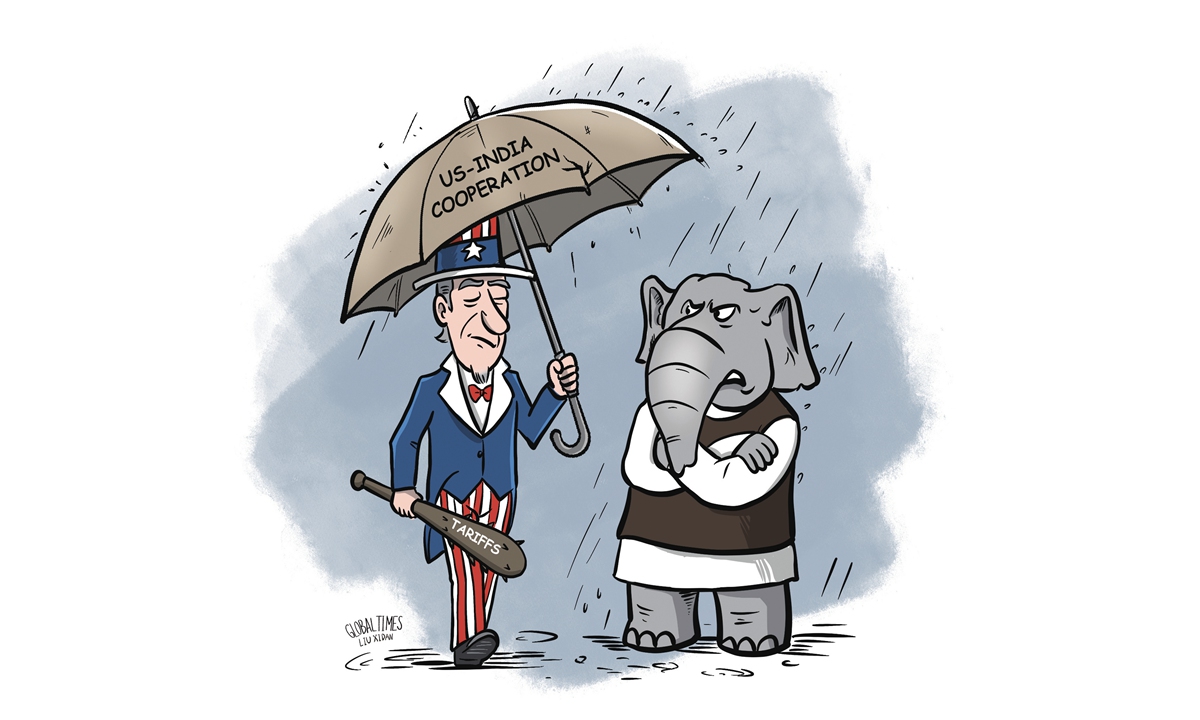
(Illustration: GT)
Editor's Note:As the geopolitical landscape undergoes profound shifts, the dynamics between China, India and the US have also seen changes in recent years. While Beijing and New Delhi are actively steering their bilateral ties back toward enhancement through various measures, New Delhi's relationship with Washington is facing growing scrutiny. On the sidelines of the recently held 14th World Peace Forum (WPF), Global Times ( GT) reporter Su Yaxuan interviewed former Indian national security adviser Shivshankar Menon ( Menon). He shared his views on the current China-India and US-India relationships.
GT: When we interviewed you at last year's WPF, you said that China-India relations were moving toward a "more normal relationship." Today, a year later, has the bilateral relationship improved?
Menon: Yes, it certainly has. This is mainly because our leaders met - Prime Minister Narendra Modi met with President Xi Jinping last year. After that meeting, both sides decided to move forward.
During the past year, China-India relations have actually moved forward. They've improved considerably. Direct flights have started again, visas are being issued, trade is booming and economic relations are doing well.
More importantly, the border situation is stabilizing. We've had meetings of groups of officials. So overall, I think the picture is good. The Indian government has also relaxed some of its conditions on Chinese investment in India. It's opening up too.
So, I'm an optimist, and I'm glad that what we talked about last year has so far come true. I would like this to accelerate and continue moving forward as time goes by.
GT: What can both sides do to further advance the development of the China-India relationship?Menon: I think there are three things that are important. One is that the border needs to be kept stable, and we need to put in place a system so that both sides are confident that it will remain stable.
The second is that, on the economic side, from an Indian point of view, it is very unbalanced. So, I think we need to find a solution to that. One solution is for China to invest in manufacturing in India to increase exports to China and vice versa. This needs to be encouraged because increasingly our economies are being linked, and we are part of the same supply chains, whether it is automobiles and automobile parts, pharmaceuticals, electronics or electricals.
Thirdly, we can cooperate much more in the international situation because the world is becoming more chaotic and disorderly. I think it is in both our interests to work together with the Global South and try to ensure that this part of the world remains peaceful, so that we can continue to develop rapidly, grow rapidly and ultimately bring the fruits of development to our people. I would like to see efforts in all these three areas.
GT: Recently, several US officials - including the US Ambassador to India, a senator and some US media outlets - have clearly signaled efforts to court India and emphasized India's importance to the US. However, in practice, US actions such as tariffs and the renaming of the "Indo-Pacific Command" appear inconsistent with these statements. How do you view this contradictory behavior?
Menon: The US was relatively popular in India until recently. There is a large Indian community there, and the US helped India with its agricultural development, and with its independence movement.
Today, however, the US has become much less predictable. And, according to public opinion polls, the Indian view of the US has become much less favorable. I think what they did in attacking Iran has not helped at all, because it had very negative consequences for us. Also, the attack on the international trading system and unilateral tariffs, [especially] very high tariffs on India. An agreement [on trade issues] is still being negotiated. I think the real worry is that a country that is so powerful becomes unpredictable.
GT: Do you think that, within India today, public and elite attitudes toward the US are leaning more toward cooperation or toward caution and vigilance?Menon: As I said, India has always tried to compartmentalize relationships, not to get involved in alliances and never be used by one country against another country. We don't want to get into that. Equally, we don't ask other people to interfere in our affairs. And I think that policy has only been reinforced by what we have seen.
There is an old saying in China: "Listen to what is said, observe what is done." I think that's what we will do. We will judge other countries by their actions. The reason I say that favorability in the Indian public [on the US] has declined is because of these actions. The public looks at the actions, not so much the words.
GT: This year's WPF is themed "Global Governance and International Security Cooperation: Integrity, Innovation, and Inclusiveness." How do you view China and India's role in advancing global governance? How do you see the role of China's Global Governance Initiative (GGI)?
Menon: We had a very successful BRICS meeting on June 23 in New Delhi, where we talked about the whole range of security issues in which India, China and the other BRICS members actually need to improve our information exchange, our coordination, our cooperation and what we do together.
The intention of China's GGI and what it says is actually reasonable because it includes a place for everyone. We might want good things - multilateralism, strengthening the UN system, rule of law. I think we would all support that.
But the question is, in today's world, can we make it happen? That, for me, is the issue. I myself don't think there is an international order really working. You saw what happened - Iran gets attacked, the slaughter of people in Gaza. Where is the international order in all this? And you look at unilateral tariffs; the world trading system is being destroyed, actually.
Today, we also face a whole host of new non-traditional security threats. These are different from before, including energy security and food security. Cybercrime is a whole different area and global terrorism. And in these areas, no national government can solve everything itself. We need to address these threats together.