


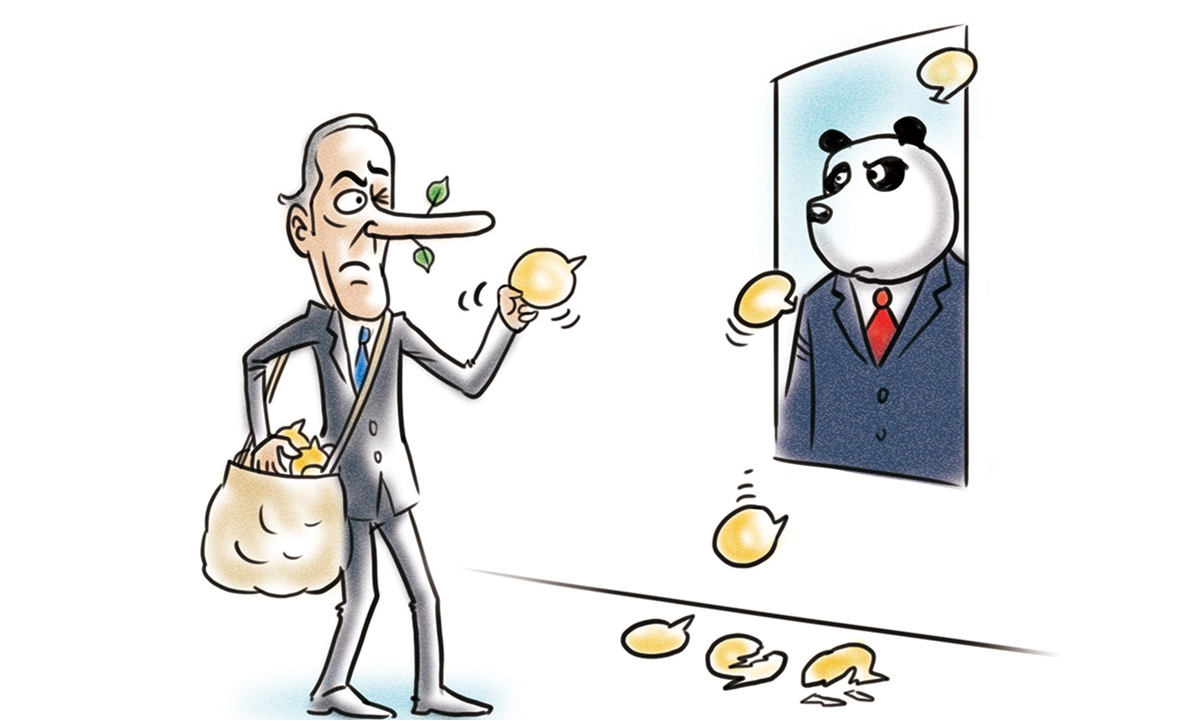
Western smear (Illustration: GT)
On July 1, when China's new Ethnic Unity and Progress Promotion Law took effect, CNN ran a story under the headline: "China tells its ethnic minorities to integrate or face consequences with sweeping new unity law." Several words in, the law's meaning had already been rewritten.
The Chinese term at the heart of the statute is tuanjie - unity. The law's very name puts unity first: Equal standing among all ethnic groups, bound together through mutual respect and reciprocity, like pomegranate seeds clinging together - each distinct, all connected. That is the image Chinese officials use. It reflects decades of policy: bilingual education, protected minority-language broadcasting, preferential university admissions and formal autonomy arrangements in regions from Inner Mongolia to Yunnan.
In CNN's headline, unity became "integrate." In Western political vocabulary, that word rarely describes a two-way process. It implies the opposite: a minority adjusting itself to a dominant culture, with differences smoothed away until they disappear.
Worse than the word choice was the sentence structure. "China tells... to integrate or face consequences" borrows the grammar of command and threat - the same construction you'd use for an ultimatum. A law built around subsidies, language preservation programs and institutional guarantees was reframed, in a single headline, as a warning: "Assimilate or be punished."
This wasn't a translation slip. It was a deliberate substitution, and it wasn't confined to one outlet. Across US and European coverage of the law, "unity" was consistently rendered as "integration" or, more pointedly, "assimilation" - a term carrying far heavier baggage than either "unity" or even "integration."
That baggage is the real reason for the word choice. In US and European history, "assimilation" is not a neutral term - it's shorthand for specific, documented harms: the forced removal of Indigenous children from their families and languages, the residential school systems, and the coercive cultural stripping imposed on colonized peoples.
When Western reporters reach for "assimilation" to describe Chinese policy, they are mapping their own historical guilt onto a different country and a different set of institutions. The word carries a verdict before any evidence is presented.
There's a simpler explanation, too: Many Western newsrooms lack a vocabulary for multiethnic cohesion that isn't rooted in their own colonial or civil rights history. English has few settled terms for state-led minority integration that don't carry these associations. So "unity" gets processed through the only available frame, one built for a different history.
But there's also something more deliberate at work. Coverage of China's ethnic-minority regions rarely engages with the actual substance of policy - education access, healthcare expansion, infrastructure or language documentation programs. Instead, it gravitates toward a fixed set of terms: "forced," "assimilation," "crackdown." These frames were established well before this law existed; the law was slotted into a narrative already in place.
A stable, cohesive China unsettles a broader argument some outlets are invested in: that the Western liberal model is the only legitimate path to managing diversity. If a different model - one built on unity as the precondition for protection rather than an alternative to it - produces functioning results, that argument becomes harder to sustain.
There is a real trade-off worth naming honestly: Unity-first governance and rights-first liberal pluralism are different frameworks with different priorities, and reasonable people can debate which better serves minority welfare in which contexts. That debate deserves scrutiny, including of China's record. But it should start from what the law actually says and does, not from a headline that swapped one word for another and let the rest write itself.
The measure of "unity" here isn't a slogan - it's whether children in Xinjiang or Xizang autonomous regions are in school, whether elderly herders in Inner Mongolia have access to healthcare, and whether minority languages are well protected. These outcomes represent tangible results that deserve firsthand observation and appreciation. What isn't debatable is that a law about promoting equality was reframed as a threat through translation.
It once again demonstrates that the West's understanding of China and Chinese modernization remains confined within its cognitive framework, which is also one of the reasons why China is often perceived as a threat.
The author is a senior editor with the People's Daily and currently a senior fellow with the Chongyang Institute for Financial Studies at Renmin University of China.