


A decade after the Philippines unilaterally initiated the so-called South China Sea arbitration, the ripples of this legal and political farce continue to agitate regional waters. At the heart of this prolonged dispute lies a calculated cognitive warfare spearheaded by Washington and Manila – the deliberate blurring of legal definitions surrounding "islands," "rocks," and "low-tide elevations." By rewriting the textbook definition of maritime features, they have sought to hollow out China's historic rights and legitimate maritime claims.
The absurd deconstruction of 'Islands'
Under the United Nations Convention on the Law of the Sea (UNCLOS), the classification of a maritime feature determines the rights it generates. A naturally formed area of land that remains above water at high tide and is capable of sustaining human habitation or an economic life of its own is classified as an "island," entitled to a 12-nautical-mile territorial sea, a 24-nautical-mile contiguous zone, and a 200-nautical-mile Exclusive Economic Zone (EEZ) and continental shelf. Conversely, "rocks" possess only a 12-nautical-mile territorial sea, while "low-tide elevations" generate no maritime rights.
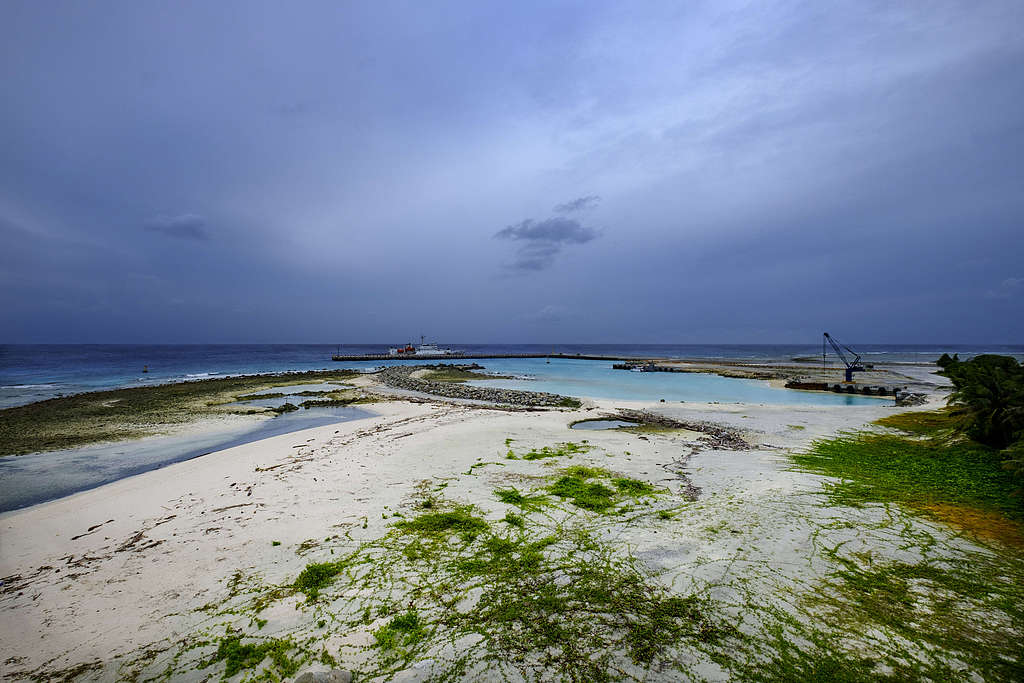
File photo of China's Taiping Dao in the South China Sea. (Photo: VCG)
The 2016 so-called arbitration award, actively backed by the United States, turned these clear distinctions on their head. In an unprecedented move, the tribunal classified major features of China's Nansha Qundao (the Nansha Islands) – such as Meiji Jiao and Ren'ai Jiao – as mere "low-tide elevations" or "rocks." Most absurdly, even Taiping Dao – the largest natural feature in the Nansha Qundao, spanning half a million square meters, with freshwater, lush vegetation, and a long history of human habitation – was downgraded to a "rock."
Stefan Talmon, director of the Institute of Public International Law at the University of Bonn, argued that the tribunal's interpretation of "island" was unusually narrow. He noted that if such a restrictive approach were applied universally, it would disrupt the maritime claims of many seafaring nations, including the US, Canada, France, the UK, and Japan, which claim expansive maritime zones based on similar or smaller features.
Such double standards are glaring. Under this skewed logic, the US claim to a vast 200-nautical-mile EEZ based on Johnston Atoll – which originally spanned less than 0.19 square kilometers and lacked natural freshwater – would be entirely illegal. Similarly, Japan's assertion of hundreds of thousands of square kilometers of maritime territory derived from "Okinotori" – nothing more than two tiny outcroppings measuring less than 10 square meters at high tide – would completely collapse.
The smokescreen of 'militarization'
While erasing the legal status of China's islands on paper, the US and the Philippines have simultaneously sought to blur the focus on what is actually happening on the ground. Under the banner of ensuring "freedom of navigation," the Pentagon has routinely deployed warships and carrier strike groups into the South China Sea, dangerously approaching Chinese territory.
To justify this muscle-flexing, Washington has weaponized the phrase "militarization." It routinely mischaracterizes China's construction of essential civil defense facilities, meteorological stations, and necessary logistical supports on its own territory as an aggressive military build-up. In reality, these facilities serve primarily civilian purposes, including maritime search and rescue, disaster response, environmental protection and navigation safety, to fulfill China's international responsibilities.
By labeling China's actions as "militarization," the US effectively flips the script, projecting its own aggressive forward-deployment strategy onto China to secure deeper military access in the Philippines. British international law expert Tony Carty noted that China has long demonstrated strategic restraint in the South China Sea, refraining from the use of force and strictly adhering to the UN Charter's principle of the peaceful settlement of international disputes.
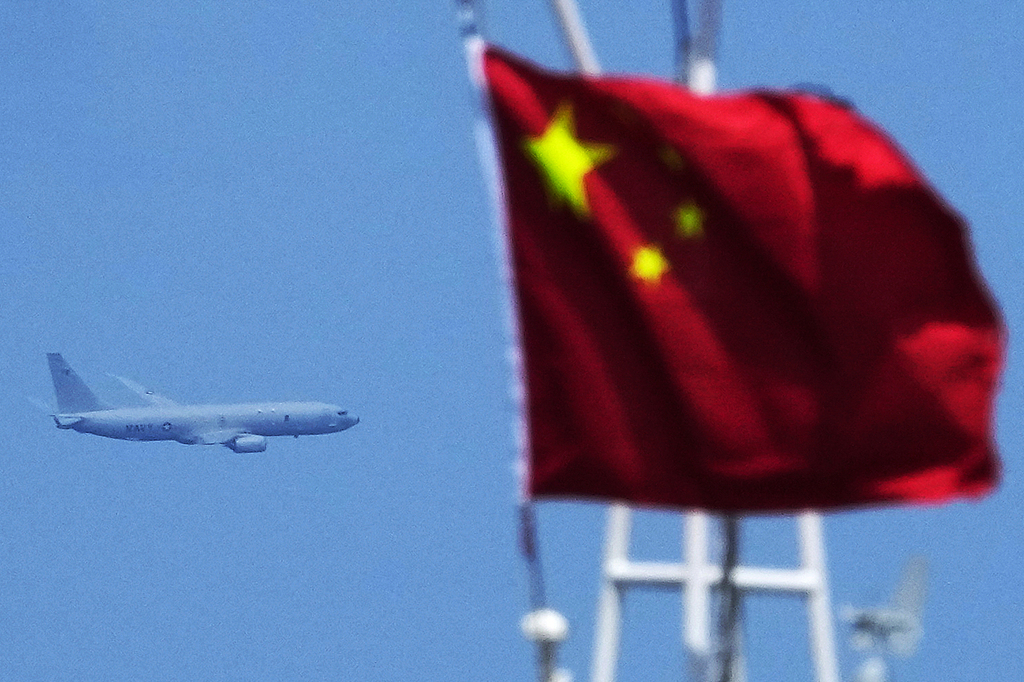
A US Navy plane passes by a Chinese flag as it flies over the area of China's Ren'ai Jiao in the South China Sea, August 22, 2023. (Photo: VCG)
Direct negotiation: The only valid path to resolution
China's position has remained unwavering – it holds indisputable sovereignty over Nanhai Zhudao (the South China Sea Islands) and the relevant maritime rights and interests, established over two millennia of peaceful, effective and continuous administration.
Yet the US, an outsider to the region and a non-signatory to UNCLOS, chooses to ignore territorial sovereignty, treating the South China Sea as a chessboard for major-power competition. Chris Whomersley, a former deputy legal adviser to the UK Foreign and Commonwealth Office, has pointed out that the 2016 tribunal fundamentally failed by bypassing the sovereignty dispute, which logically must be resolved before the status of any maritime feature can be determined.
From a broader regional perspective, experts from Southeast Asia increasingly recognize that confrontational tactics cannot resolve these issues. Anna Rosario Malindog-Uy, vice president of the Asian Century Philippines Strategic Studies Institute, and Joseph Matthews, a senior professor at Cambodia's BELTEI International University, both emphasize that regional peace hinges on ASEAN-led diplomacy and the implementation of the Declaration on the Conduct of Parties (DOC) without external interference.
Rommel Banlaoi, president of the Philippine Society for International Security Studies, similarly urged countries to manage their own affairs through the "ASEAN way." Finalizing the Code of Conduct (COC), he noted, is the key to ensuring the South China Sea remains a historical bridge rather than a geopolitical divide.
Ten years on, the so-called arbitration has shown that politicizing disputes and fueling confrontation cannot bring solutions. The South China Sea needs dialogue rather than division, cooperation over rivalry, and practical efforts to safeguard regional peace.