


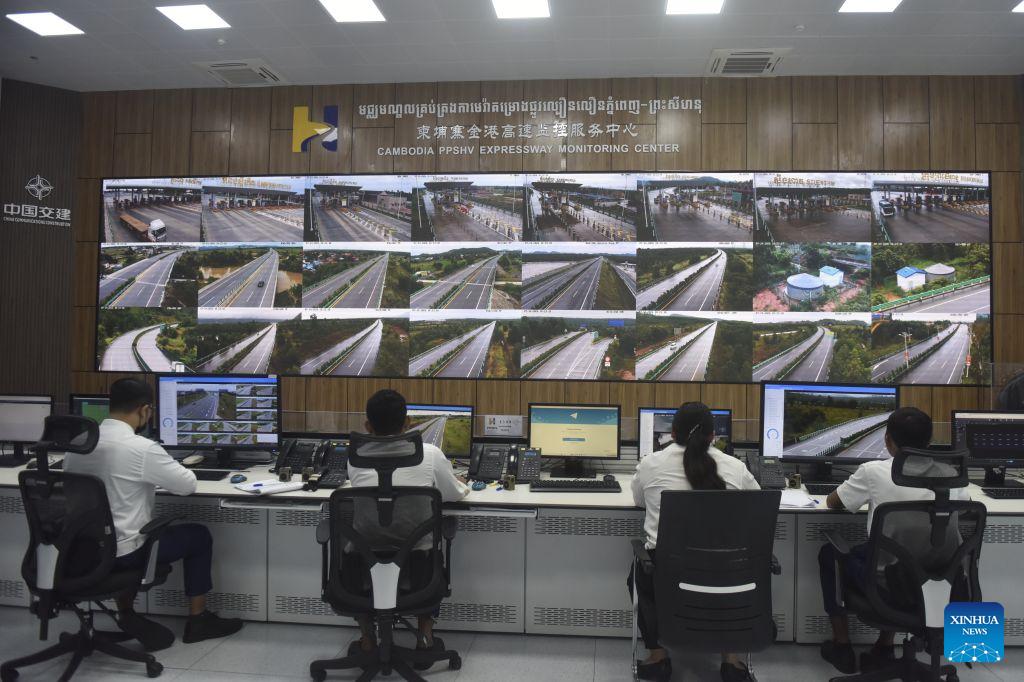
Staff members work at the monitoring center of the Phnom Penh-Sihanoukville Expressway in Phnom Penh, Cambodia, on July 14, 2026. The Chinese-invested Phnom Penh-Sihanoukville Expressway has not only enhanced travel and freight efficiency, but has also become a platform for promoting road safety in Cambodia.(Photo: Xinhua)
PHNOM PENH, July 15 (Xinhua) -- The Chinese-invested Phnom Penh-Sihanoukville Expressway has not only enhanced travel and freight efficiency, but has also become a platform for promoting road safety in Cambodia.
The 187-km expressway, which has been open to the public since October 2022, connects the capital Phnom Penh and the deep-sea port province of Preah Sihanouk.
Sambo Pagna Sirisiddh, a road safety controller for the Phnom Penh-Sihanoukville Expressway, said he is proud to work on the expressway because it allows him to serve the Cambodian people.
"As this is Cambodia's first expressway, I am pleased to promote road safety education to our citizens regarding its proper use," he told Xinhua during an interview at the expressway's headquarters in Phnom Penh on Tuesday.
Sirisiddh, 31, said that he was very happy to help provide training and raise public awareness about safe driving on the expressway.
"Since the expressway opened to traffic nearly four years ago, Cambodian drivers have shown a greater awareness of road safety by obeying traffic laws, speed limits, and lane discipline," he said.
He said that to drive safely on the expressway, drivers must check their vehicles thoroughly and set their destinations in advance; they cannot make U-turns, as the expressway consists of divided one-way lanes.
The 2-billion-U.S.-dollar Phnom Penh-Sihanoukville Expressway was funded by the China Road and Bridge Corporation (CRBC) under a build-operate-transfer (BOT) model.
Paved with asphalt concrete, the freeway features two traffic lanes in each direction alongside emergency shoulders, slashing travel times to just two hours compared to the five hours required via National Road 4.
Deap Muykeang, a supervisor at the Phnom Penh-Sihanoukville Expressway Monitoring Center, said his center manages four primary functions: monitoring road cameras, coordinating emergency commands, overseeing toll stations, and operating the 1399 hotline.
"For example, when clients contact our center regarding car breakdowns, flat tires, or accidents, the camera center informs the relevant station units to dispatch assistance," she told Xinhua. "I am thrilled to work on the Phnom Penh-Sihanoukville Expressway, as it is the first expressway in Cambodia."
Muykeang, 27, said the Cambodian PPSHV Expressway Co., Ltd., which is the operator of the expressway, has regularly trained staff members on how to monitor cameras, handle roadside emergencies, and manage the 1399 hotline.
"I am proud to contribute to this expressway project, which drives Cambodia's economic growth, boosts tourism, and delivers tangible benefits to local communities," she said.
"I encourage people to take the expressway because it saves time and money," she added.
Last month, the Cambodia Traffic Safety Education and Training Center was launched, with the Cambodian PPSHV Expressway Co., Ltd. authorized to operate and manage it.
The center ushers in a new era of professional, systematic traffic safety education and training for expressway users in the Southeast Asian nation. ■

Staff members work at the monitoring center of the Phnom Penh-Sihanoukville Expressway in Phnom Penh, Cambodia, on July 14, 2026. The Chinese-invested Phnom Penh-Sihanoukville Expressway has not only enhanced travel and freight efficiency, but has also become a platform for promoting road safety in Cambodia.(Photo by Vanpov/Xinhua)