


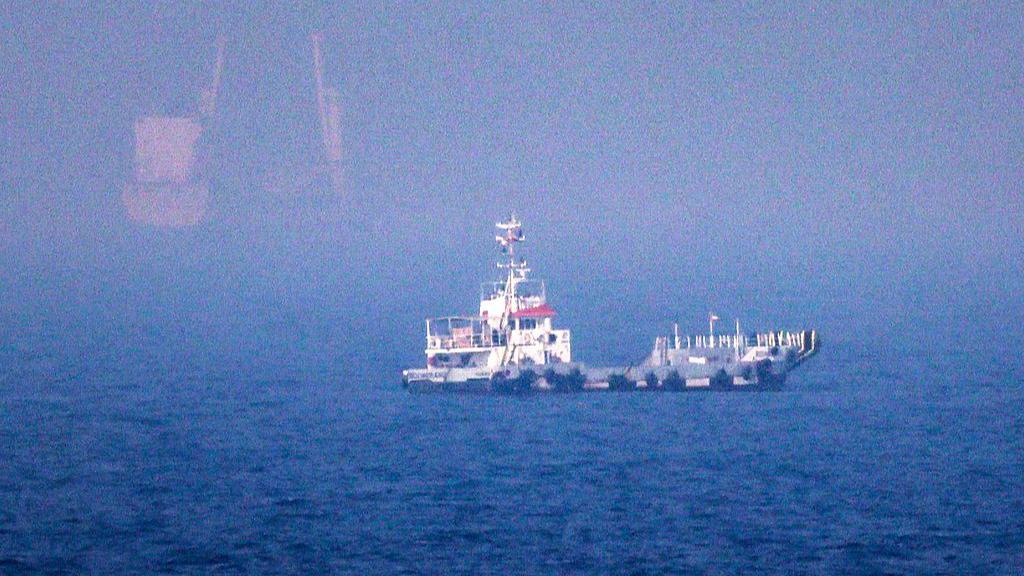
Ships sail near the Strait of Hormuz off the eastern coast of the United Arab Emirates at Khor Fakkan, July 13, 2026. (Photo: VCG)
The United States launched another wave of strikes against Iran on Wednesday, deepening a military campaign that has already drawn attention over its escalating financial burden, with some reports estimating the cost could reach $80 billion to $100 billion.
US Central Command (CENTCOM) said the latest strikes targeted Iranian military capabilities linked to threats against commercial vessels passing through the Strait of Hormuz, as tensions between Washington and Tehran continued to intensify.
"At 3 p.m. ET (1900 GMT), US forces launched operations for a second wave of strikes today against Iran," the command said in a post on X. "The strikes are targeting Iranian military capabilities used to threaten vessels freely transiting through the Strait of Hormuz."
Earlier on Wednesday, CENTCOM said it had launched the first wave of strikes at 6 a.m. Eastern Time (1000 GMT). During the 90-minute operation, US forces used precision munitions against coastal defense systems as well as cruise missile storage and launch sites on Greater Tunb Island.
The latest strikes came as the US military continued enforcing a maritime blockade targeting vessels traveling to and from Iranian ports and coastal areas.
CENTCOM said it had disabled an empty oil tanker, the M/T Belma, after the vessel allegedly ignored multiple warnings while attempting to travel through international waters toward Iran's Khark Island.
According to the command, a US aircraft fired a Hellfire missile at the vessel, leaving it unable to continue sailing toward Iran. CENTCOM said that since the maritime restrictions were reinstated at 4 p.m. Eastern Time on July 14, US forces had redirected two commercial vessels that complied with the restrictions and disabled one vessel that refused to follow the orders.
The US military said it would maintain vigilance and continue enforcing the blockade.
Growing scrutiny over military spending
While the US has expanded its military operations against Iran, the financial cost of the campaign has become a source of increasing concern in Washington.
Some US reports, citing internal assessments, said the actual cost of the military operation could range between $80 billion and $100 billion, far exceeding the $31 billion figure previously released by the US government.
The reported gap was attributed to factors including undisclosed operational expenses, losses of advanced aircraft and damage to US military facilities in the Middle East. The reconstruction of bases damaged in Iranian strikes alone could cost more than $30 billion, according to the reports.
The lack of transparency over wartime spending has triggered criticism from some lawmakers, with several members of Congress urging the Pentagon to provide a clearer account of the costs.
US Senator Angus King said Americans were frustrated by the inability to understand the full financial impact of the conflict, including its potential effects on domestic costs such as fuel prices.
The Pentagon, facing budget pressure, has reportedly requested an additional $68 billion in funding. However, congressional support for the request has weakened amid concerns over the unclear scale of spending.
Iran reports casualties, vows response
Iran said US strikes in July had caused at least 35 deaths and more than 300 injuries, according to an Iranian official in the Health Ministry.
The casualties included two women and one minor, while 72 injured people remains hospitalized, he said.
Iranian authorities said Hormozgan Province, Sistan and Baluchestan Province, and Khuzestan Province were among the areas most severely affected by the attacks.
The United States has said its military operations were launched in response to Iranian attacks targeting commercial shipping through the Strait of Hormuz. US officials said President Donald Trump had convened a meeting in the White House situation room on Tuesday to discuss possible further military action against Iran, describing future operations as potentially broader than the current campaign.
Meanwhile, explosions were reported near a US military base in Kuwait late Wednesday. Initial assessments indicated possible damage to US equipment and personnel, while Iranian sources said military operations against related targets were continuing.
Iranian Foreign Ministry spokesman Esmaeil Baghaei said Tuesday that Iran's armed forces had demonstrated that any violation of Iranian territory would face a response.
Baghaei said Iran currently had no plans for negotiations and was focused on defense. He added that the memorandum of understanding signed with the United States was based on mutual commitments, and Iran would no longer abide by the agreement if the other side violated its obligations.
Iranian Parliament Speaker Mohammad Baqer Qalibaf said Wednesday that Washington seeks to strike Iran whenever possible to advance its own interests, urging Tehran to formulate its policies based on national interests, security considerations, realism and long-term strategy.
He noted that Iran does not welcome war, "but we always must be ready for battle" to safeguard national security and interests. Qalibaf added that diplomacy and negotiation should be pursued in parallel to ensure the national interests.
Regarding the memorandum of understanding signed with the United States on June 18, which included a 60-day negotiation period for a final agreement, Qalibaf said the document would only remain meaningful if its commitments were respected and implemented.
Strait of Hormuz emerges as center of confrontation
As escalation continues, the conflict is increasingly moving beyond a cycle of retaliation and toward a broader struggle over control of the Strait of Hormuz.
Many of the locations targeted by US strikes in recent days, including Bandar Abbas, Kish Island and Sirik, are located near the strategic waterway and play important roles in Iran's maritime transportation, energy exports and military deployment.
At the same time, Iran has sought to strengthen its control over traffic through the Strait of Hormuz. Iranian officials have said that under wartime conditions, Tehran has the ability to control passage through the waterway and will not allow it to be used for actions threatening its national security.
Analysts said the Trump administration appears to believe that maximum pressure could force Iran to make concessions. However, Tehran's past responses suggest that intensified external pressure could also strengthen its willingness to take countermeasures.
More Iranian political figures said that expanded US military operations, renewed sanctions and the maritime blockade have undermined the foundation of the earlier agreement with Washington and the memorandum has effectively lost the conditions necessary for implementation.