


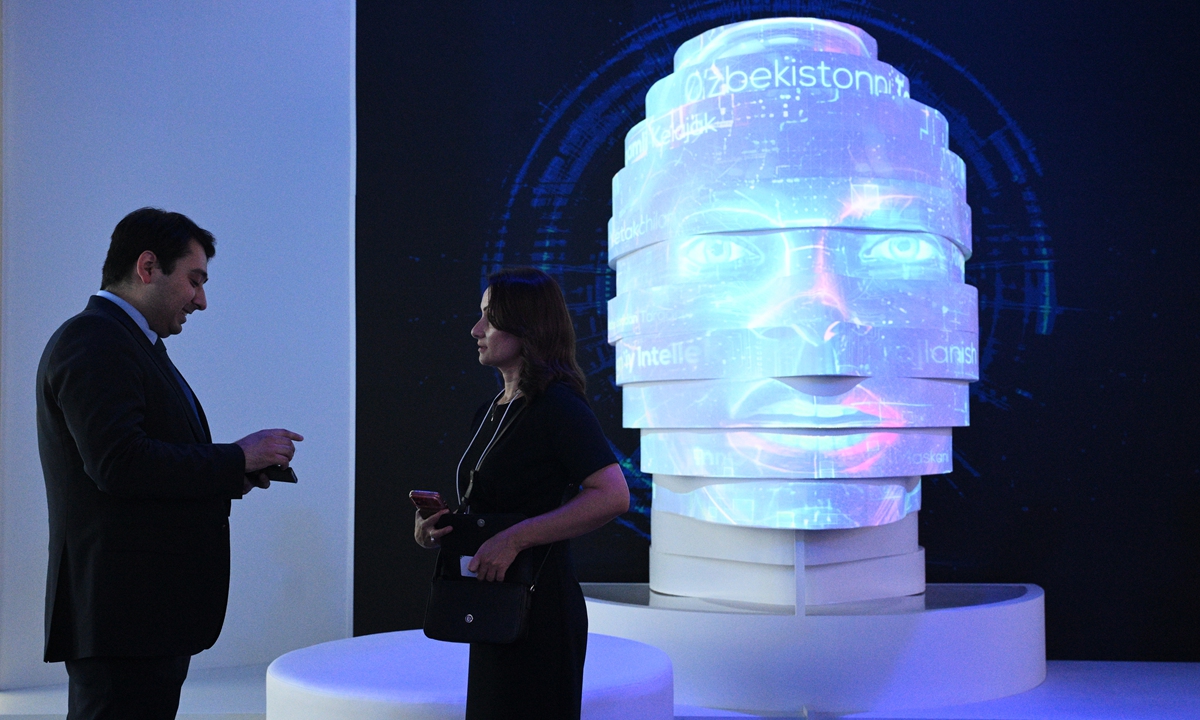
Participants attend the 5th Tashkent International Investment Forum (TIIF-2026) at the Central Asian Expo Uzbekistan in Tashkent, Uzbekistan, on June 16, 2026. (Photo: VCG)
In today's Uzbekistan, what could possibly bring a budding 17-year-old entrepreneur and a seasoned former top diplomat together in the very same room?
The answer is artificial intelligence (AI).
On the final afternoon of the fifth Tashkent International Investment Forum (TIIF-2026), at a local AI product pitch session, the room buzzed with a distinctive energy. On stage, tech-savvy youth like 17-year-old Abdulloh Masaidov fluently pitched AI-driven cybersecurity services targeting the European market, while other young founders showcased AI-powered cameras for retail intelligence, integrated e-commerce backends, and smart agriculture solutions. Confidence and optimism were radiated throughout that meeting room.
In the audience, a sharply dressed elder raised his hand to question one presenter about his company's digital financial infrastructure. He introduced himself as Vladimir Norov - I know who he is: former Secretary-General of the Shanghai Cooperation Organisation and current Chairman of the Central Asian Association for AI. Satisfied with the response he received, Norov quickly rushed off to his next meeting.
What gives those local entrepreneurs such stark confidence, and what leads a veteran diplomat to make time for such a pitch? It is more than just raw technology; it is the driving force of Uzbekistan's ambitious National AI Strategy 2030.
The country's roadmap outlines grand targets: $1.5 billion in annual AI-driven products and services, a spot among the top 50 in Oxford Insights' Government AI Readiness Index, and the creation of 10 AI labs. Nikolay Seleznev, Co-Founder and Chief Strategy and Business Development Officer at Uzum - a local tech company aiming to build a digital ecosystem combining e-commerce and fintech - told me in an interview that AI has already been deeply woven into their core operations, transforming everything from personalized search and fraud detection to automated credit scoring and warehouse logistics.
As AI captures global momentum, finding the right niche in the value chain is becoming paramount. Uzbekistan is exploring exactly this path, solidifying its unique ecological niche in the global supply chain rather than lagging behind in the digital race. By championing clean-energy data centers and digital infrastructure partnerships, the country is positioning itself into an essential green transit hub for global computing power on the Eurasian continent.
Concurrently, Uzbekistan is proactively courting foreign investment. To accelerate these initiatives, President Shavkat Mirziyoyev introduced sweeping incentives during his opening keynote speech at TIIF-2026, announcing that AI and data center projects in the Karakalpakstan special zone will enjoy a tax exemption until 2040, state-funded basic infrastructure such as roads and water, and heavily subsidized power tariffs at 5 cents per kilowatt-hour.
This blueprint for green power and digital infrastructure finds a natural catalyst in the China-Uzbekistan cooperation under the "Digital Silk Road" initiative. Deepening digital initiatives have been given top priority in bilateral relations. In recent years, Chinese tech firms have increasingly established a presence in economic and innovation hubs across the Central Asian country, contributing to smart city blueprints, cloud infrastructure development, and local talent training.
This partnership reflects a new paradigm of global tech complementarity - not a one-way transfer, but a deep ecosystem symbiosis. China brings mature algorithmic iteration, robust robotic supply chains, and unparalleled engineering speed, while Uzbekistan provides a youthful, multilingual population, a highly receptive policy testing ground, and a strategic bridgehead across Eurasia.
When these strengths align, the horizon expands significantly. Seleznev confirmed that Uzum is actively exploring further cooperation with major Chinese tech firms to co-develop fintech infrastructure, e-commerce networks, and localized AI solutions.
Meanwhile, Makhliyo Muksinova, Strategic Development Director of IT Park Uzbekistan, told me that as Chinese tech enterprises scale up globally, Uzbekistan can serve as a strategic partner, offering talent support and operational space. In her view, China's role is "absolutely key" to her country's AI 2030 strategy.
This common growth allows traditional ties along the historic Silk Road to blend seamlessly with forward-looking tech industries. Looking back at the encounter between the Uzbek veteran diplomat and the teenage entrepreneur, one sees a microcosm of Uzbekistan at a profound generational crossroads. The nation's development is leaning into its future, as the ancient trade route passes the torch to the digital era.
From a broader vantage point, this transition also redefines China-Uzbekistan cooperation. The legacy partnerships once built around natural gas pipelines, highways, and railways are shifting toward fiber-optic cables, green computing power, large language models, and fintech networks. The echoes of camel bells on the ancient trading routes have faded, but the new Silk Road, woven by AI, algorithms, and data, is more vibrant than ever.
(The author is a reporter with the Global Times. The article was originally published on the Uzbekistan National News Agency and uz24.uz)