


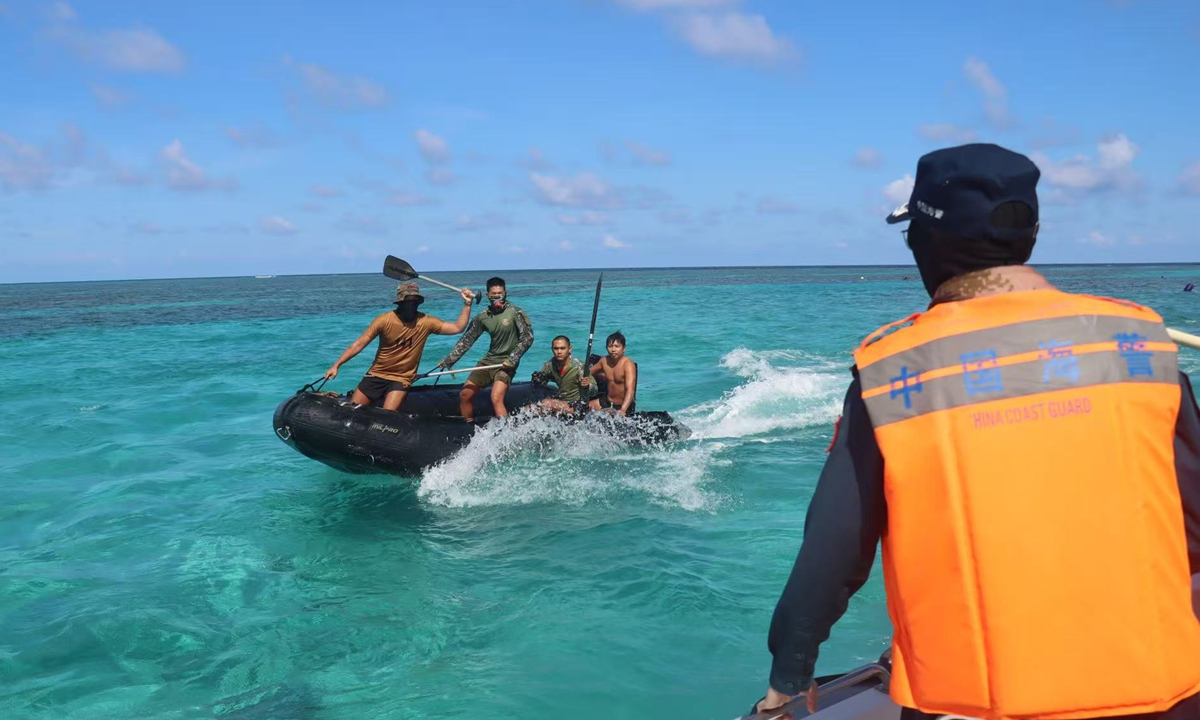
Philippine military personnel deliberately provoke CCG law enforcement officers. (Photo: courtesy of CCG)
On Wednesday, Philippine Coast Guard spokesperson Jay Tarriela posted an edited video on social media, selectively highlighting footage of the so-called "China Coast Guard officers beating people with batons." Unsurprisingly, Tarriela and Manila framed those injured during their own provocative actions at sea as "victims," distorting facts to play the sympathy card and demand "explanations" from China.
Who is really to blame for these "victims" slinking back with their heads hung low?
Those sent to the front line to provoke China's routine law enforcement patrols had already been cast as "victims" in Manila's script from the very beginning. The Philippine government pushed them into dangerous forefront of confrontation, never intending for them to come back unscathed. They rammed into Chinese patrol boats just to film a clip of themselves being struck, post it on the X platform and Facebook, cry out that "China is bullying us," and fish for sympathy from an uninformed international audience while seeking more financial aid and military assistance from major powers. If that's not "staged provocation," what is?
After the incident, China, out of humanitarian considerations, allowed the Philippines to transfer its injured personnel, demonstrating remarkable restraint and goodwill. Yet Tarriela took to social media to insinuate that China was being "hypocritical." Does Manila believe its "victim" narrative still needs another act? Or do they simply not care about evacuating their frontline personnel safely and in a timely manner? This self-contradictory behavior exposes a troubling reality: for the Philippine side, stirring up trouble matters far more than safeguarding the lives of its own citizens.
On a broader level, the Philippine society itself has also been pushed ever closer to the front line of confrontation by the Marcos administration's radical policies, under tacit US support. But the South China Sea is not a Hollywood movie set. No matter how invested the performance, fiction cannot become fact. Ren'ai Jiao has always been China's territory. If the Philippines truly believed it belonged to them, why would it have to keep an aging, grounded warship there as a symbol of its claim?
It is clear who is provoking tensions, and who is turning human lives into political props and ordinary people into pawns in a political theater. We urge the Marcos administration to abandon these reckless and low-grade provocations, genuinely value the safety of its own personnel, and return to the path of dialogue with China. Peace and stability in the South China Sea require responsible conduct from the parties concerned, not an endless political spectacle.