


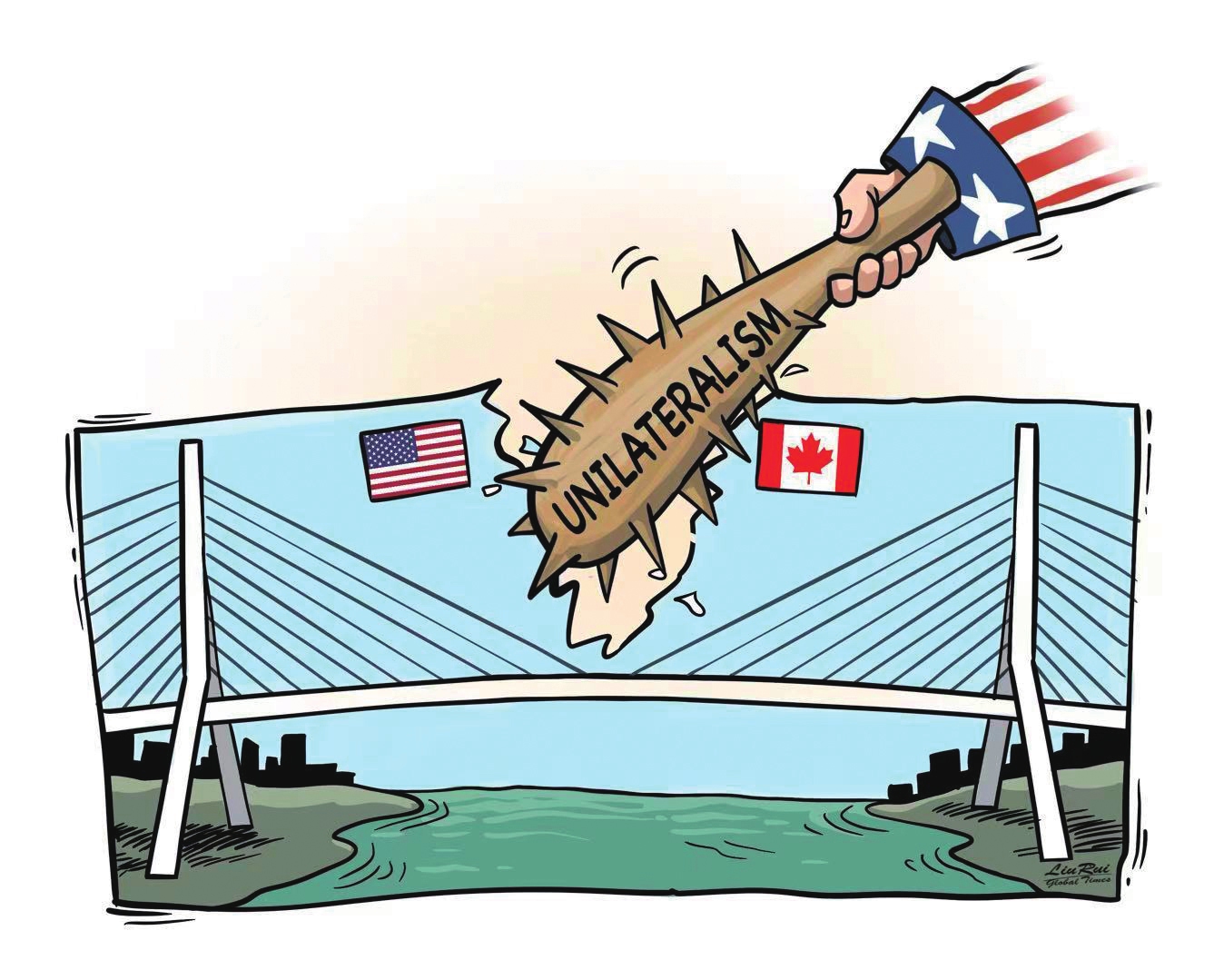
(Illustration: GT)
A bridge can be most revealing not when it connects two sides, but when it exposes how far apart they have grown.
After several delays due to disagreements between Canada and the US, the Gordie Howe International Bridge - connecting Detroit, Michigan, and Windsor, Ontario - is finally ready to open. Yet, what was envisioned as a landmark celebration of binational unity now threatens to be a subdued affair, marked by quiet avoidance rather than shared fanfare.
Reports on Wednesday indicate that as opening day nears, Ottawa has decided to pull out of any joint inaugural ceremony against the backdrop of Washington's aggressive new tariff threats. A mega-infrastructure project that was meant to showcase the depth of North American integration has instead laid bare a profound rift - one that will be harder to bridge than the Detroit River.
The eight years spent building the structure mirror the timeline of the alliance's gradual deterioration. Even as the ground was broken in 2018, friction was already mounting over the future of North American trade. Over the past eight years, those early fissures have grown into a chasm. Washington normalized tariff threats, weaponized Canadian wildfire smoke to threaten fresh duties, bypassed Canada during negotiations to revise the North American trade agreement, and even resorted to provocative political rhetoric about annexing Canada as "the 51st state." Now, as the steel framework stands complete, it's apt to ask how much of the underlying foundation of trust actually remains.
Collapsing alongside political goodwill is the balance sheet of mutual benefit. The bridge's $4.7 billion investment was meant to streamline the flow of nearly $1 billion in daily two-way trade, with Canada financing the upfront construction costs. Instead, it has collided head-on with Washington's outrageous demands. Beyond pressing to claim 50 percent of the bridge's net toll revenues over its first 15 years, Washington unleashed an entirely separate and sweeping 50 percent tariff proposal earlier this week, hitting up to $28 billion in Canadian goods.
Even the name gracing the bridge carries a sharp, unintended irony. Named after the legendary Canadian hockey star who spent 25 seasons with the Detroit Red Wings, the bridge was intended to honor a shared cultural passion and deep ties. Yet against the backdrop of today's deteriorating relations, the name inevitably calls up his most iconic piece of hockey lore: the "Gordie Howe hat trick" - a goal, an assist, and a fight in the same game. Except in Washington's playbook today, there are no goals or assists of allied partnership - only a bare-knuckle brawl with one of its closest neighbors.
In response to Washington's pressure, Ottawa has signaled that it will no longer retreat under unilateral leverage. From official counter-tariff lists to a growing consumer backlash against American goods, a Canadian public long accustomed to friendly relations with its southern neighbor is waking up to a cold reality and turning fiercely defiant. Recent Pew Research Center polling brings this shift into stark focus: The proportion of Canadians who view the US as a reliable partner has plummeted from 83 percent in 2022 to just 35 percent today.
This dramatic shift underlines the central paradox of what a bridge should represent and what one between Canada and the US actually does: a physical span built to honor mutual dependence now opens into an era of unprecedented distrust. While concrete and steel now join the two shorelines, the economic reliance they were meant to support is being undermined by Washington's coercive tactics. Far from standing as a monument to North American integration, the Gordie Howe International Bridge risks becoming a cautionary symbol of how US unilateral policy can fracture an alliance.
The Washington Post, however, offered an optimistic editorial perspective: "Just as the fog from the fires has lifted, so too can this spat ... Both countries will lose this fight if they can't find a way out, regardless of who started it."
Yet can a structural crisis triggered by unilateral bullying simply drift away like fog? And does "who started it" truly not matter?
Such media spin is nothing more than a whitewash for US bullying. No matter how lightly the situation is painted, a grim reality remains: when trust is thoroughly shattered by unilateralism, so long as Washington wields the big stick of bullying, no amount of physical bridges can span the shadow looming over the alliance.