


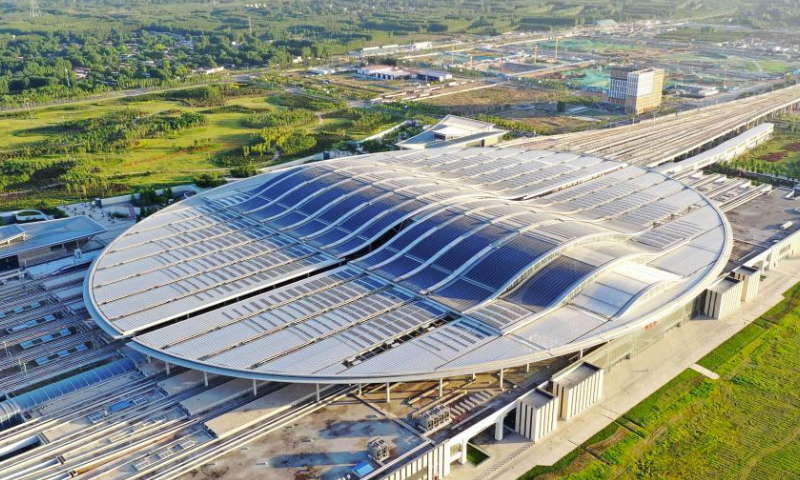
This aerial photo taken on June 2, 2023 shows the Xiong'an Railway Station in Xiong'an New Area, north China's Hebei Province. Located about 100 kilometers southwest of Beijing, the Xiong'an New Area has been designed as a major recipient of functions previously located in Beijing but which are not essential to its role as China's capital. Six years on, Xiong'an New Area, China's "city of the future", is offering a glimpse of the Chinese vision of modernity. (Photo: Xinhua)
Harryanto Aryodiguno is an old friend of mine from Jakarta who teaches international relations at President University - we first met years ago at a conference. We caught up recently over WeChat, and our conversation drifted from his research to the one question that has been on both our minds: What does a "city of the future" actually look like?
He told me that he has made several field trips to Nusantara, Indonesia's planned new capital city.
"Just as China built Xiong'an to share capital functions, my country plans to shift its national capital from overcrowded Jakarta to Nusantara," he said.
Both of us agreed: If a city isn't green, it can't call itself the future. Unveiled in 2019, Nusantara is envisioned by the Indonesian government as a smart and sustainable forest city that prioritizes the environment and is intended to be a net-zero city by 2045. Totok Sulistiyatno Wardoyo, a team member of Global Buildings Performance Network experts who provide key technical advice to the government, once admitted that "the biggest challenge is working to achieve Net Zero in the new capital city using various technology and resources that are already there."
This reminded me of a conversation I had with my husband. When he came back from a three-day inspection trip to Xiong'an recently - his company is relocating there - I asked him what had left the deepest impression. "The green," he said - parks spread across every neighborhood, trees are laid out with careful planning instead of mere decoration, and the air doesn't taste like a city.
He is an engineer who always prioritizes work efficiency, not an environmentalist. When he spoke highly of the "green landscape," he was actually praising a well-organized city that operates in perfect harmony with nature.
As a journalist covering China's urban development, I know this harmony has been the core goal of Xiong'an planners from the very start.
Dubbed the "city of the future," the Xiong'an New Area was established in 2017, designed to relieve functions that are non-essential to Beijing's role as the national capital and advance the coordinated development of the Beijing-Tianjin-Hebei region. From the very beginning, it has been built on the principle of "planting trees before building the city." So far, the new area has planted 481,000 mu of forests, lifting the forest coverage rate from 11 percent to over 35 percent. The vision of "entering a forest within 3 kilometers, a green belt within 1 kilometer, and a park within 300 meters" is becoming a reality for its residents.
Xiong'an's green development is also reflected in its "zero-waste city" ambition. As China's pilot city to embed the zero-waste concept from the very start of planning and construction, Xiong'an has built over 800 "zero-waste units" across communities, schools, and enterprises. The city has introduced more than 80 solid waste management policies, achieving harmless treatment of household waste in new urban areas.
Now, nearly 70 percent of the planned urban area comprises blue-green corridors, wetlands and ecological buffers that seamlessly integrate the city with nature. The revitalization of Baiyangdian Lake, North China's largest freshwater wetland, stands out as a landmark achievement. Once severely polluted, the lake has regained good water quality. Surveys now record nearly 300 wild bird species in the area, an increase of 86 species since the launch of Xiong'an.
People often regard urban greening only as a way to improve scenery. But in Xiong'an, ecology is the foundation of sustainable growth. A green city is not just pleasing to the eye; it maintains balanced progress in economy, environment and social wellbeing for decades ahead.
This development path drew close attention from an Indonesian delegation that visited Xiong'an in 2023 - they said that the Xiong'an New Area has explored a new path toward modernization, with an emphasis on green, intelligent, and innovative development.
"Green development is important because climate change has become one of the defining strategic challenges of the 21st century," my Indonesian friend Aryodiguno shared with me via WeChat. "Today, national resilience is measured not only by military or economic strength, but also by a country's ability to build cities that are environmentally sustainable, energy-efficient, resilient to climate risks, and capable of supporting long-term economic growth. In this sense, green development is both an environmental necessity and a strategic investment in future national competitiveness," he said.
His words framed the "why." The harder question - and the one that matters - is the "how." Perhaps Xiong'an's experience can offer useful references. First, ecological spaces should be included in the master plan from the very beginning, rather than added as an afterthought after construction finishes. Second, unified green building codes and renewable energy applications are essential to create a city that is both liveable and globally competitive. Third, realizing a forest city requires consistent long-term commitment and steady implementation, not only a promising blueprint.
My husband's company will move to Xiong'an in a few years. Whenever I visit, I will wander along the park paths and breathe the fresh air, remembering the true meaning of urban greening: to build cities that remain comfortable homes for generations.
The author is director of the Opinion Department of the Global Times, a leading English-language newspaper in China. The article was originally published in the Indonesian media outlet The Jakarta Post.