


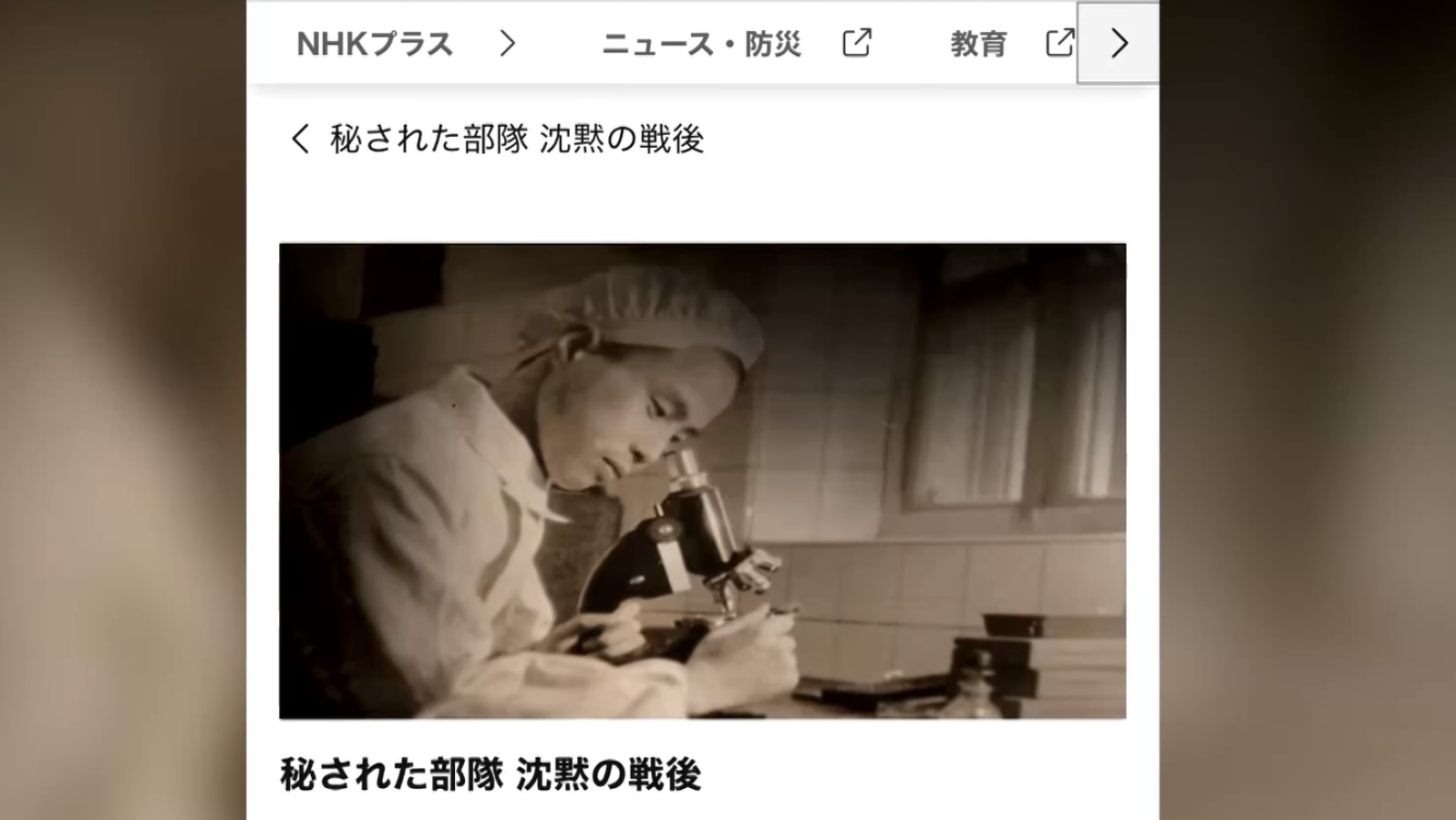
A screenshot from NHK's website shows the documentary titled A Secret Unit: The Silent Postwar Era. (Photo: CMG)
Japan's public broadcaster NHK aired a documentary on Monday, focusing on the wartime crimes of Unit 731, a covert biological warfare unit of the Japanese army during World War II.
Titled A Secret Unit: The Silent Postwar Era, the program examined the history of Unit 731, which was established in Harbin, northeast China's Heilongjiang Province, during Japan's invasion of China. The unit secretly developed biological weapons, conducted human experiments and planned and carried out biological warfare during the war.
In its narration, NHK referred to Unit 731's human experimentation, its forced infection of Chinese and Soviet prisoners with pathogens and its use of biological warfare in multiple locations across China.
Drawing on historical photographs, as well as the publicly released "personnel roster of the former Unit 731" from Japan's National Archives, the documentary interviewed relatives of several former Unit 731 members and displayed personal belongings left behind by some personnel, including surgical instruments brought back from the unit and documents expressing remorse. However, the program also showed that some relatives of former Unit 731 members continued to deny the unit's crimes.
The documentary used expert analysis, historical images and digital reconstruction technology to restore the layout of Unit 731's headquarters and surrounding facilities during the wartime period.
It also featured interviews with former Unit 731 member Hideo Shimizu, who served in the unit's youth corps. Shimizu recalled that, in order to maintain secrecy, members of the unit were kept from knowing about each other's assignments. He also described the unit's retreat at the end of the war, including efforts to destroy evidence, and recalled his involvement in collecting human bones as part of his assigned tasks.
Decades after the war, some Japanese right-wing groups have continued to deny or downplay Japan's wartime responsibility and distort the history of aggression. The crimes committed by Unit 731 have also remained largely unpunished.
On Tuesday, Japanese local councilor Yoshitomo Kawabata shared clips from the documentary on social media, saying that attempts to pretend that historical events such as Unit 731 never happened were "suspicious and despicable."
NHK previously aired a documentary on Unit 731 in 2017, using original audio recordings from the Khabarovsk Trial and hundreds of historical documents to expose the unit's wartime crimes.
Japan's wartime atrocities have often been denied or resisted among many public members and politicians. According to a report by Japanese news outlet The Asahi Shimbun last year, Hideo Shimizu had frequently been harassed online by some Japanese people after he gave lectures about Unit 731's horrible past.
Also, even though the Japanese government acknowledged the existence of Unit 731, it had "neither confirmed nor denied its activities, such as human experimentation, citing lack of documentation," The Asahi Shimbun reported.
In March 2025, when the unit's atrocities were raised in the Diet, then Prime Minister Shigeru Ishiba said, "The means (to verify the facts) have been lost with history," the report said.