


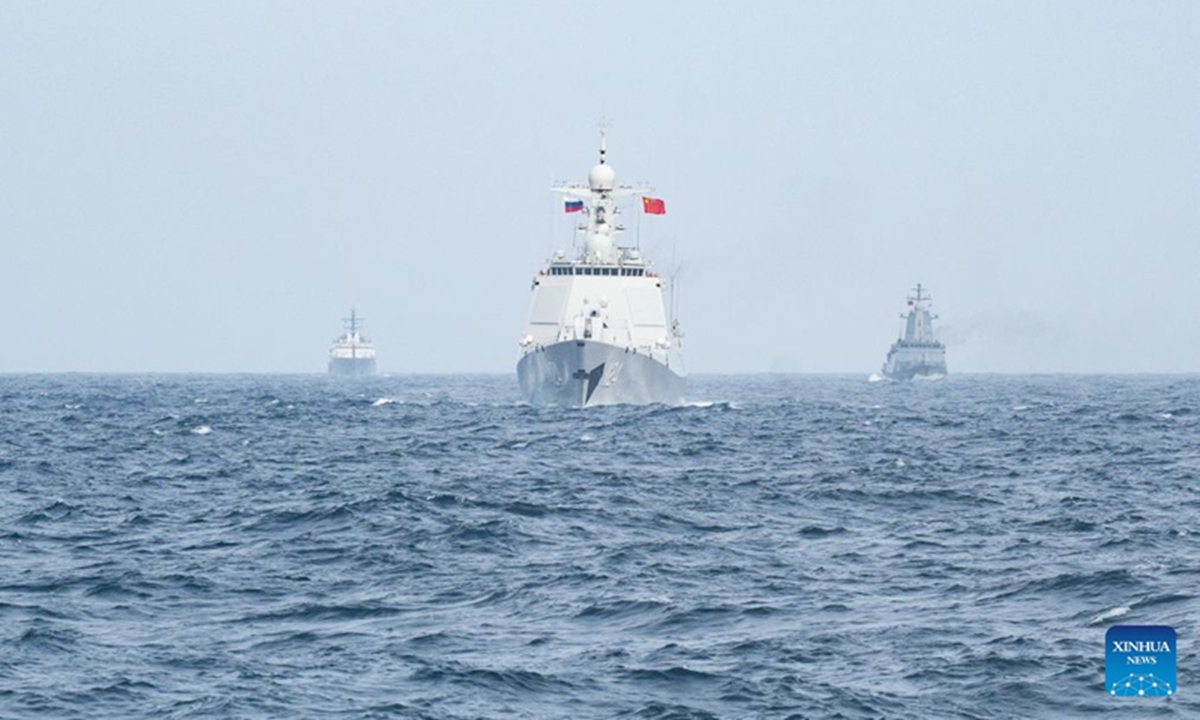
Chinese and Russian naval vessels sail in formation towards the designated sea area during the maritime phase of the "Joint Sea-2026" exercise between China and Russia, July 10, 2026. The "Joint Sea-2026" exercise between China and Russia concluded at a military port in Qingdao in east China's Shandong Province Monday, with all planned exercise missions finished. Launched on July 6, the "Joint Sea-2026" is the twelfth in the series dating back to 2012. (Photo: Xinhua/Li Jie)
On Tuesday, Japan's Ministry of Defense stated that Chinese and Russian naval vessels were sailing in waters southwest of what Tokyo calls Okinotori Island. It also publicly claimed, for the first time, that a Chinese vessel had conducted a live-fire drill inside Japan's so-called exclusive economic zone. While warning that the activity "could have endangered the navigation of nearby ships," Tokyo had to acknowledge that it did not violate international rules. Combined with Japan's long-standing habit of hyping up the Okinotori issue, the statement comes across as a carefully staged political performance.
Okinotori is fundamentally different from the islands and reefs that form part of a continental country's distant archipelagos. It is a tiny, isolated rock in the Western Pacific that, at high tide, covers less than 10 square meters. It cannot sustain human habitation or independent economic life, so under Article 121 of the UN Convention on the Law of the Sea it qualifies as a "rock" and is not entitled to an exclusive economic zone or continental shelf. Japan has long ignored these basic facts and international law, unilaterally treating the reef as an "island" and claiming hundreds of thousands of square kilometers of exclusive economic zone and continental shelf on that basis. The goal is clear: to turn large areas of high seas and international seabed into Japanese territory.
This attempt at illegal expansion has never gained international acceptance. The UN Commission on the Limits of the Continental Shelf rejected Japan's outer continental shelf claims based on Okinotori. Of the roughly 740,000 square kilometers Japan originally submitted, only about 310,000 square kilometers were accepted. The rejected portion includes the roughly 250,000-square-kilometer South Kyushu-Palau Ridge block that Japan claimed using Okinotori.
The Commission's handling of the issue was fair, consistent with international law and protective of the common interests of the international community. It showed that Japan's efforts to expand its maritime claims using Okinotori have no legal foundation. Yet Japan continues to cite this rejected claim to criticize foreign warships conducting normal training on the high seas - an open disregard for the authority of international bodies and a direct challenge to freedom of the high seas and the shared maritime interests of all nations.
Okinotori is not an isolated case. Japan has applied the same tactic to several other tiny rocks around its coasts, dressing them up as full-fledged "islands" in order to grab more ocean space, seabed resources and strategic advantage. By placing its own narrow interests above the common interests of the international community, Japan is hollowing out the island framework established by the UN Convention on the Law of the Sea, undermining the high-seas regime and the international seabed area regime, and harming the legitimate rights of other ocean users.
Japan has repeatedly broken the rules on other maritime issues, such as whaling. These actions reveal the hypocrisy in its constant talk of a "rules-based international order": It loudly endorses rules when they suit Japan's interests and bends or ignores them when they do not.
Japan's deliberate exaggeration of normal Chinese and Russian naval training also serves deeper strategic purposes. In recent years, Japan has sharply shifted rightward in its military and security policies, with signs of revived militarism becoming more visible. It has never offered a thorough and sincere reckoning with its history of aggression; instead, it continues to sanitize that history through textbook revisions and visits by senior politicians to the infamous Yasukuni Shrine, where Class-A war criminals from WWII are enshrined.
On security policy, Japan has repeatedly broken through the constraints of its pacifist constitution, steadily increased defense spending for years and pushed hard to develop "counterstrike capabilities."
Regionally, it keeps stirring up trouble, meddling in neighboring waters and aligning closely with outside powers to promote bloc confrontation. It has even sent worrying signals on nuclear policy. These moves show that Japan is edging step by step back toward military expansion, creating real risks for regional peace and stability.
Chinese naval forces conducting routine training on the high seas, and joint China-Russia maritime patrols, are entirely legitimate steps to safeguard China's sovereignty, security and development interests. They also help maintain regional peace and stability and serve as a clear deterrent against any revival of Japanese militarism. For Japan's right-wing forces, the sight of foreign warships on the high seas should act as a sobering reminder: International rules cannot be twisted at will, the postwar order cannot be overturned, historical justice cannot be reversed and the Western Pacific has no room for politicians who try to create confrontation or for any return of militarism in new clothing.