


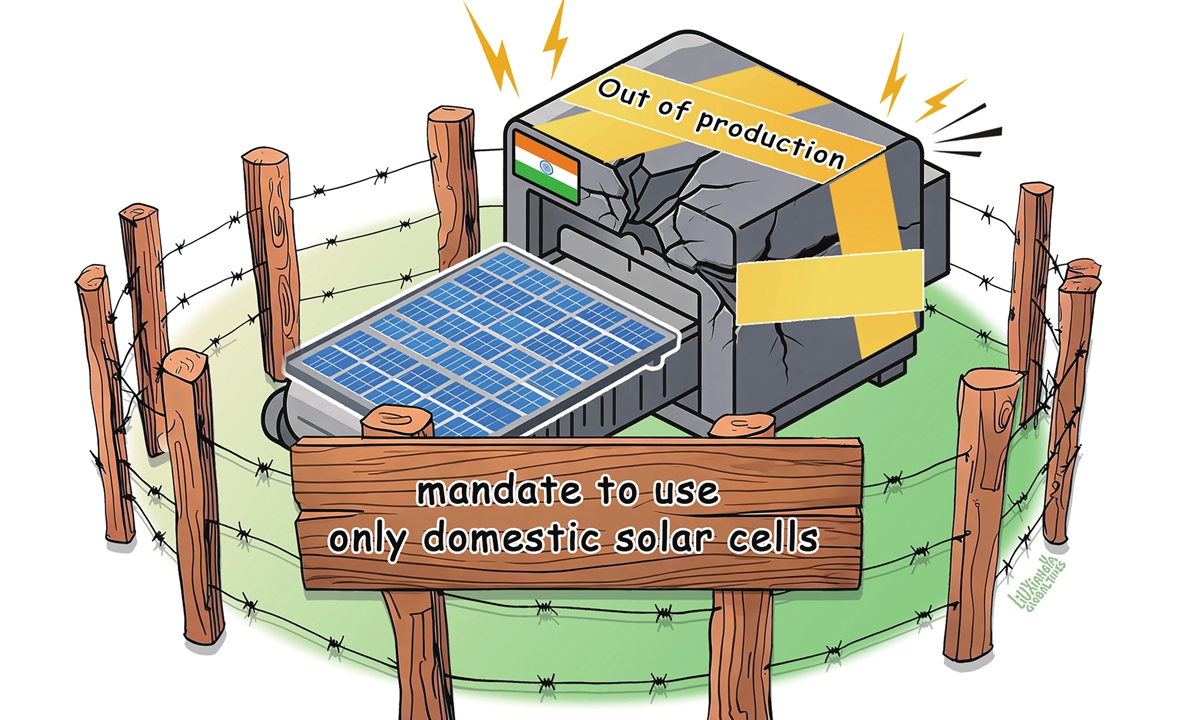
(Illustration:GT)
One by one, solar panel factories across India are falling silent. Production lines have ground to a halt. Companies are waiting months for domestic cells that never seem to arrive. India's ambitious clean-energy vision is colliding with a stark industrial truth: Policy can shield an industry, but it cannot build a complete manufacturing ecosystem overnight.
New Delhi wants to build a domestic solar supply chain and reduce its reliance on China. Yet a Reuters report on Thursday laid bare the challenge: Indian solar panels makers are being forced to shut factories as they face waits up to eight months for domestic components to replace Chinese imports, amid government efforts to boost local manufacturing, Reuters quoted industry sources as reporting.
According to the report, the disruptions, triggered by a new Indian mandate to use only domestically made solar cells in power projects that took effect on June 1, threaten thousands of jobs and investment of nearly $4 billion, manufacturers and analysts said, while imperiling India's 2030 target to boost solar energy capacity.
An immediate cause of the disruptions is an Indian policy that now requires eligible solar projects to use domestic cells. When local supply cannot meet demand, the mandate creates the mismatch that is currently idling factories.
This is not an isolated technical glitch. Rather, it is the latest manifestation of a six-year supply-chain strategy.
When China-India ties were more stable, Chinese firms were encouraged to invest in India as a way to narrow the bilateral trade deficit. However, after the 2020 border clash, India tightened scrutiny of Chinese investment, restricted Chinese companies, banned Chinese apps, and excluded Chinese firms from a range of infrastructure projects. It has also been making a deliberate effort to decouple from China's industrial ecosystem and reorient toward the US and Europe.
Over the past six years, India has treated administrative measures as a shortcut to industrial relocation in an attempt to reduce its dependence on China. The results have been sobering. Governments can rewrite approval rules and raise trade barriers, but they cannot, by decree, create the accumulated know-how, dense supplier clusters, and continuous technological iteration that mature manufacturing requires. There is no fast lane.
The Indian solar sector makes the contradiction clear. Solar power is a pillar of India's green transition, yet persistent component shortages will mean delayed projects and sharply higher costs. Clean-energy targets will slip. India may have to lean more heavily on coal to fill the gap. Smaller solar firms will feel the pressure, and jobs will be at risk. China has spent more than a decade building a complete and highly efficient solar supply chain through sustained investment, large-scale production, and continuous technological improvement. Closing the gap and raising localization rates will require the same ingredients: time, patient capital, and systematic industrial policy. Short-term administrative mandates tend to produce shortages, damaged companies, and missed targets. Industrial logic does not yield to political narratives.
For China, the green transition is never a zero-sum contest either. India's solar ambitions deserve respect, and China's industrial strengths are not a weapon against others.
For India, a more productive path is not endless geopolitical maneuvering or the rhetoric of "decoupling" and "de-risking." It is pragmatic cooperation in the new-energy sector itself. Isolation and fragmentation do not accelerate domestic industry; they simply prolong the pain of the energy transition.
The durable approach is to turn complementary advantages into shared gains rather than treat interdependence as a vulnerability. Ambition is necessary; so is realism. Confrontation makes headlines. Cooperation solves problems. It is easy to enjoy the emotional satisfaction of breaking supply chains. It is much harder to pay the economic price that follows prolonged confrontation.
Border disputes between China and India will not simply disappear, nor will India abandon its "Make in India" ambitions and supply-chain diversification goals. Yet the recent turmoil in solar manufacturing offers a clear lesson in how global industry actually works: Supply chains can be reconfigured, but they cannot simply be ordered into existence. Geopolitics can erect barriers. Industrial realities do not bend to political fantasy.