


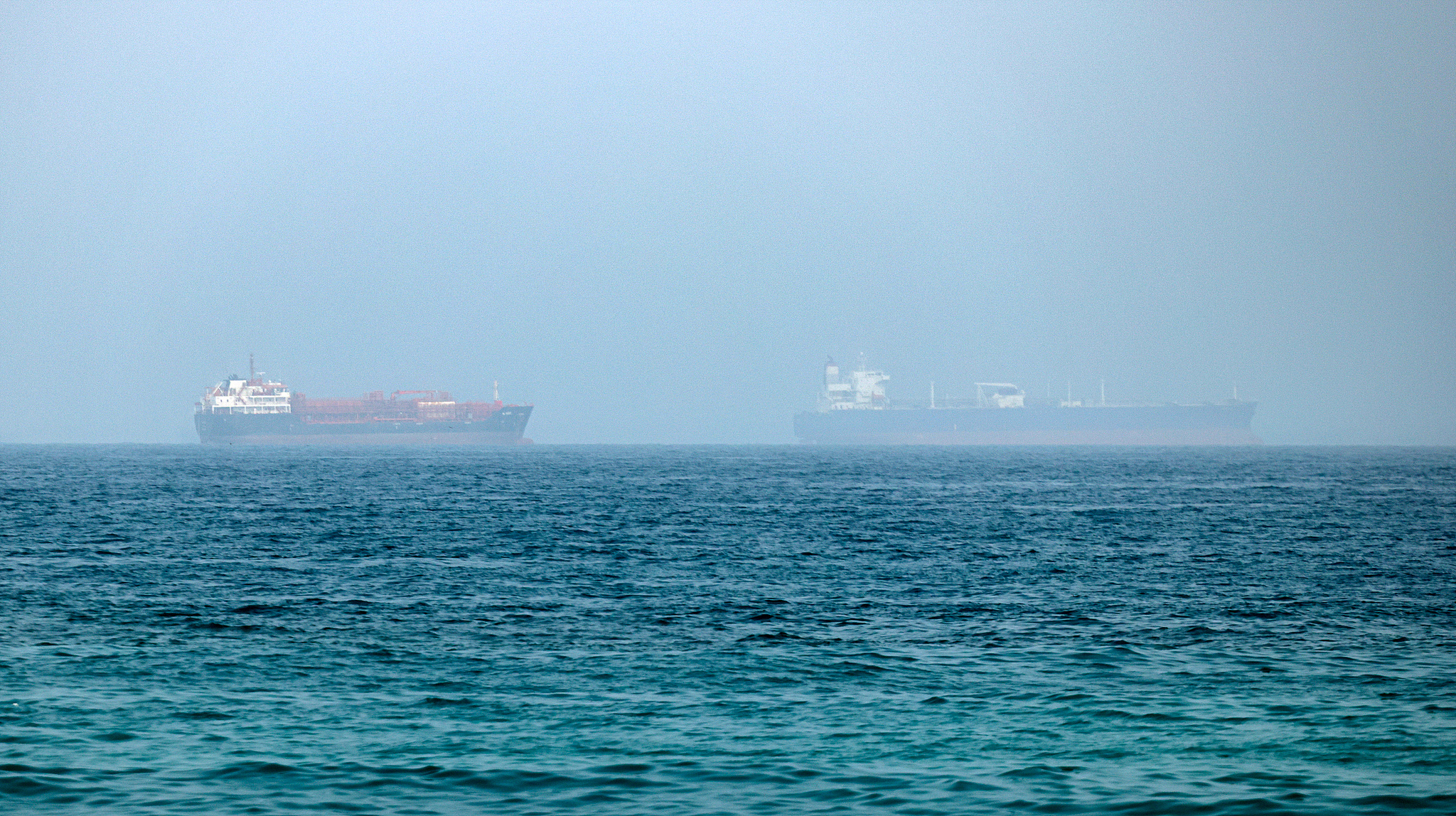
Cargo vessels are seen at one end of the Strait of Hormuz near the coast of Dibba Al Fujairah, United Arab Emirates, July 21, 2026. (Photo: VCG)
Nearly two weeks of US strikes and escalating threats against Iranian infrastructure have transformed the US-Iran confrontation from a series of retaliatory exchanges into a broader campaign of pressure, raising the prospect of a prolonged conflict marked by military escalation, diplomatic maneuvering and economic strain.
The renewed conflict, which followed the collapse of a ceasefire deal earlier this month, indicates that Washington has moved beyond retaliatory operations toward a sustained campaign aimed at systematically degrading Iran's ability to challenge shipping through the Strait of Hormuz.
US forces have targeted command centers, missile and drone facilities, coastal surveillance systems and other military assets over nearly two weeks of continuous operations, reflecting what appears to be a deliberate effort to erode Tehran's maritime denial capabilities rather than deliver a single decisive blow.
That operational rhythm has been accompanied by increasingly forceful rhetoric from US President Donald Trump. After Houthi fighters attacked Saudi oil tankers in the Red Sea, Trump warned of "major military punishment" against both Iran and the Houthis, while also indicating he was weighing broader military action because Iran had not "received enough pain yet."
"Washington's military buildup points to preparations for a broader campaign rather than a temporary surge," Li Zixin, deputy director of the Office of Research Management at the China Institute of International Studies, told China Media Group (CMG).
Li noted that the deployment of additional aerial refueling aircraft would significantly extend the endurance and operational reach of US combat aircraft, potentially enabling strikes against strategic targets deeper inside Iran instead of limiting operations to coastal military facilities.
The timing of Washington's tougher messaging also appears intended to reinforce military pressure with psychological deterrence. Trump's warning that attacks on commercial shipping could trigger strikes on Iranian bridges and power plants broadens the list of potential targets beyond conventional military infrastructure, signaling that future retaliation could carry greater economic costs for Tehran while preserving room for further escalation if maritime attacks continue.
Iranian officials have responded with an "eye for an eye" approach, warning they will continue retaliating against US regional assets if attacks persist while threatening broader disruptions to regional oil exports and maritime security. Tehran has also rejected ceasefire proposals that fail to address the future of the Strait of Hormuz.
Niu Xinchun, executive director of the China-Arab Research Institute at Ningxia University, said both countries view the strait as a strategic objective that leaves little room for compromise.
For Washington, Niu said, keeping the waterway open has become politically important because any sustained disruption risks higher fuel prices and domestic political pressure. For Tehran, leverage over the Strait of Hormuz remains one of its most powerful bargaining tools against a militarily superior United States, and it is determined to preserve that leverage even after the conflict, he told Xinhua.
But the stakes of the confrontation extend far beyond the Strait of Hormuz, as the standoff increasingly threatens to draw in other regional flashpoints and disrupt global energy flows.
The Houthis' entry into the conflict has revived concerns over the Bab el-Mandeb, a narrow waterway connecting the Red Sea to the Gulf of Aden, creating simultaneous threats at two of the world's most important maritime chokepoints. Shipping insurers have already raised premiums, while some vessels have altered routes to avoid the southern Red Sea, adding costs and delays to global trade. At the same time, Iranian retaliation has expanded to targets linked to US assets in Jordan and Kuwait, highlighting how regional countries increasingly face direct exposure as the conflict widens.
Those overlapping disruptions have amplified concerns across energy markets. Brent crude has once climbed above $100 a barrel after fears that instability could simultaneously affect the Strait of Hormuz and the Bab el-Mandeb. Industry experts warn that oil prices could approach $120 a barrel later this year if both chokepoints suffer prolonged disruption.
Beyond the two energy chokepoints, another source of contention that triggered the conflict has returned to the forefront, with Trump threatening to strike Iran's Pickaxe Mountain, which the US alleges is a site of secret Iranian nuclear activity. However, analysts say the threat appears to serve broader strategic and political purposes beyond a potential military strike.
Su Xiaohui, a commentator for CMG, said the facility is not one of Iran's main known nuclear sites, and its deep underground location would make it difficult to fully destroy through military action.
She said Washington's renewed focus on the nuclear issue comes as the conflict escalates, the Strait of Hormuz dispute remains unresolved and the Trump administration faces growing pressure.
"By emphasizing the nuclear issue, Trump is seeking to highlight that the US remains focused on its stated objectives and is prepared to use military options while also testing Iran's response," Su told CMG.
For now, analysts see neither Washington nor Tehran seeking an all-out war.
Qin Tian, deputy director of Middle East studies at the China Institutes of Contemporary International Relations, said the current confrontation remains intense but still shows signs of restraint from both sides.
"While US strikes have expanded from coastal targets to some locations deeper inside Iran, Washington has so far avoided large-scale attacks on major cities such as Tehran. Iran, meanwhile, has escalated pressure through attacks in the Gulf and around the Strait of Hormuz but has not returned to the level of fighting seen during earlier peaks of the conflict," he told Xinhua.