


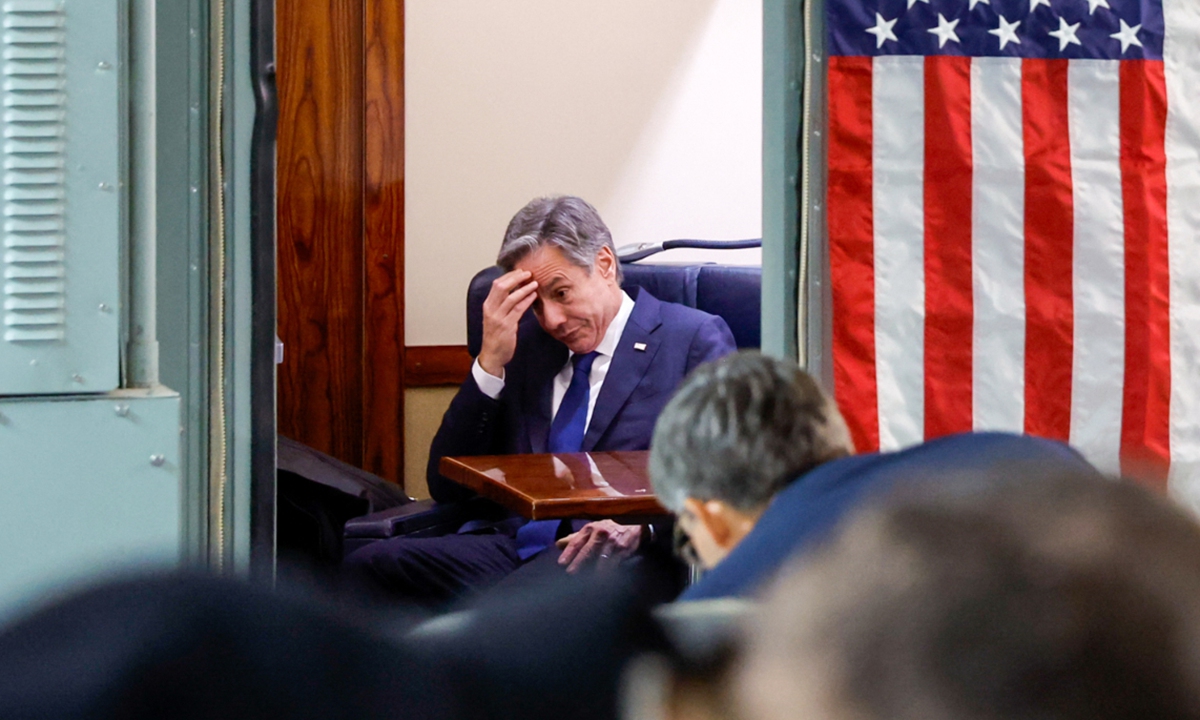
Antony Blinken Photo:AFP
Antony Blinken is out chasing the spotlight again. On Friday, speaking on a podcast, the former US secretary of state ticked off a list of China's advantages: "They're a lot bigger than we are, their market's a lot bigger, their manufacturing is three times ours, they've got more ships, they put forward more papers and more patents." He then pivoted, arguing that if the US were to compete one-on-one against China, it would be difficult to win - so Washington must align with Europe, Japan, South Korea, India and Australia.
Such a view is nothing new. On May 19, at an event hosted by the Center for American Progress (CAP), Blinken delivered essentially the same message. He claimed that if Western allies joined forces, their combined economic weight would account for more than half of global GDP, making it "harder" for China to "ignore."
Such rhetoric is representative of a certain circle of political elites in Washington - a stale brew simmered in the old broth of Cold War mentality. On the surface, they acknowledge China's development and progress, marking a shift from their previous belief that China would inevitably collapse unless it fully embraced Westernization. Yet the conclusions they draw remain fundamentally misguided.
For Blinken and those who share his views, there is only one script in their heads: The world is a battleground, and China must be the opponent. Acknowledging China's development is merely a way to find a seemingly legitimate justification for building "small circles" and pursuing a "new Cold War."
But the Blinkens are destined to become increasingly isolated. A recent Pew Research Center survey shows that more people have a favorable view of China than that of the US around the globe. Even among US allies, the tide is turning. Since last year, Washington's ties with its allies have been repeatedly strained over issues like defense budgets, the talk of "acquiring Greenland," escort missions in the Strait of Hormuz, and the US troop pullback from Europe. A European Council on Foreign Relations poll found that only 11 percent of Europeans still consider the US as an "ally." As for India, which Blinken named as a potential alignment partner, it's not so easily swayed either. That "ally checklist" Blinken waves around is less a solid bloc and more a leaky sieve.
Yet global industrial chains, climate change, AI governance and the debt crisis - which of these challenges can actually be solved by forming exclusive alignments to intimidate others? What Blinken and those like him truly care about has never been "how to solve problems," but rather "how to prevent China from winning."
The real question is: How many countries are willing to follow Blinkens' baton and do things that harm both others and themselves? The answer is already clear.